We had lots of advice about where to go on the South Island, and everyone agreed that Milford Sound was a spectacular must-see. The simplest way to visit the Sound (which is technically a fjord, because it was carved out by glaciers rather than rivers) is by a full-day bus tour from Queenstown, so that’s what we booked.
We were also looking forward to having dinner in Queenstown with Greg’s friend and former Royal Canadian Signal Corps colleague Martin. He and his wife Gyl were on package tours of Australia and New Zealand, covering many of the same spots we did but on a much more compressed schedule. We had actually all been in Franz Josef on 15 March, but with our full day of walking tours it wasn’t possible to meet. However, we were heading the same direction and did have a coincidental free evening in Queenstown.
The trip from Queenstown to Franz Josef was another long day on the bus, departing at 8:30 am with an expected arrival of 4:30 pm (ha) which turned into 5:30 pm due to road works. But so it goes.
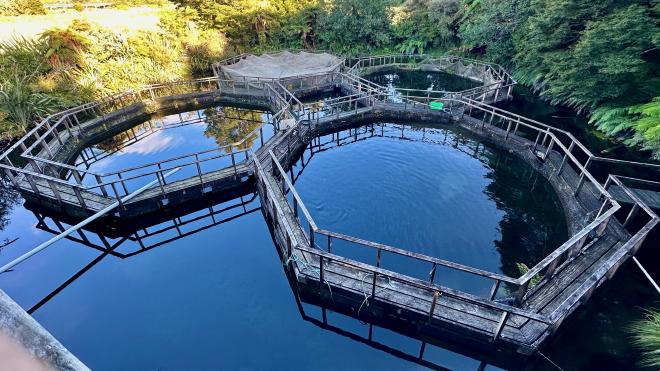
Our breakfast stop was at the South Westland Salmon Cafe, which is unusual in that it’s also a small salmon farm. This is the view from the cafe’s balcony. They serve their own salmon, so of course we had some with cream cheese on a bagel as part of our breakfast.
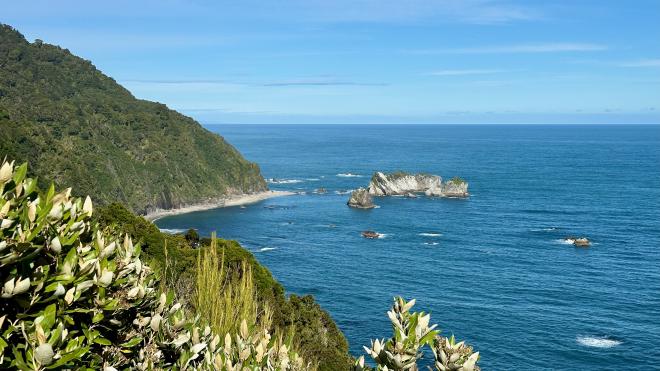
The first part of our route was south along the coast, before turning inland towards Wānaka. As with our trip to Franz Josef, this gave us some lovely ocean views.
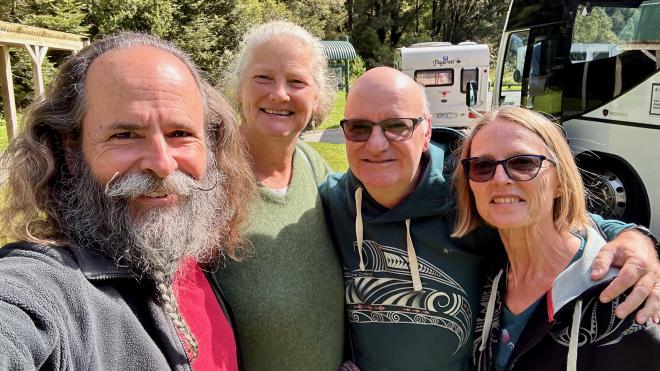
At noon we stopped in Mount Aspiring National Park for a toilet break and to change drivers. A few moments after our bus had stopped, a sixteen passenger van pulled in behind us, and who got out but Martin and Gyl! Greg and Martin were so busy talking that Martin’s driver had to come and almost drag him back to the van.
Our afternoon driver gave us several short stops to take photographs. “We stop here for seven minutes. Not five, not ten: seven. Make sure I don’t leave you behind.” Spoiler: we did not get left behind.
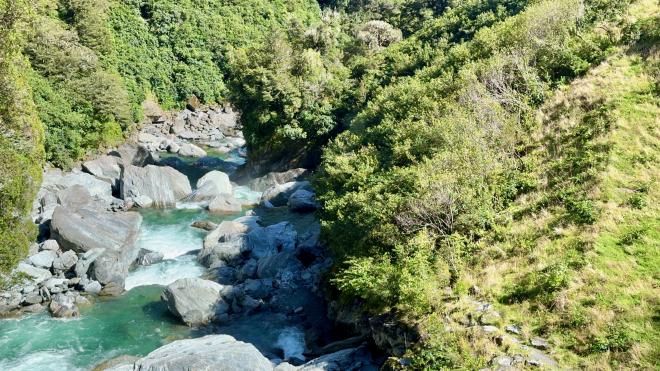
You can tell from the colour that this creek is glacier-fed.
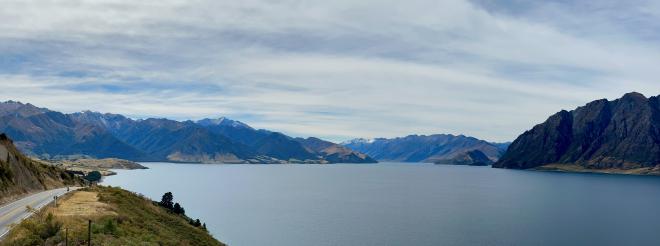
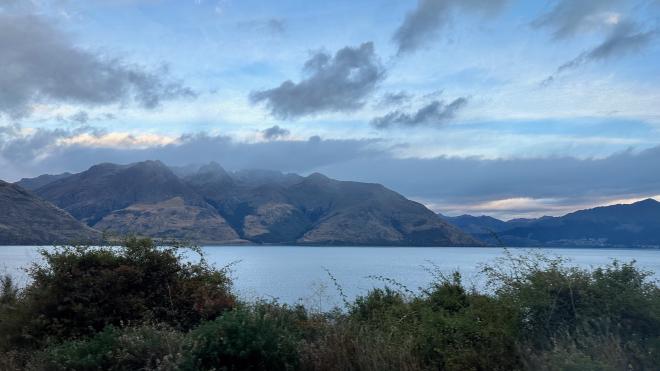
This is the view looking north from the side of Lake Wānaka.
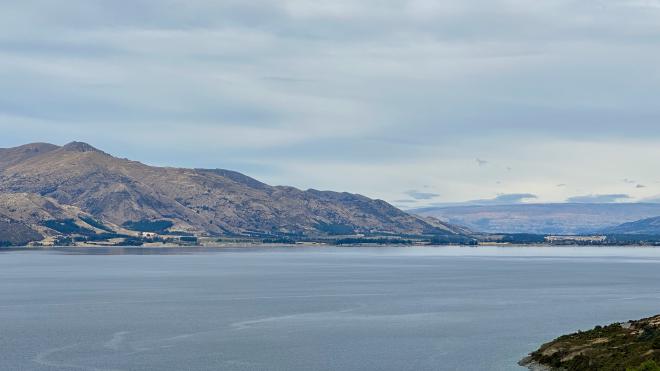
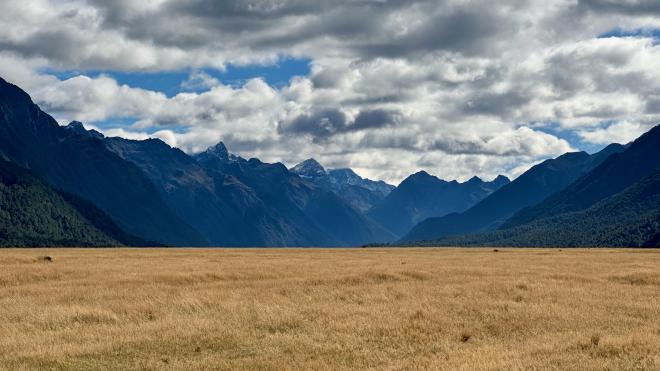
And this is the view looking south. As you can see, we’ve moved out of the wet west coast rain forest and into the dry interior. In fact, as we were coming through the pass, the change from wet to dry and green to brown was almost like flicking a switch.
After dropping our bags off at our apartment, we had just enough energy left to walk into town for dinner and a beer at Smiths Craft Beer House and a side quest for some groceries. We found another flavour of Great Uncle Kenny’s Amazing Snacka•Changi Chips at the store, which turned out to be just as tasty as their Sweet Chili.
We had nothing much planned the next day, which was good since we were both exhausted from a day of hiking followed by a day on the bus. We spent the morning and afternoon in the apartment, doing laundry and catching up on some maintenance, reading, and work.
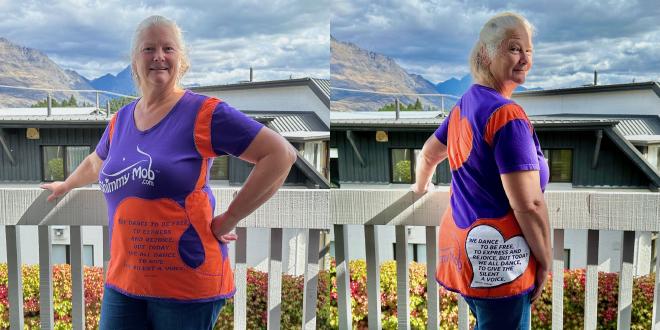
Karen’s big accomplishment for the day was finishing this shirt, which she had made by artistically combining the t-shirts from two years of Shimmy Mob. She started planning this one way back at the European Juggling Convention in August, and had been working on it when time and space permitted ever since. Of course, since we were travelling the whole time, everything is hand-stitched. As you can see, we had a lovely mountain view from our apartment’s balcony.
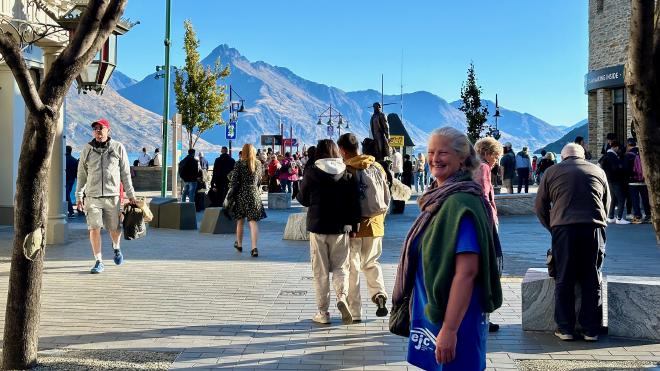
That evening we walked into town and met up with Martin and Gyl for dinner. We had a great time catching up on the last many years and talking about careers, family, and retirement – Martin retired from the Army four years ago and Greg is retiring from RMC in 2025.
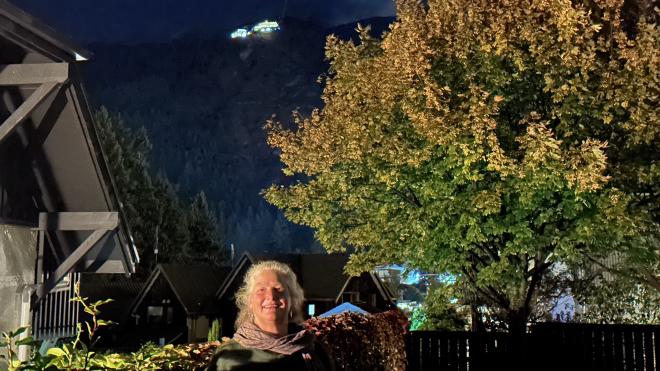
Walking back to our apartment we could see the lights of the Queenstown Gondola station hovering at the top of the hill.
On the 18th we had an early start and a long bus ride from Queenstown to Milford Sound, followed by a boat tour on the fjord, and another long ride back.
Queenstown is part-way up Lake Whakatipu. Once we’d left the town itself, we headed south around the end of the lake. Our route to the fjord was three sides of a rectangle: south-west, then north-west, then north-east again. Milford Sound is only seventy kilometres from Queenstown in the air, but by road it’s 288 kilometres due to some inconveniently-placed lakes and mountains. But they’re very pretty lakes and mountains, so we forgive them.
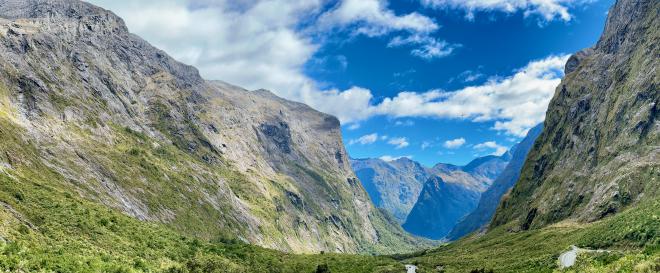
Most of our trip was through valleys, with mountain ranges on either side…
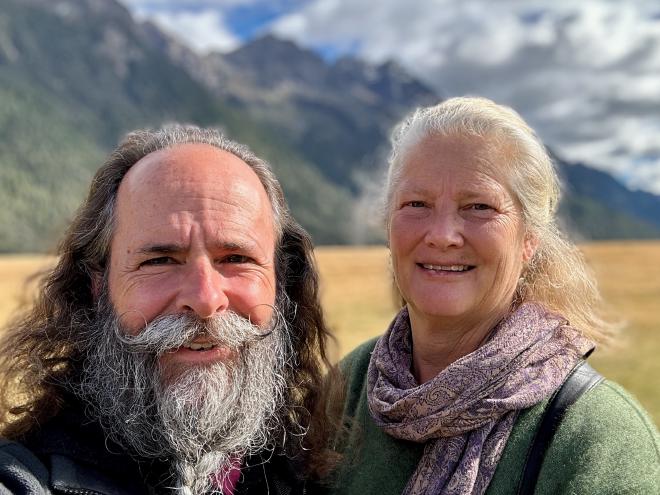
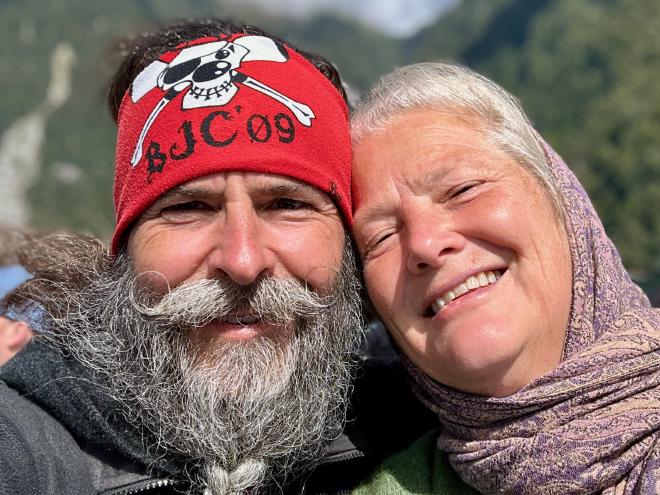
… which made for nice selfie backgrounds.
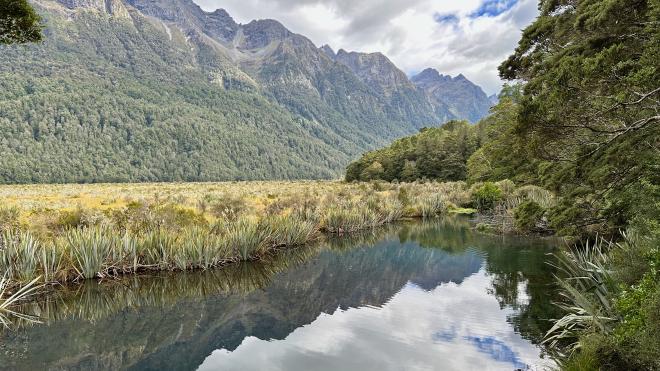
We made a brief stop along Black Creek. Like Lake Matheson, this is a great spot for pictures of mountains reflected in water. There were a few ripples during our visit, so conditions weren’t perfect, but still lovely.
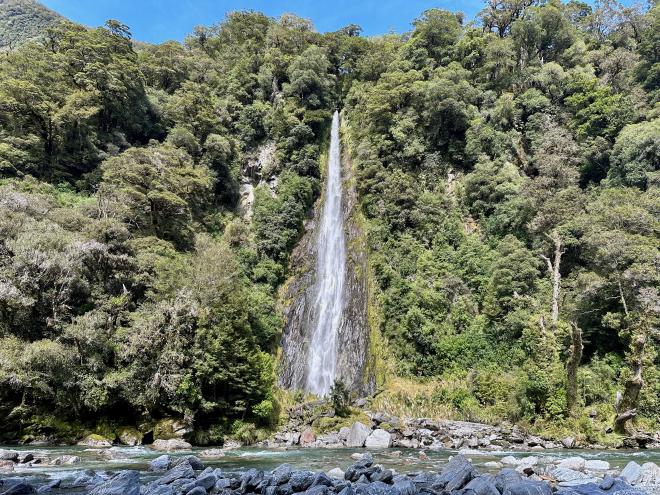
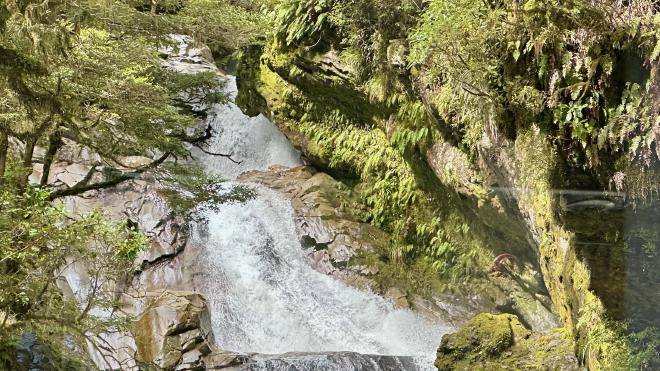
A waterfall, seen out the bus window.
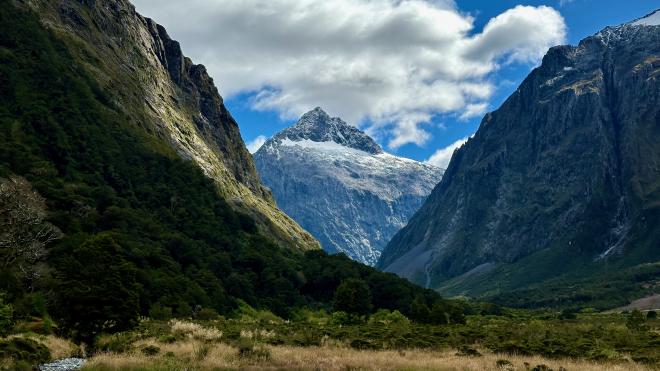
A mountain peak, framed by cliffs.
Yet more mountains.
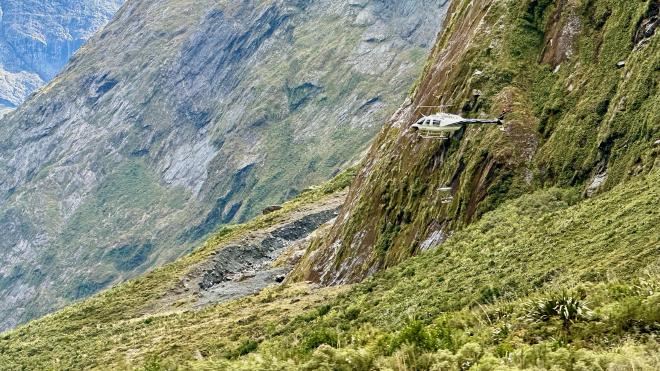
As we approached the fjord, we saw this helicopter with a spreader bucket going back and forth over the hillsides. It was spreading 1080 poison bait, designed to kill invasive species, as part of the New Zealand government’s plans to completely rid the islands of introduced predators by 2050.
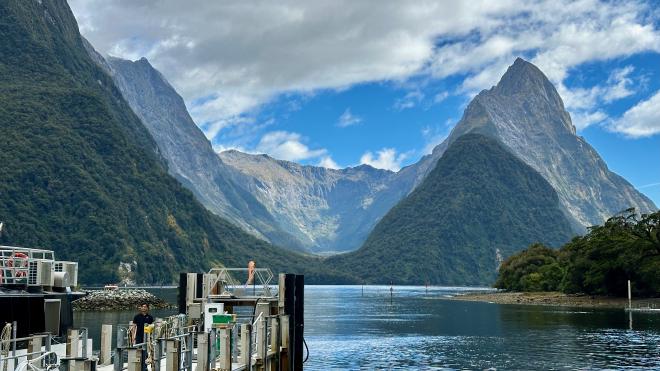
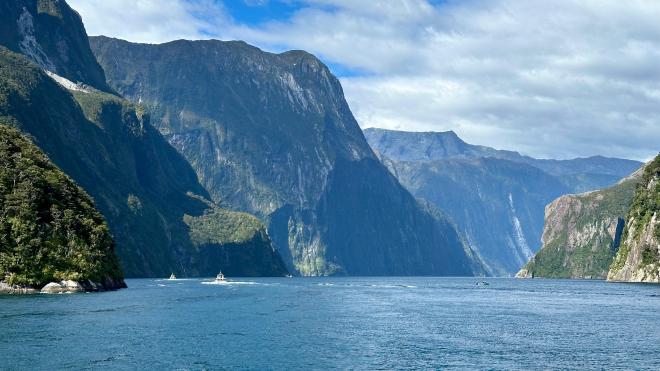
We arrived at the fjord about 1 pm, got lunches and our boat tickets, and headed out to the dock. Even before getting on the boat, the scenery was amazing.
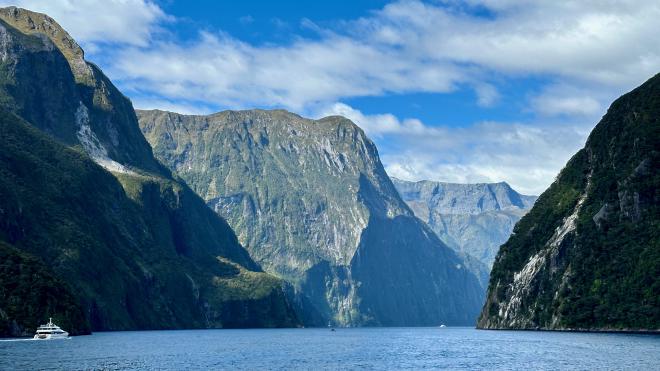
The boat tour was just a bit under two hours. In that time we went west to the mouth of the fjord along its south side, briefly out into open water, and then back along the north side. The weather was nearly perfect the whole ride, so we stayed on the top of the boat and took loads and loads of pictures. What’s included below is a small selection of the better ones.
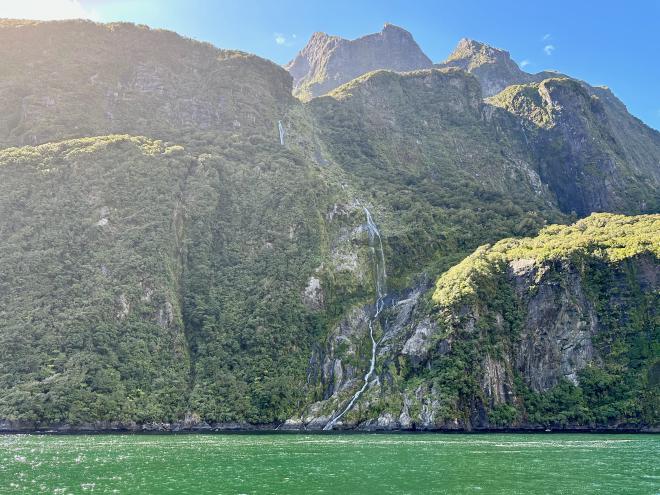
It rains about two hundred days a year around the fjord, so having clear skies was a serious stroke of luck. The only thing that could have made it better would have been serious rain the day before, which would have added literally hundreds of transient waterfalls to the view. The waterfalls we did see were spectacular, ’though.
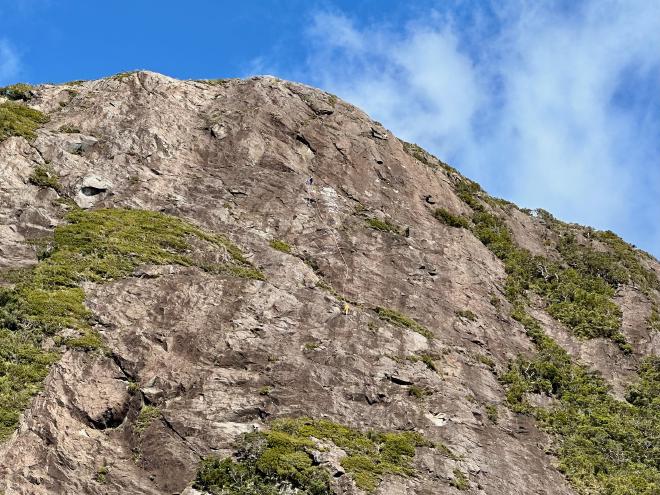
The cliffs of the fjord are good, solid rock and very popular with climbers. If you look closely you should be able to see a pair, joined by a rope, right in the middle of this photo.
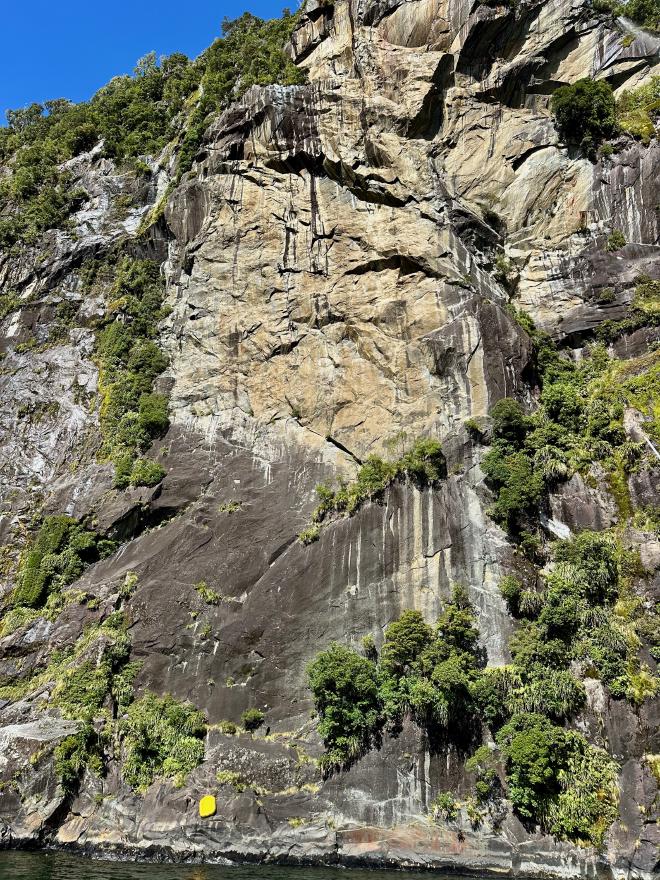
A bit farther down the fjord we saw another pair, who had obviously reached the foot of the cliff in a yellow inflatable. They’re difficult to see in this photo, but if you look hard you might be able to spot them. Go straight up from the boat to about half-way up the big lighter patch, then over to its centre.
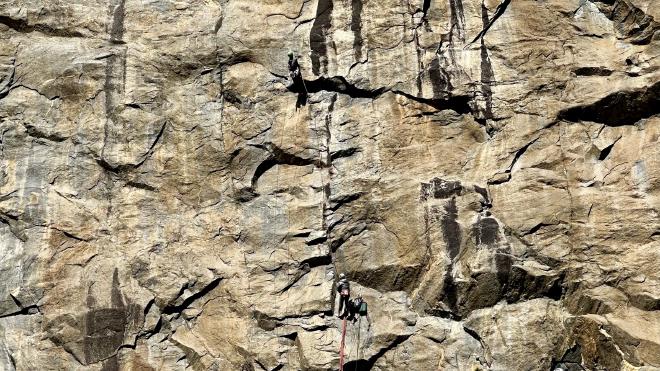
Here’s a closeup. While we were watching them, the lead climber fell at least three times, caught by their rope on each fall. It was a little nerve-wracking to see, but we can only assume they knew what they were doing.
This is the mouth of the fjord, viewed from the open water. At left is one of the other tour boats.
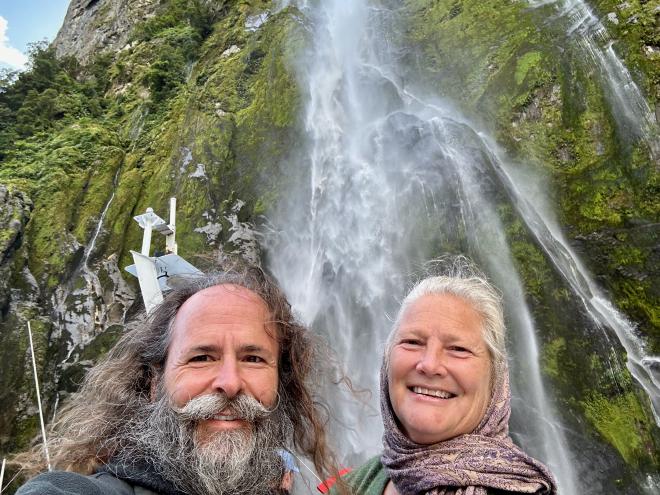
Time for another selfie?
Or maybe another angle looking down the fjord?
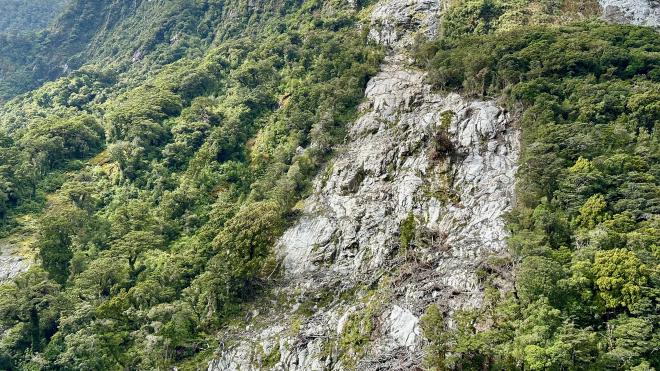
Many of the not-quite-vertical cliffs are densely treed. Some of the tree roots are anchored into holes in the rock, but a lot of them are anchored on the roots of other trees.
This leads to something called a “treeslide”, which is exactly what it sounds like: a landslide made of trees. Typically strong winds will blow down a few trees at the upper end of a slope, and they’ll begin to fall, taking their neighbours with them and creating a cascade effect. The bare area here is the site of a long-ago treeslide, and you can see the trunks of the trees tangled towards the bottom.
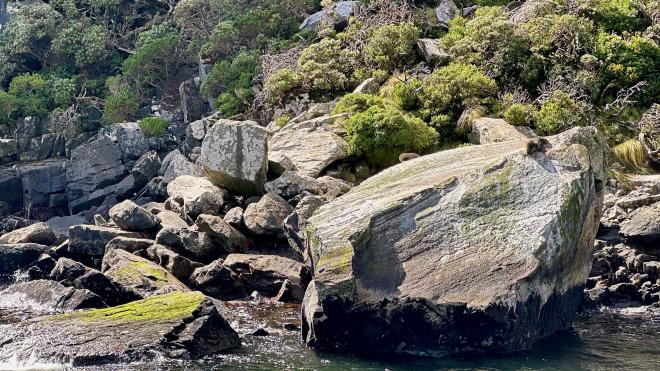
On the way back in we paused by this rock to take a look at the seals. There are at least three in the picture. Apparently these are juvenile males, who get kicked out of the group by the senior male, spend their adolescences hanging out and trying not to get eaten by sharks, and later rejoin the group.
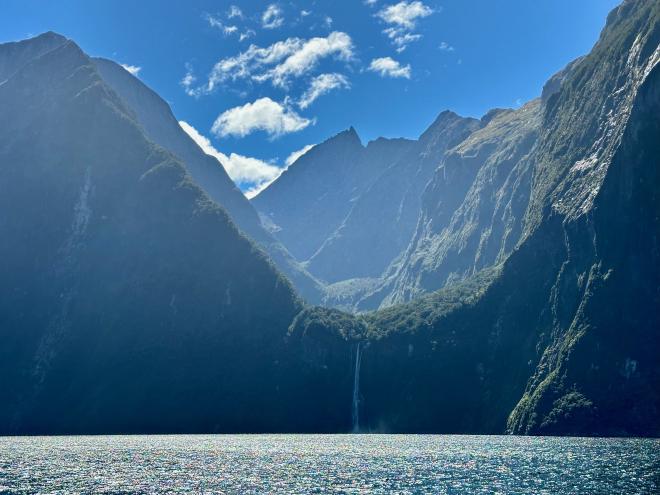
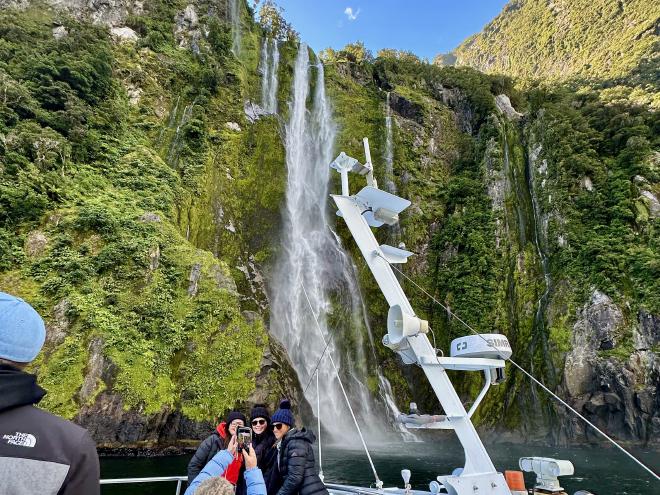
Stirling Falls is one of only two permanent waterfalls on Milford Sound.
The ship idled close to the falls for several minutes so we could take pictures and get a bit of a shower.
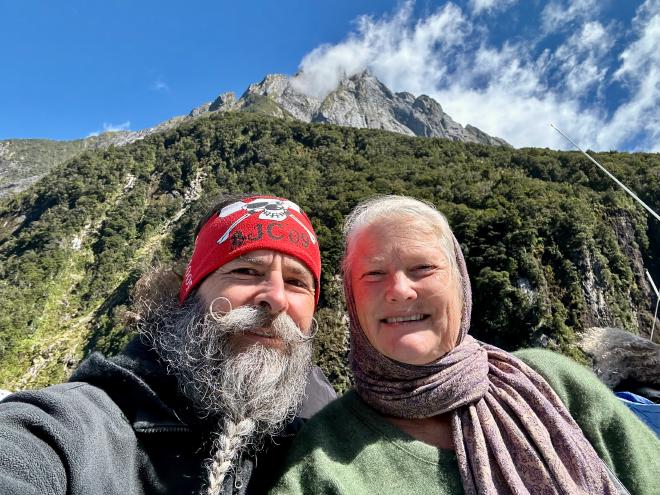
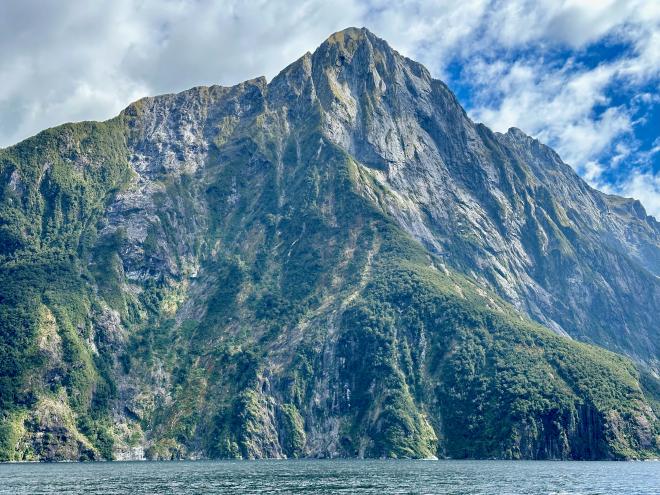
On the way back we had an excellent view of Mitre Peak, which is claimed to be the most photographed mountain in New Zealand. It’s the peak on the right in the photo from the dock, above, and the backdrop for the selfie immediately below that, so maybe the claim is true.
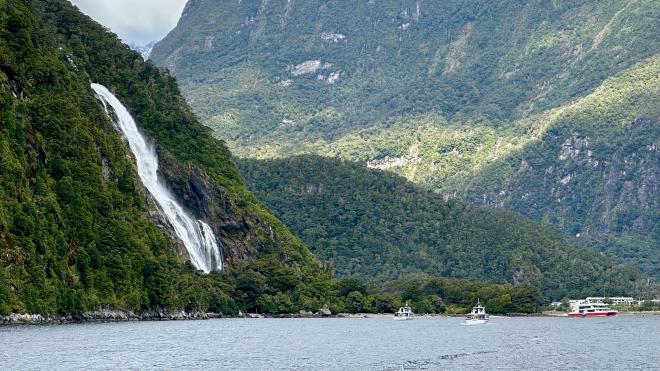
Alas, the tour came to an end and we headed back to the dock. Lady Bownen Falls, on the left, supplies all the electricity and water for the small Milford Sound townsite. We were encouraged to fill our bottles before leaving.
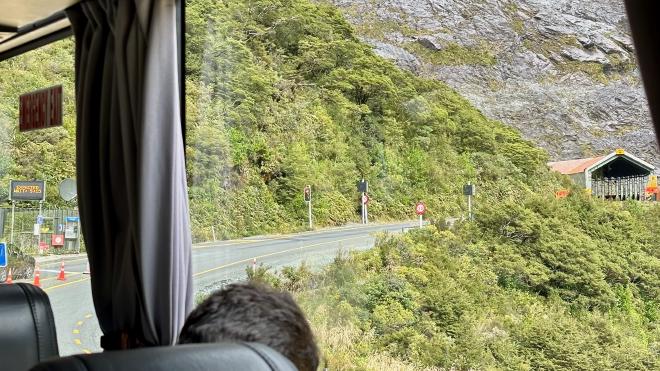
The trip back to Queenstown was pretty much a straight drive, with just a few toilet stops. This is the mouth of the Homer Tunnel, which we also drove through on the way to Milford Sound. It’s named after mountaineer W.H. Homer who discovered the location and proposed creation of a tunnel in 1889. Construction began in 1935 and the tunnel opened in 1954, with a nine year pause in the middle caused by World War II. The tunnel is 1207 metres long and a single lane, aside from two passing bays, so traffic takes turns. At the left edge of the photo is an electronic sign showing that our direction will be able to move in a bit over five minutes.
We had another slow morning following our trip to Milford Sound. In the afternoon our major accomplishment was heading to the Reading Cinemas to see Dune Part 2, which we both enjoyed.
After the movie we went for a walk along the Queenstown waterfront, and around the Te Kararo Queenstown Gardens, which are on a peninsula called the Frankton Arm that juts out into Lake Whakatipu.
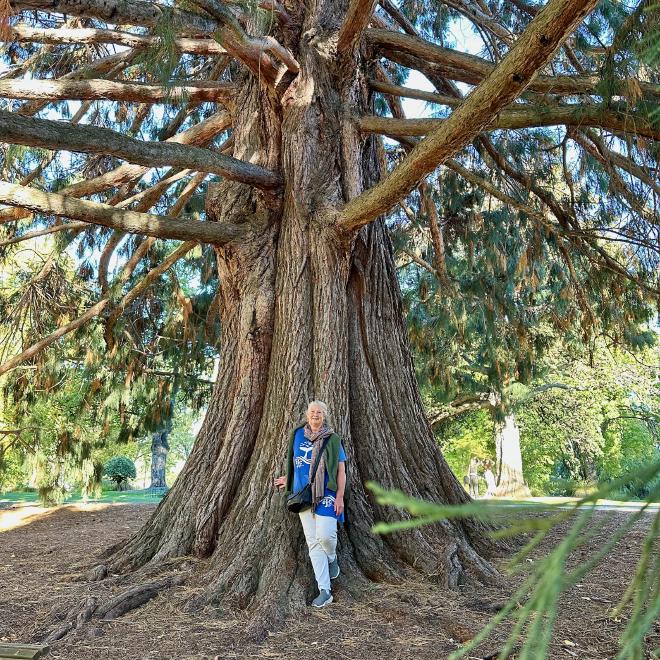
The Gardens include some rather large trees…
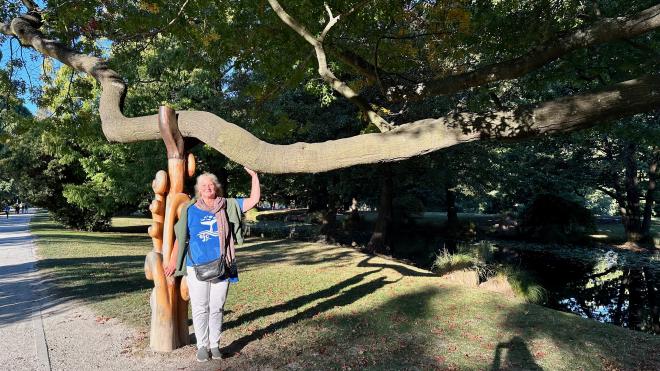
… as well as a few that need assistance to keep their branches off the ground. Karen was happy to lend a hand.
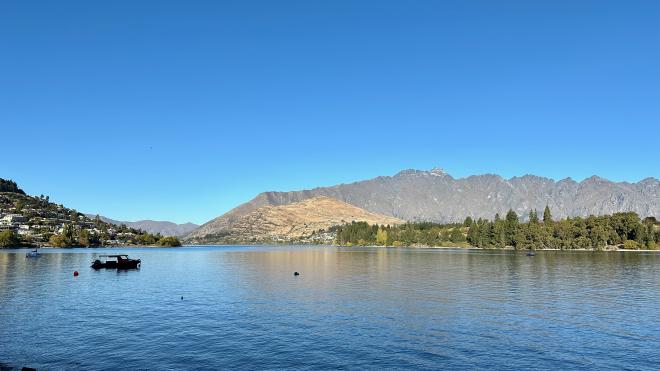
We had a lovely view south down the lake as the sun was beginning to set.
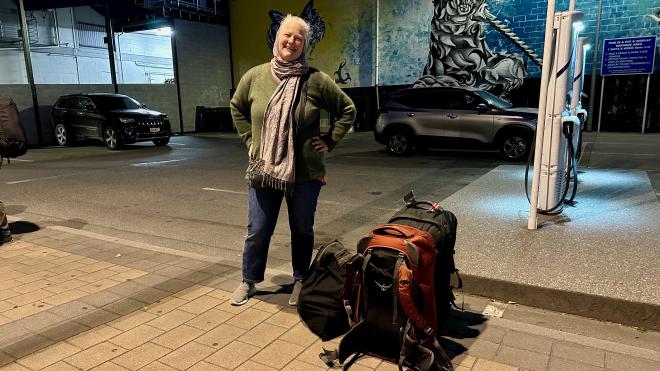
The next day was to be twelve hours of travel, from Queenstown to Christchurch by way of Mount Cook. So, 7:15 am found us once again at the bus stop, waiting to load up.