After spending the day with Tim in Wellington, our next stop was… Wellington! We were staying with Graham and Em at their home in Johnsonville, which is towards the northern end of the Wellington area. Graham is British, and a juggler, and we knew him from our time in the UK. He emigrated to New Zealand a few years ago to take up a job in the public service, married Em, and they started raising a family. We had a very pleasant first evening meeting their young children (about whom nothing more, for privacy reasons), catching up with Graham, and getting to know Em. She’s from the Dunedin area of New Zealand and lived for a few years in Vancouver, so we had lots to talk about.
We spent the next morning doing some much-needed planning for our visit to the South Island, and making accommodation and transportation bookings. The transport plan was complicated by the fact that buses on the west coast only run three or four days a week, one bus per day, which limited our options a bit. And unlike the North Island, where we knew lots of people, we had no real contacts on the South Island, so it was commercial lodging the whole way.
By early afternoon we had things mostly sorted, so we walked down the rather steep hill from their home to the centre of Johnsonville and caught a bus into Wellington.
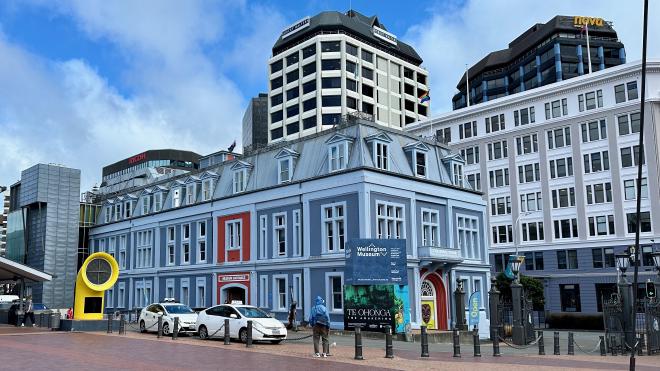
Our first stop was the Wellington Museum. Housed in what used to be the Bond Store, where items shipped to New Zealand were held in bond until import duties were paid, it’s a modest-sized museum focused on the local history and culture of the Wellington area.
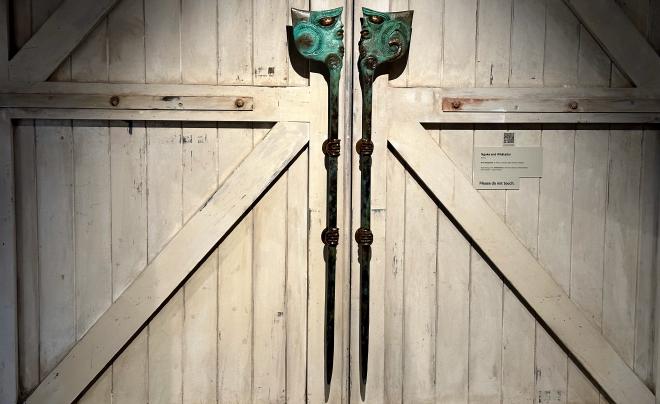
The lower level had an exhibit of modern interpretations of traditional Māori art, all done by local Māori artists, entitled Responding to the Tewhatewha in the Pain. These door handles are Ngake and Whātaitai by Brett Rangitaawa. “Ngake and Whataital [are] legendary beings responsible for the creation of Te Whanganui a Tara (Wellington Harbour). The harbour was once a lake and as they grew the taniha yearned for more space. To create a channel to the sea Ngake crashed through a wall of rock at Maraenui (Seatoun) and escaped into Te Moana a Raukawa (Cook Strait). Whātaitai tried to follow but was stranded by the outgoing tide. Trapped, he lived for many years in shallow water until a tremendous earthquake lifted the harbour floor and he died.”
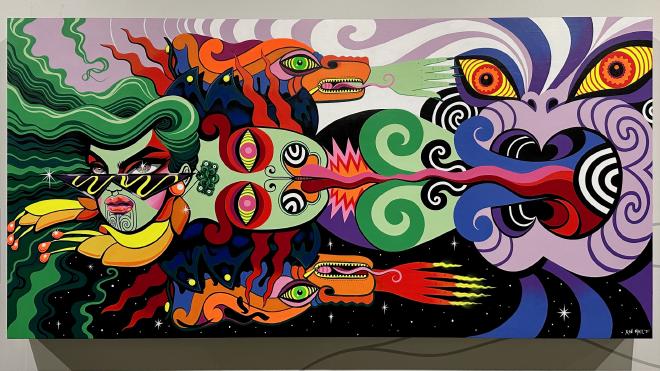
This is Te Whanganui-A-Tara, by Xoë Hall (Ngāi Tahu), from the museum’s permanent collection. “The earth mother Papatuanuku and
Tāwhirimātea, atua of wind and storms, channel the creative energy of
Te Whanganui-a-Tara. Hine-raukatauri, atua of musical instruments, is drawn to the city lights in the form of a moth. Mahuika, atua of fire, represents resilience to the winds of change.”
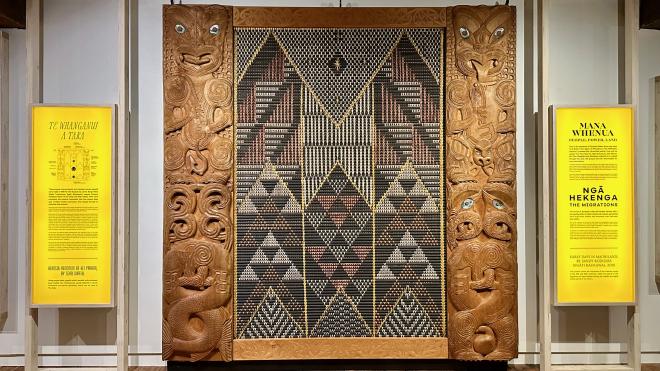
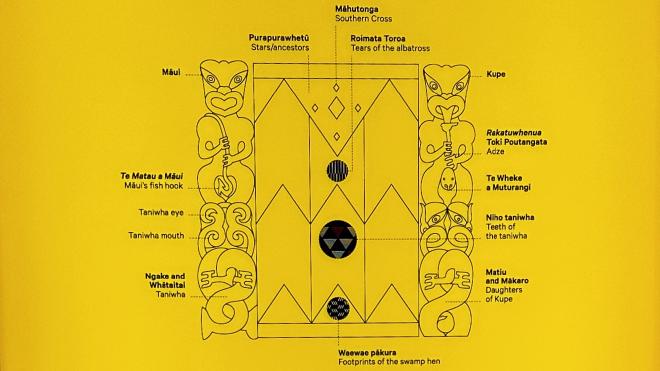
“These poupou (carved posts) and tukutuku (woven panels) were made in 1999 for the Museum by carver Rangi Hetet (Ngāti Tuwharetoa, Ngāti Maniapoto), weaver Erenora Puketapu-Hetet (Te Āti Awa) and their family.” They represent the creation of North Island – the great fish – by Māui, when he pulled it out of the water, and other Māori stories.
This is a key to the panel from the previous photograph.
The top floor of the Wellington Museum is called “the Attic” and houses a lot of random and unrelated items from the local history of Wellington.
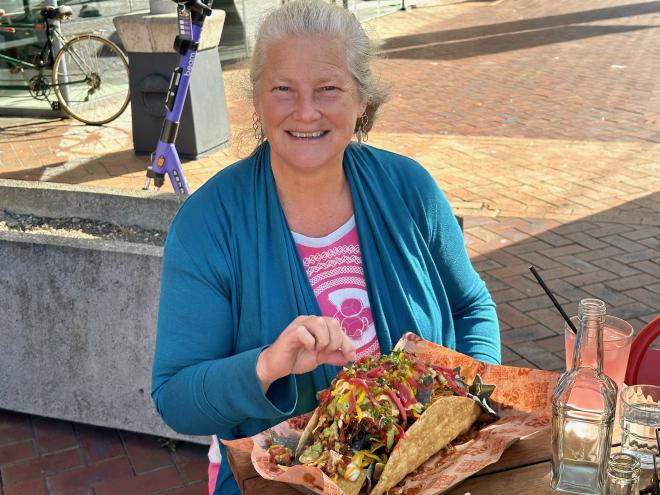
After visiting the museum we headed into the nearby square, where we had a dinner at Rosie’s Red-Hot Cantina & Taco Joint consisting of the highest-stacked nacho platter we’ve ever seen.
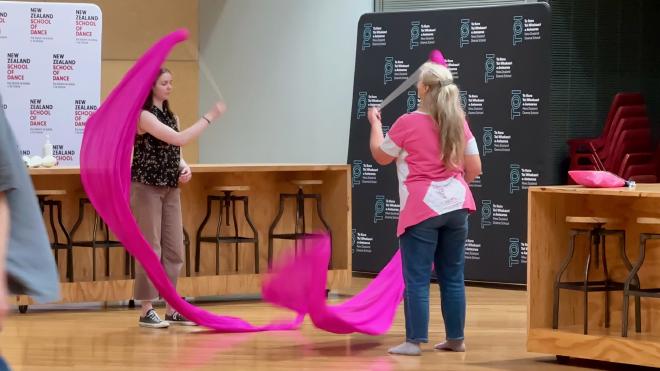
Our next destination was the New Zealand School of Dance, which is where the Wellington jugglers meet on a Wednesday night. What a coincidence that we happened to be there on a Wednesday; it couldn’t possibly have been planned that way! This was the view from where Graham picked us up to go to juggling.
As usual, people were curious about Karen’s veil poi and she got to do a bit of basic instruction. While we were juggling there was a Māori choral group rehearsing in an adjoining studio, which was a very cool accompaniment.
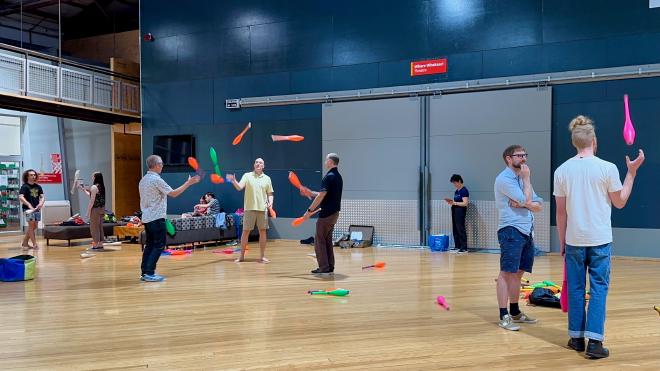
There are quite a few serious club passers in Wellington, so Greg was able to do some fun passing. Unfortunately we don’t have any pictures of that, but here’s some of the rest of the jugglers. Graham is in the blue shirt towards the right. The juggler in the yellow shirt is Jonathan, originally from Austin, Texas, and now living near Wellington — we’d met him many years ago at the Austin Juggling Festival.
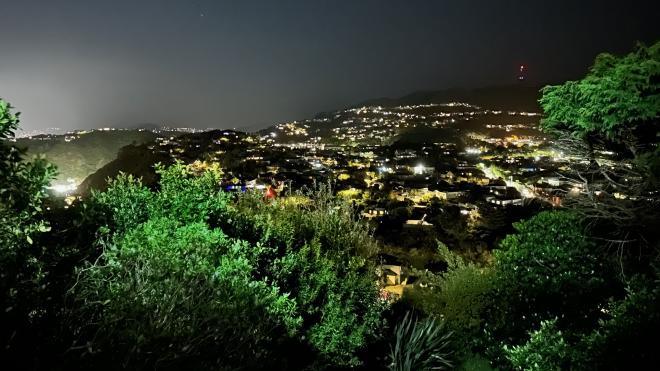
After juggling most of us went out together for food and beer at a nearby pub. Then it was back to Graham and Em’s place, where we were treated to this amazing view from the back of their house. It was quite windy by our standards, with gusts in the 90–100 kilometre per hour range, but apparently that’s just normal for Wellington.
The next day we were up and out of the house quite a bit earlier. We decided to head back to Te Papa, to have a look through the exhibits we hadn’t had time to visit two days previously.
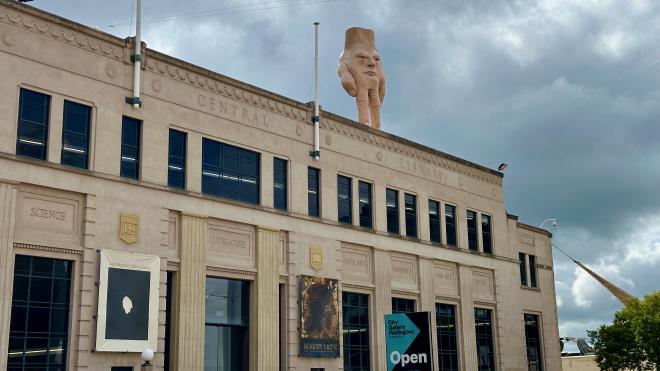
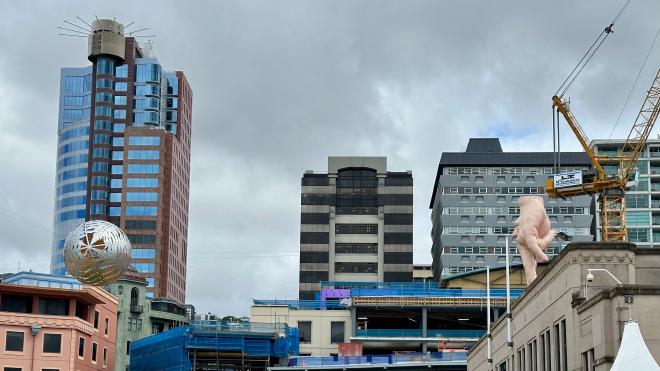
We got off the bus a few stops early so we could walk through parts of the city centre that we hadn’t yet seen. This building was formerly the Central Library and is now the City Gallery Wellington. We’re not quite sure what the sculpture on the roof is trying to say.
Here’s a view looking back across the same square, showing Wellington’s mix of old and new buildings.
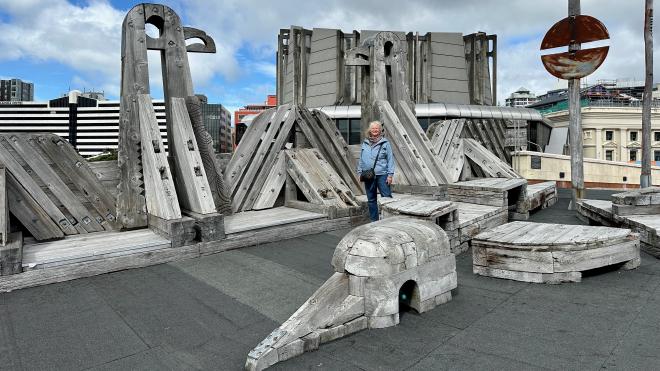
These interesting weathered wood sculptures were on a pedestrian overpass leading towards the harbour.
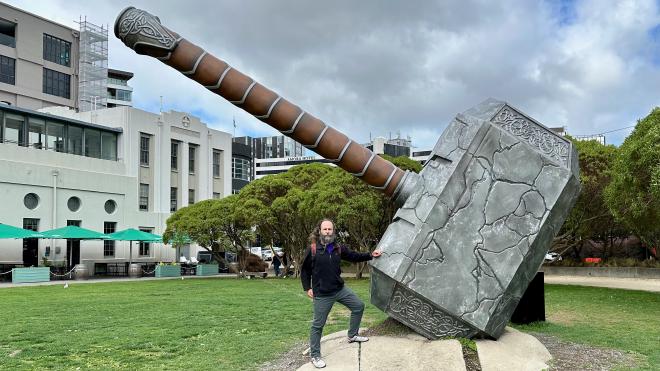
Apparently Thor left his hammer lying around near Wellington harbour. We can see why it’s so difficult to pick up; it’s much larger than it looks in the movies.
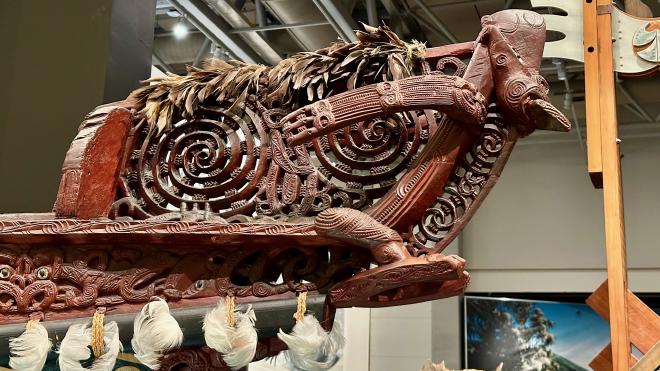
Then it was back into Te Papa. This is the prow of the Teremoe, the waka we left off at, two days previously.
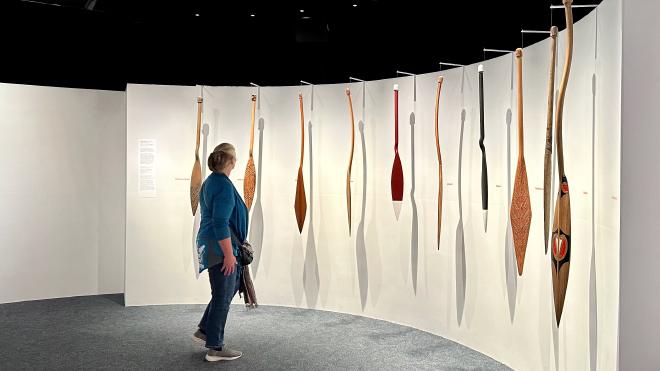
These paddles are modern artistic interpretations of traditional Māori motifs, on traditional Māori paddle styles.
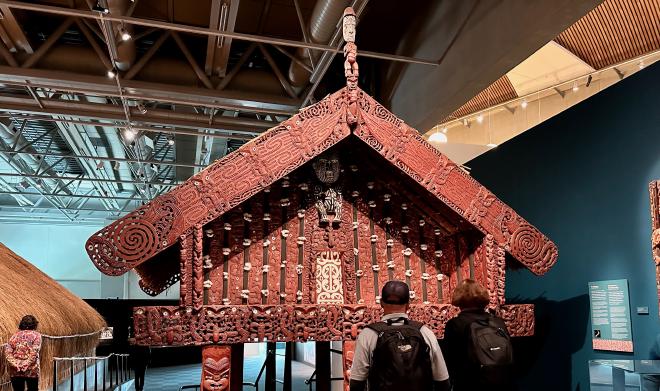
This is one of two beautifully-carved Māori meeting houses in Te Papa. The museum requests that the front of the other, on the left with the thatched roof, not be photographed for cultural reasons (’though we saw a few people ignoring that request).
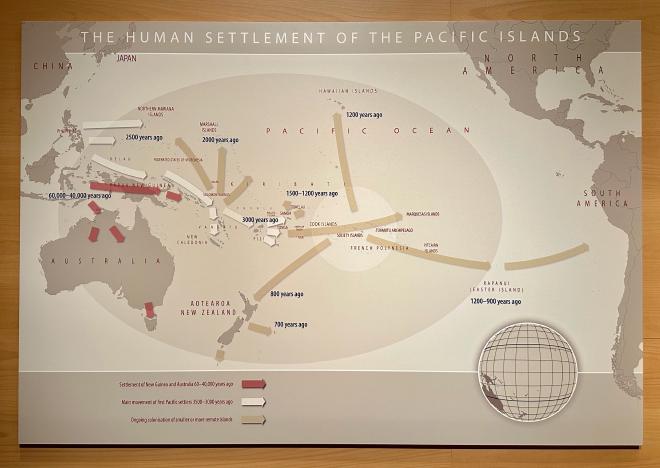
As mentioned previously, Aotearoa (New Zealand) is one of the most recently populated places on Earth, the Māori having first arrived about 800 years ago, around 1280 CE. This map from Te Papa shows our current understanding of the routes of human settlement in the Pacific Ocean.
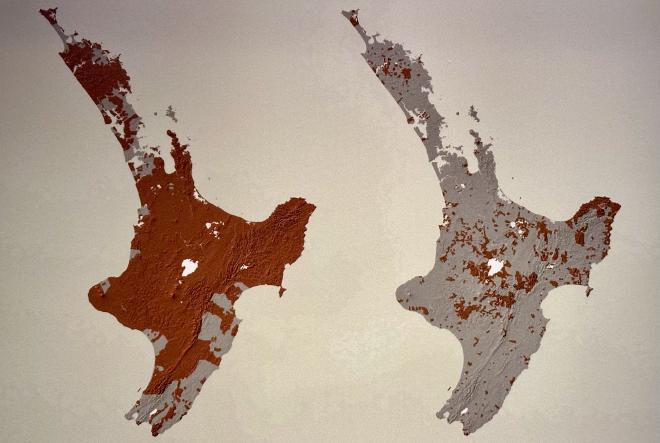
One exhibit in Te Papa covers the Treaty of Waitangi, the main document governing relations between the British colonial government and and the Māori. There are both English and te reo Māori versions of the Treaty, in nine copies, which were sent around the Islands to be signed by the Māori chiefs. These remain controversial, partly because not all the chiefs of the time chose to sign, partly because the te reo Māori versions appear to give the Māori greater rights than the English versions, and partly because the colonial government largely ignored the treaty and dispossessed the Māori of lands they had been promised. These are maps of the North Island. The brown regions represent Māori ownership of the land, on the left in 1839 and on the right in 1860.
We also visited several other exhibits, covering the social history of New Zealand, the immigrant experience, and other subjects, but have no pictures of those to show you.
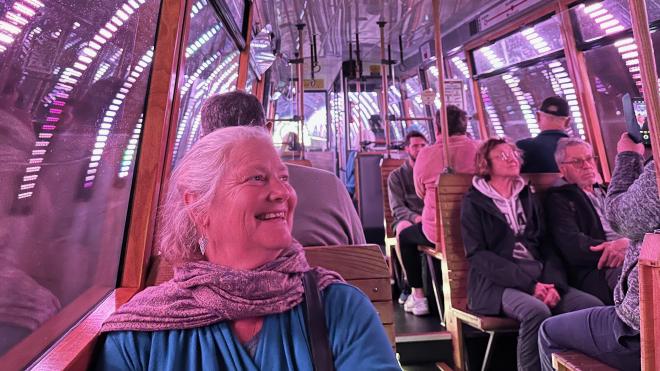
We walked from Te Papa to the base of the Wellington Cable Car track and rode it to the top. The system, built starting in 1898, is 785 metres long and climbs 119 metres, through three tunnels and over four bridges. It connects the lower (harbour) level of Wellington with the top of the hill, and was important to the early development of the city. Here we’re going up through one of the tunnels.
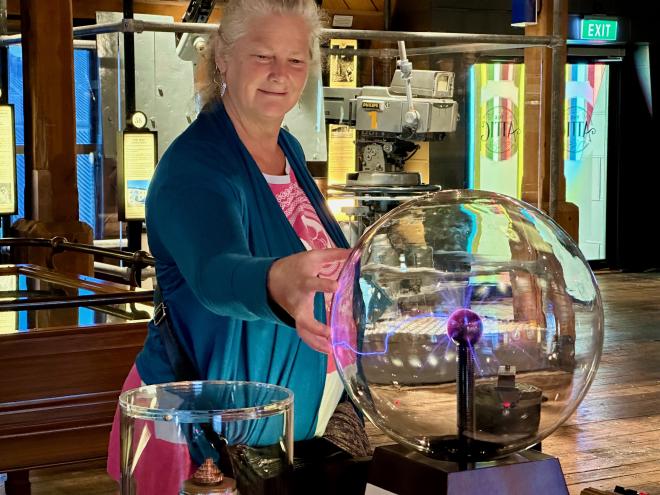
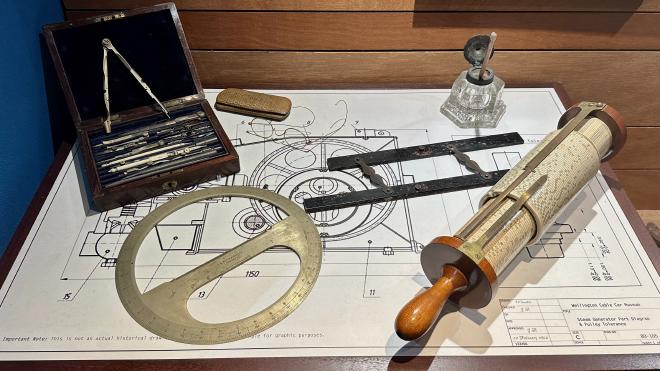
There’s a small museum dedicated to the cable car at the top of its run, in the building that housed the steam-powered winding mechanism before the system was converted to electric. These are some of the engineering tools that were used in the system’s design, including a relatively rare cylindrical slide rule.
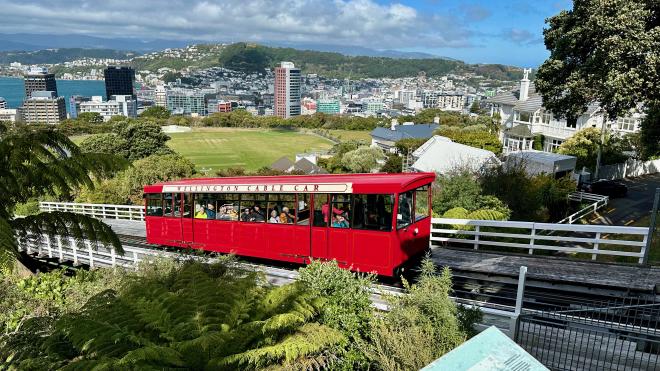
Here’s a car arriving at the upper station, viewed from a lookout beside the museum.
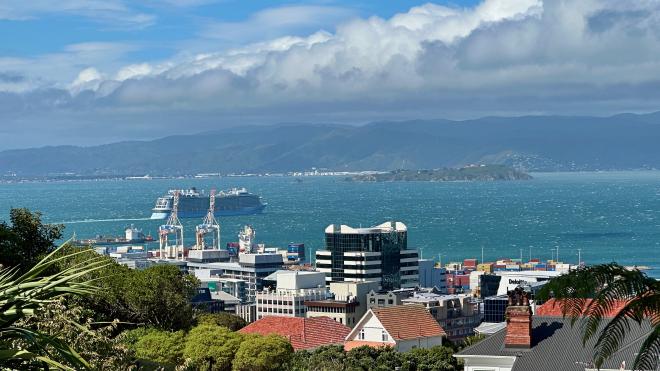
The lookout also gives wonderful views of the harbour. The ship pulling out here is Royal Caribbean’s Ovation of the Seas, which we also saw on our walk through Sydney in early January. It’s the same design as RCI’s Quantum of the Seas, which we’ll be taking from Brisbane to Honolulu in April.
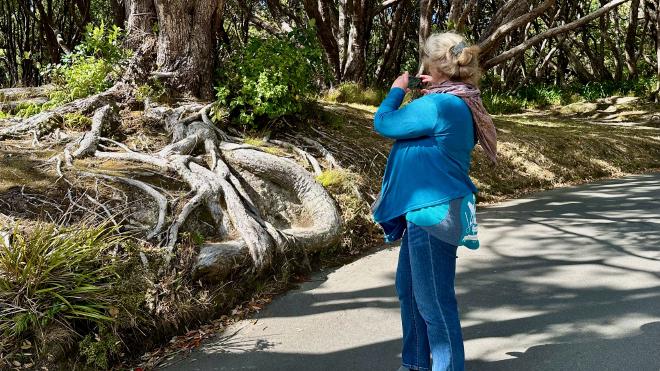
One entrance to the Wellington Botanic Garden is beside the Cable Car’s upper station. Of course we took a wander through; here’s Karen taking a picture of a tree.
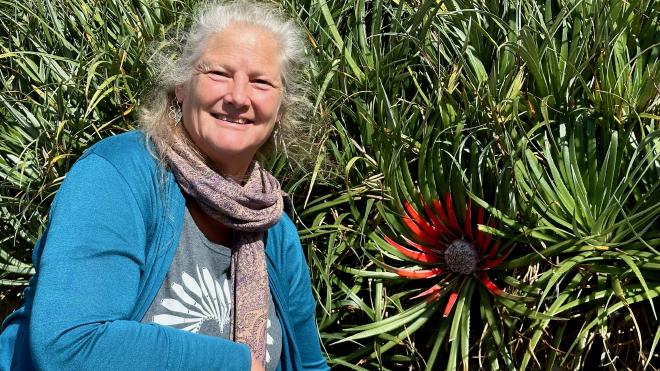
And here she is beside a spiky looking flower we weren’t able to identify.
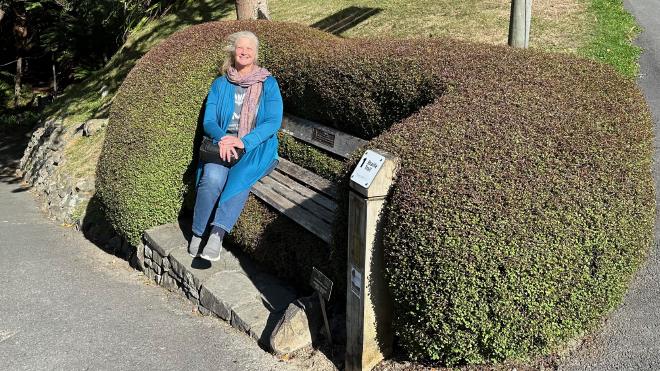
And here she is one more time, on a bench completely embedded in a hedge.
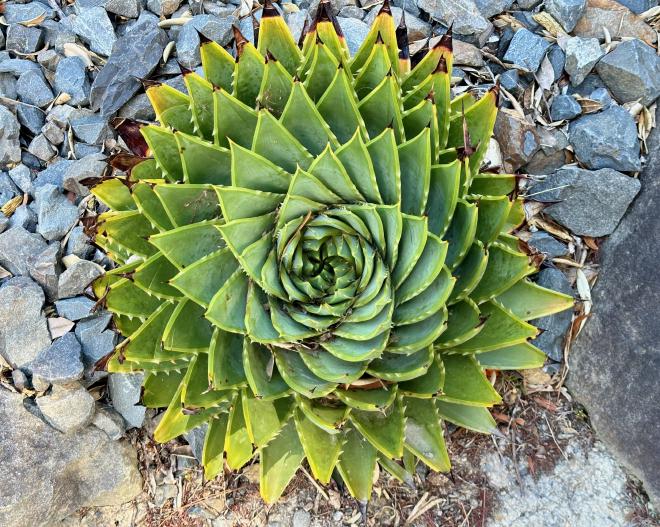
Greg thought this Spiral Aloe was particularly striking.
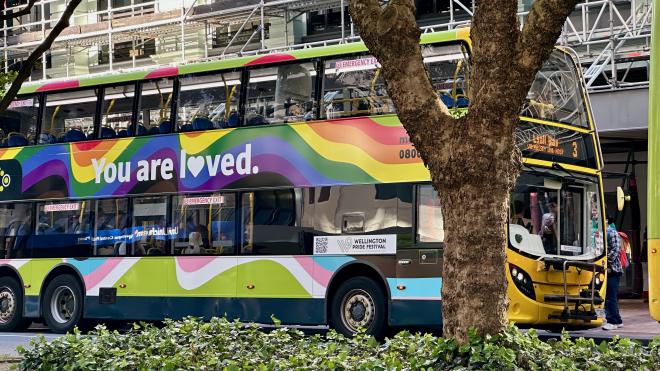
We took the Cable Car back down the hill and walked from there to the train station. The Wellington Pride Festival was going on during our visit, but it wasn’t particularly visible other than this nicely-decorated bus.
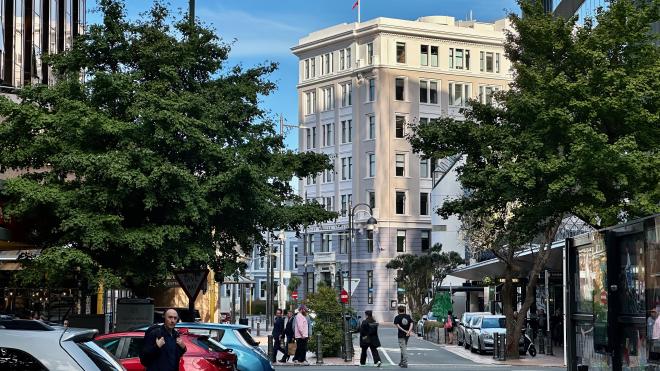
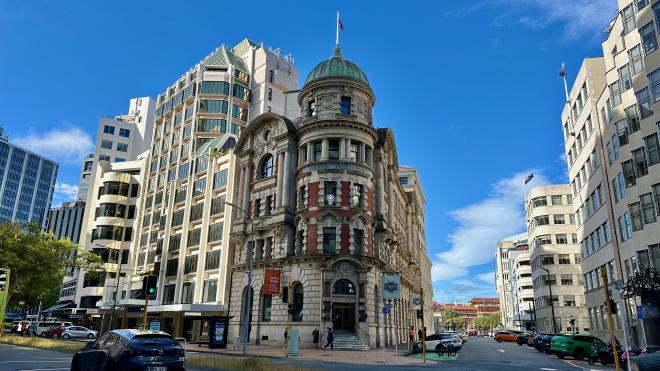
The building on the corner is Public Trust Hall. We quite liked the contrast between the old a new architecture.
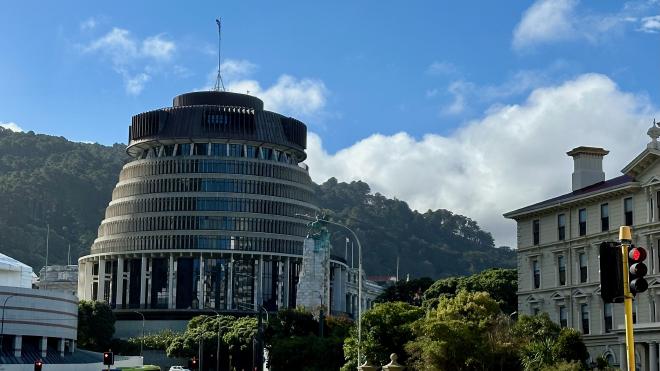
The rather odd conical building is called the Beehive and is the executive wing of the New Zealand Parliament. Behind it you can just see a bit of Parliament House itself.
We took the train back to Johnsonville, where we picked up some Thai take-away for dinner and were in turn picked up by Graham for the ride up the hill. We had a nice meal together, some happy chaos as the kids got ready for bed, and a pleasant evening chatting once they’d settled for the night.
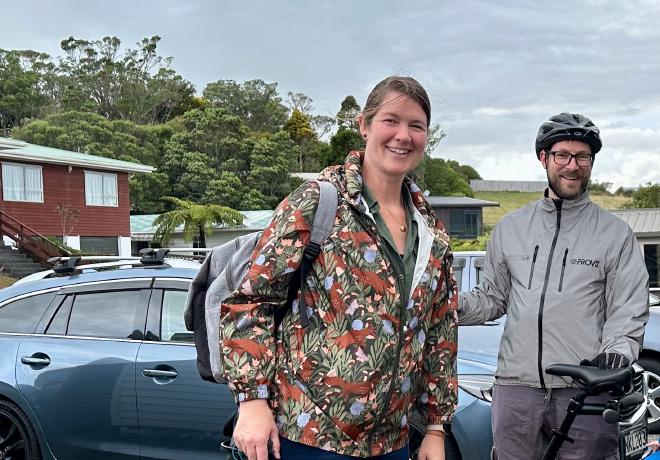
The next morning we bid farewell to Graham and Em as they headed off for work, Em by bus and Graham on the extra-long electric bike with the kids so he could drop them off at day care. Then we hiked down the hill with our bags, hopped the train into town, and were on the ferry to the South Island.
Our thanks again to Graham and Em for looking after us so well on our visit to Wellington. It was lovely getting to know you both, and we’ll look forward to seeing you at the Aotearoa New Zealand Juggling & Circus festival in a few weeks!