Queen Elizabeth voyage summary (30 October to 3 December)
Table of Contents
This entry is a quick summary of our time aboard ship on the 34-night trip from Barcelona to Melbourne. If you’re looking for details about what it’s like sailing on a Cunard ship, we’ll refer you to our entry about crossing the Atlantic on the Queen Mary 2, way back in July. In fact, you might want to have a look at that anyway, as we’ll be mentioning a few differences.
We won’t be talking about our port visits in this entry, as we’ve already posted diary entries about all of those. And we didn’t actually take all that many pictures of the ship itself, so illustrations are a bit random.
What’s the ship like? #
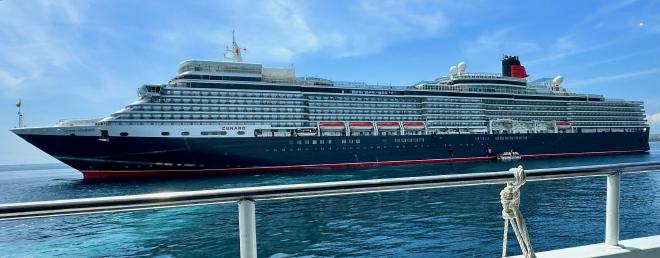
The Queen Elizabeth is similar to the Queen Mary 2 in many ways. She’s smaller (about 2100 passengers vice 2700) and narrower (so fewer inside cabins), with a more conventional layout (the Queen Mary 2 is weird). Cunard calls the Queen Mary 2 “the last true ocean liner” while the Queen Elizabeth is a cruise ship. The Queen Elizabeth is arguably less “grand”, with fewer and smaller public spaces and less impressive art, but still very well-appointed and pleasant. The decor in the two ships is quite similar — you can get a pretty good sense of the look from the photos in our Queen Mary 2 diary entry. Many of the restaurants, bars, and other public spaces have the same names on both ships.
And your stateroom? #
As we mentioned in our first post about this sea voyage, we took a balcony stateroom so we’d have a bit more private space, some natural light, and a more pleasant place for Greg to work along the way.
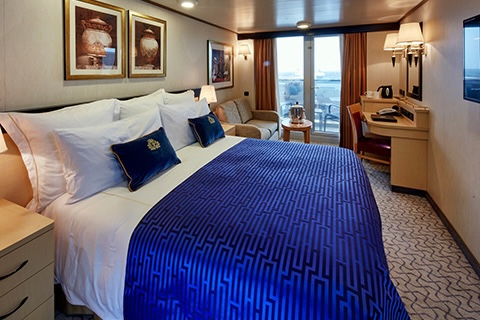
Our cabin was an “obstructed balcony view”, which saved us a bit of money over a regular balcony. The “obstruction” was the lifeboat just below us and its launching crane. In practice this just meant that we couldn’t look straight down at the water – the view was otherwise just fine.
Our cabin steward was an forty-something guy from the Philippines, named Lito, who took very good care of us. His current contract has him aboard until July of 2024, when he’ll be home with his family for a bit before taking his next contract.
Who’s aboard? #
On our transatlantic trip the passengers were mostly affluent retired folks, with a sprinkling of late-middle-agers like us and a few others. On the first part of this trip it was the same, only more so – we were well at the younger end of the demographic on a ship full of passengers mostly in their 70s and 80s.
Given the itinerary, it’s not too surprising that the majority of the passengers were Australian. There were a few Brits, some other Europeans, and a very small number of Canadians and Americans.
The trip was effectively in three legs: Barcelona to Singapore (20 nights), Singapore to Fremantle (8 nights), and Fremantle to Melbourne (6 nights). Perhaps 25% of the passengers disembarked in Singapore, to be replaced by a somewhat more mixed demographic including some younger folks and some east Asians. Quite a few of the Australians disembarked in Fremantle, to be replaced mostly by more Australians, many of those quite a bit younger. These were either on board just for the short hop to Melbourne, or continuing on to New Zealand.
That’s a lot of old folks — any medical issues? #
Yes, there were a few minor health issues and a couple of major incidents that we heard about (for other passengers, not us).
Early in the voyage there was a week with a lot of coughing going on, including us, but it seems to have been mild colds. We were advised at one point that there were some passengers with COVID who had been isolated in their staterooms, but we didn’t see a major outbreak. And both of us had a bit of what I will euphemistically call “tummy trouble” for a few days mid-voyage, but whether that was a virus or a reaction to an unaccustomed diet remains a mystery.
Shortly before we got to Singapore we woke in the middle of the night to a ship-wide announcement sending a medical team to one of the staterooms on our deck. The next morning there was another announcement requesting that anyone with O-negative blood, who was a blood donor, had their donor card, and was eligible and willing to donate, go to one of the ship’s meeting rooms for screening. Greg is O-positive, but Karen fit the profile, so she reported. This was when she was just getting over her cold, and they had enough other donors to meet the need, so they screened her and put her on standby. In the end she wasn’t required. Not surprisingly, we were never told the details of what happened. (Later edit: our Nurse Practitioner daughter Shona speculates that it was likely a gastro-intestinal bleed, perhaps caused by an infection. As she says “hemoglobin can actually get surprisingly low before we would transfuse.” And there’s a very narrow window where someone would be sick enough to require a transfusion but not sick enough to require immediate medical evacuation.)
Then, when we were two days out from Fremantle, the Captain let us know that we were diverting slightly north to rendezvous with a helicopter so that one of the passengers could be medically evacuated. Again, we never found out the details.
What were the sea days like? #
Mornings #
On most sea days, we’d wake up when we woke up; typically around 8:30 am. On days when we were heading west to east, we’d often have a one-hour time change at noon, in which case we’d set an alarm the next morning to make sure our schedules didn’t start drifting. We also had one time zone change in the other direction, going from Singapore to Jakarta, even though that’s almost due south — have a look at how weird Singapore is on a time zone map (it’s the key-shaped green notch just north of Indonesia). But all time zones are political and weird anyway.
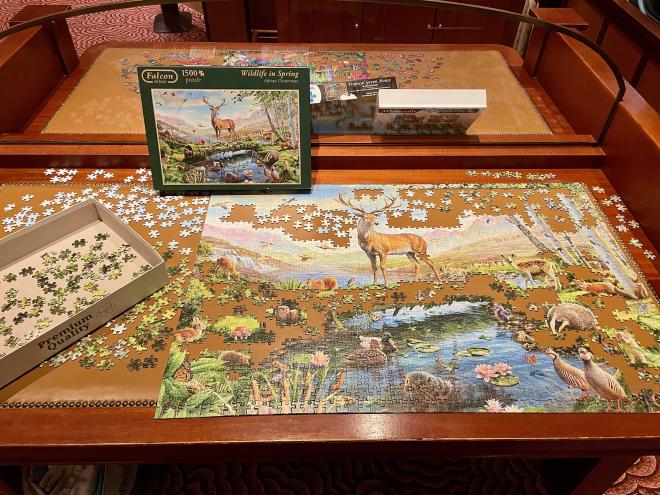
If we were up early enough we’d sometimes have breakfast in the full-service Britannia Restaurant, but most days we ate in the Lido Buffet. Then Greg would typically go back to the stateroom to get some work done, and Karen would head for the jigsaw puzzles in The Alcove on deck 3 beside the Grand Lobby.
Most mornings there were lectures in the Royal Court Theatre by academics or people of some renown. Canadian astronaut Robert Thirsk was on board from Barcelona to Singapore, and Greg went to several of his talks. As a side note, Greg worked opposite Robert’s brother Richard in the mid-1990s: Greg was a customer-side engineering representative on a large Army acquisition project, and Rich was team lead on one of the software systems Greg was responsible for.
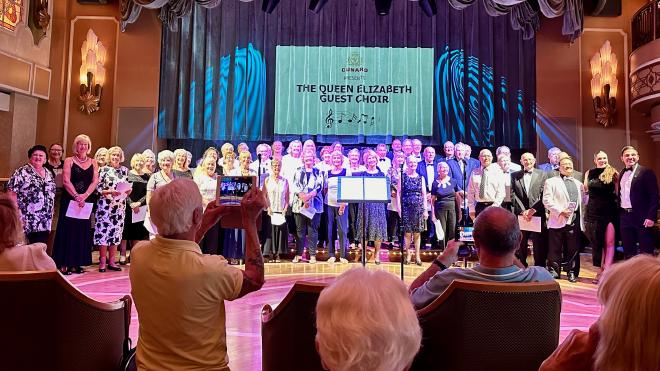
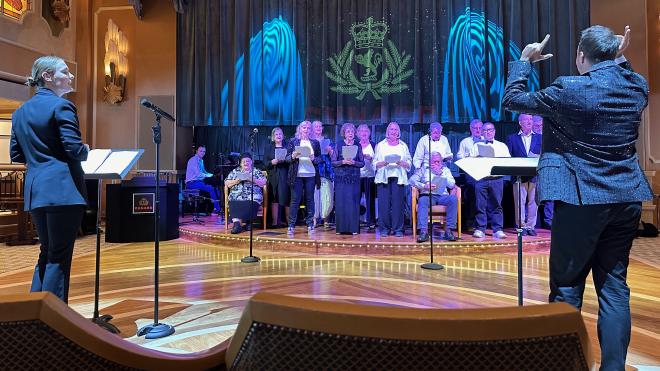
Afternoons #
After Karen’s rehearsals we would normally meet up for lunch. Sometimes rehearsals ended early enough we could have lunch in the Britannia Restaurant, but most days it was in the Lido Buffet. We also had lunch in the Red Lion Pub, and a couple of times got burgers from the Lido Grill beside the aft pool on the Lido deck. We also substituted the afternoon tea in the Queen’s Room for lunch, a couple of times.
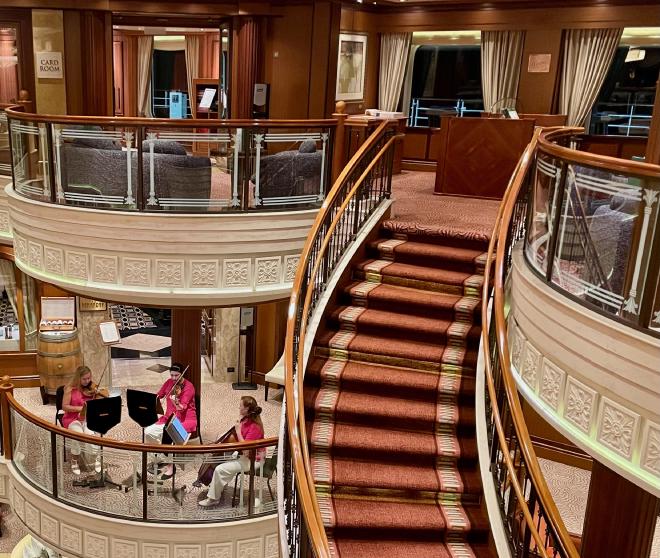
Later in the afternoon there was a craft group meetup in the Commodore Lounge. Karen would bring her sewing; most of the other crafters attending were either knitting or crocheting. Almost all the participants were women, but there was one guy who did rug hooking. He gave up on the group after a few days as he was getting tired of people coming by and either asking what he was doing or offering unsolicited advice.
In the afternoons Greg would normally head back to the room to get more work done. Sometimes he’d take his laptop to the rear deck or into one of the public lounges and work there; sometimes he’d read a book.
Later in the afternoon Greg would often go up to the midships pool deck, which was open but protected from the wind, and juggle for a bit. After that he’d head to the fitness centre and either go for a run on the treadmill or work out. While he was doing that, Karen would usually go for a swim.
Evenings #
Most evenings we had dinner in the Britannia Restaurant at about 7:30 pm. Required dress most nights was fairly casual, with a short-sleeve collared shirt being acceptable for men. About once every four evenings would be a “Gala Night”, where the minimum standard for men was jacket and tie and women were expected to wear a nice dress or equivalent.
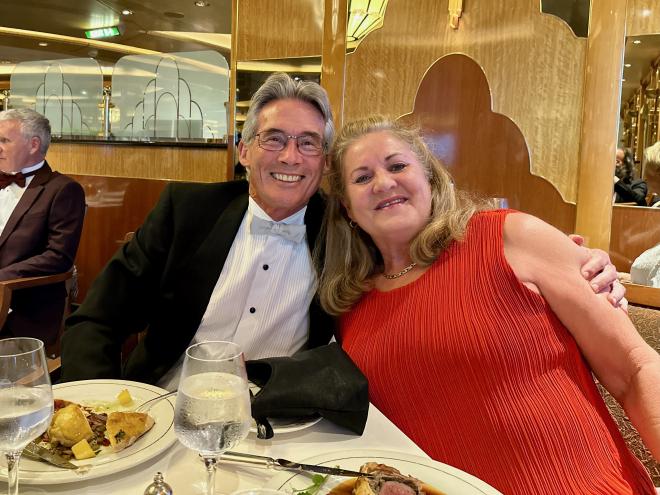
We also had a room service dinner on our stateroom balcony on one of the nights we were both feeling poorly.
After dinner, if the show in the Royal Court Theatre looked interesting, we’d go catch that. If not, we’d either head back to the room to read or watch something on Greg’s laptop, or go to one of the lounges to have a drink and listen to the musical performers.
Verandah Steakhouse #
We hadn’t intended to bother with the specialty restaurants, since the food in the Britannia was generally excellent and quite varied. However, one day (for reasons that were never revealed to us) we had a gift certificate for two evenings in the Verandah Steakhouse show up in our stateroom mail. There’s usually an extra US$50 per person charge to eat dinner there, so we figured we might as well.
The meal was about what you’d expect from a high-end steakhouse: very good quality ingredients, well-prepared, and really more food than you should eat at one sitting. The service was also extremely attentive, with about one waiter for every two tables.
We enjoyed both visits, but likely our second visit more than our first: since we now knew what to expect, we’d deliberately eaten lightly all day to save up room for the big meal. That said, our main waiter on our first visit, Lance, was a real hoot, and the waiters on our second were much less fun.
Verdict: at no additional charge we’d certainly do it again, but we don’t think it really rates the extra fee over what you’d get in the Britannia. Then again, we’re not big steak eaters, so why should you listen to us?
How was the shipboard entertainment? #
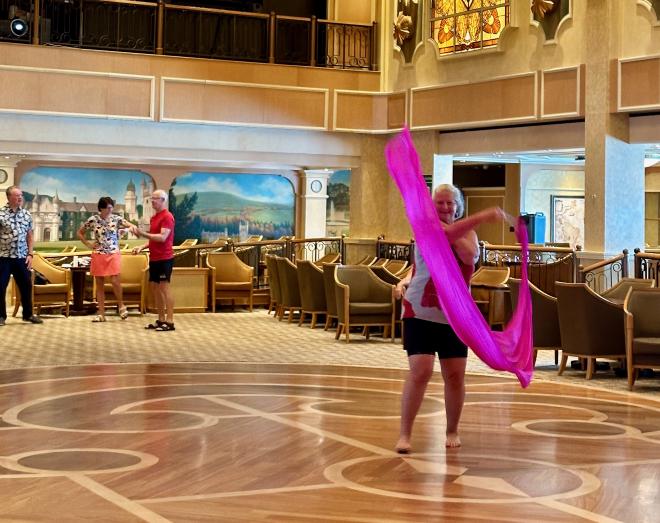
The Royal Court Theatre Company performed on about half the nights, with guest performers on the other half. As with the Queen Mary 2, we were very impressed with the quality of the singers and dancers who made up the Company, particularly given the number of different shows they put on throughout the voyage. The Royal Court Orchestra also performed almost every night and were always excellent.
If you’ve been following along, you may remember us lamenting the lack of circus and variety guest performers during our voyage on the Queen Mary. This trip did still feature mostly singers, musicians, and comedians, but there were also jugglers, acrobats, and a magician. Because good folks like them can always use more publicity, here they are:
- Magician Stephen Garcia,
- Acrobats and aerialists Power of 2: Ilia & Oksana,
- Comedy juggler Goronwy Thom, and
- Jugglers and acrobats Cameo Rascale, James and Rebecca.
What about those seas? #
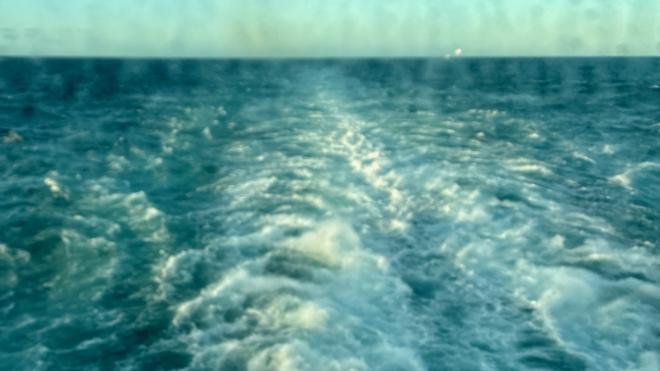
Given our route, we were expecting to see some rough water along the way. We didn’t – the seas were extremely calm all the way to Fremantle, and only got slightly rougher for about a day as we rounded the south west corner of Australia. No seasickness medication for either of us.
We’ll see what we get in April on our two Pacific voyages: we’ve heard that “pacific” is a fine name, but a lousy descriptor.
Any other excitement? #
When we were transiting the Red Sea we had a British Royal Marine Colonel come aboard to coordinate anti-piracy measures. Greg went to a talk the Colonel gave, which seemed to be about half information and half reassurance that everything was fine.
Security measures included water cannons mounted on the promenade deck to repel any boarders, plus enhanced sentries. The most direct impact on us was that the ship went into blackout mode — all curtains were required to be closed after dark and no passengers were permitted on the open decks. We also had an anti-piracy drill one morning. For passengers, this essentially meant that those of us with exterior cabins spent half an hour sitting in the corridors chatting with our neighbours.
At the time we thought the security measures were a bit overblown, but the Houthi attacks that started about the time we arrived in Singapore made us re-think that position.
Closing thoughts #
Unless you’re really into the cruising life, thirty-four nights is a heck of a long time to spend on a cruise ship, even with the port visits to break things up. To be fair, there were a lot of available activities in which we had no interest: trivia competitions, gambling in the casino, lectures about fine art by the shipboard gallery, bridge lessons, auctions for high-end watches, and so on.
By the time we got to Fremantle (twenty-eight days in) we were definitely ready to get off the ship, but we still did enjoy our last six days.
Did we enjoy the voyage? Sure! Would we do it again? Maybe!
On our widdershins journey we still have a sixteen-night voyage from Brisbane to Honolulu in early April, and an eight-night voyage from Honolulu to Vancouver nine days later. Those are on Royal Caribbean International, which has much more of a “fun” vibe than the rather staid Cunard, so the experience will be quite different. And the first of those trips is aboard the Quantum of the Seas, which has a maximum passenger capacity of 4900, compared to the Queen Elizabeth’s 2100. That means more facilities, and more variety, but also a lot more crowds.
We’ll have to see what we think!