Our visit to Singapore was absolutely the most fun we had on the voyage from Europe to Australia!
To understand why, we need to flash back to 1999, not long after Greg started juggling. In those days the worldwide juggling community organized itself around the rec.jugglingUsenet newsgroup, which was essentially a text-only discussion forum, and Greg was a very active poster.
In November of 1999 a juggler from Singapore, Loh Koah Fong, posted a description of a three-ball multiplex pattern he’d come up with as a symmetric variation on the Georgian Shuffle. Keeping with the geographical theme, he called it the Singapore Shuffle.
Koah Fong’s pattern was really fun, and it seemed obvious that it could be extended to four balls and maybe even five. Greg, Koah Fong, and a couple of other jugglers (Multiplex Dan and Bill Coad) tried to figure out what those would look like, and after a some false starts Greg and Koah Fong worked them out. A little bit later, Greg created a vaguely-related three-ball pattern he called the Kingston Shuffle.
In the process of all this, Greg and Koah Fong became good friends and have stayed in touch ever since – though they’d never met in person. When we realized our ship would be stopping in Singapore, Greg asked Koah Fong if we’d be able to connect. Conveniently, the port visit was on a Sunday when Koah Fong didn’t have to work, and he offered to spend the day with us.
Then in July at CoastlessCon we met two more jugglers from Singapore, Di Hong and Xin Fang (aka Chia). We mentioned our planned visit and that we would be hanging out with Koah Fong – who is one of the original Singapore jugglers and well known in the community – and they offered to join us as well.
Koah Fong took a lot of the photos in this post; they’re marked (LKF).
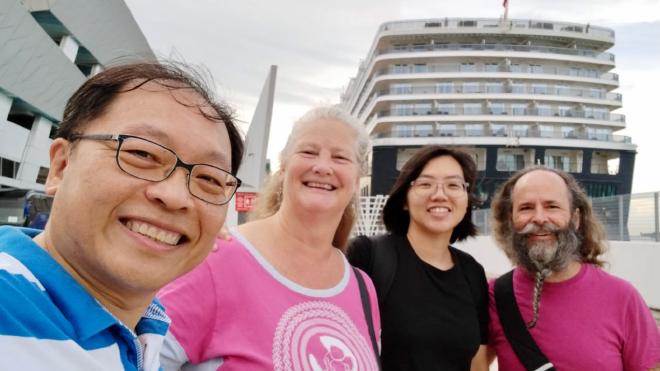
Koah Fong (left) picked us up right at the cruise dock, with Chia. There were many hugs. That’s the Queen Elizabeth behind us. (LKF)
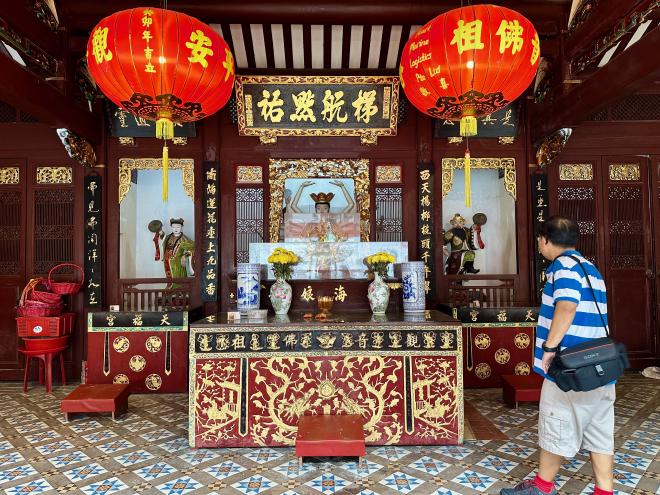
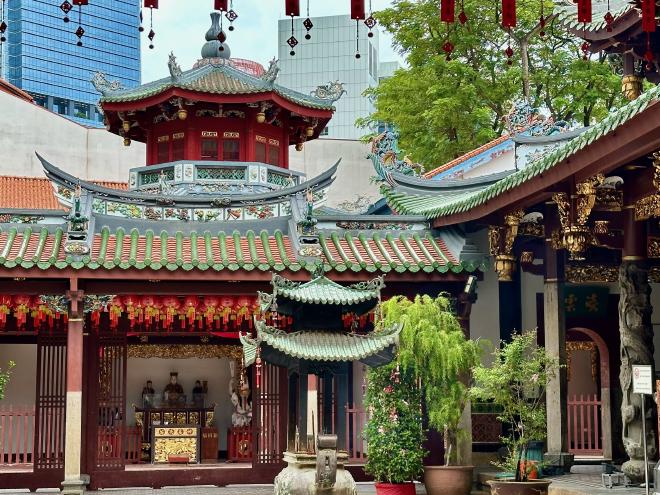
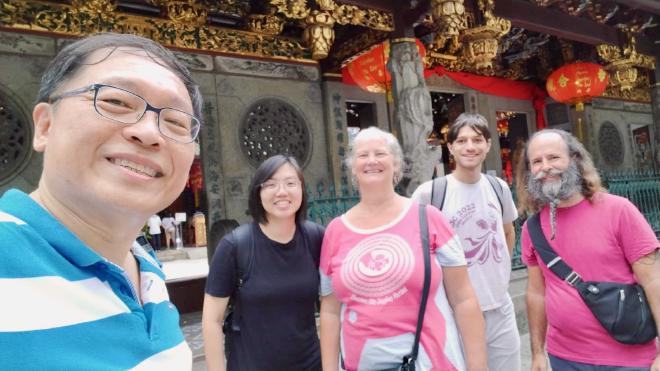
From there we went to the Thian Hock Keng Buddhist Temple. This was built to worship Mazu, the Chinese sea goddess, and was right on the shoreline when it was completed in 1842. These days it’s well inland – much of Singapore is on land reclaimed from the sea.
Thian Hock Keng is a very traditional Chinese design, a huge contrast from the Indian design of the Gangaramaya Temple we’d visited a few days previously in Colombo.
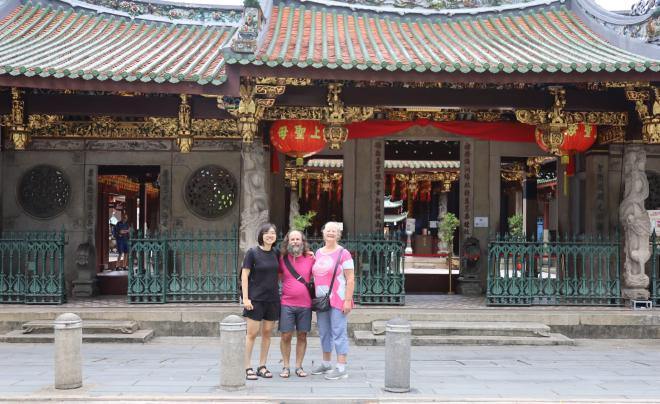
Since we were there early on a Sunday morning, the streets were eerily quiet. A photo like this from across the street would be almost impossible any other time – Singapore is a crowded place.(LKF)
As we were leaving Thian Hock Keng we had a bit of a surprise when Cyril, a French juggler we know from the European Juggling Convention and CoastlessCon, also joined us. Unbeknownst to us, Cyril is studying in Singapore for nine months as part of his university degree. (LKF)
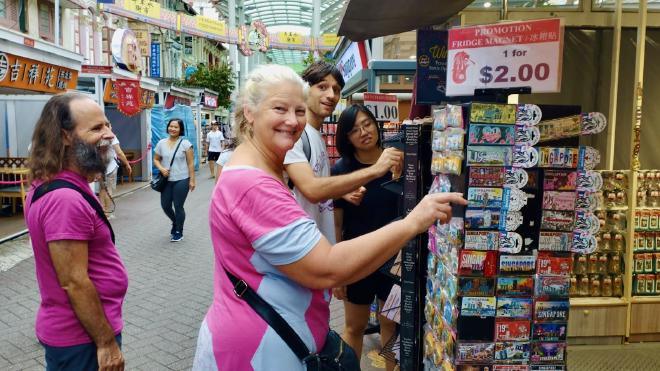
From there we took a walk through the touristy section of Singapore’s Chinatown, where Karen hunted unsuccessfully for a souvenir magnet. But don’t despair: she found one later in the gift shop at Gardens by the Bay. (LKF)
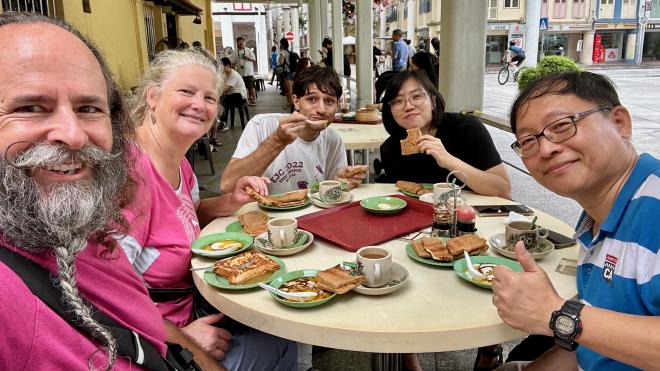
By this point it was time for a late breakfast, so we stopped at Ya Kun. This does a number of typical Singapore breakfast dishes, most featuring soft-boiled eggs, which are normally eaten with soya sauce. As the sign in the restaurant said: “Do you want your eggs soft and runny, or runny and soft?” We tried those accompanied by coffee, kaya toast (thinly sliced toast with coconut jam), and french toast with smoked cheddar. We had a bit of a wait – immediately ahead of us in line was a tour group leader ordering 32 meals – but the food and company were both delightful.
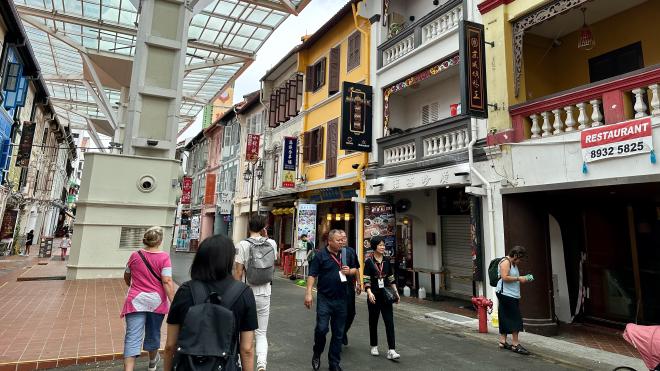
After breakfast we continued our walk through Chinatown. The street in this section of nineteenth century buildings is almost fully covered with a rain shelter; handy in Singapore’s monsoon season.
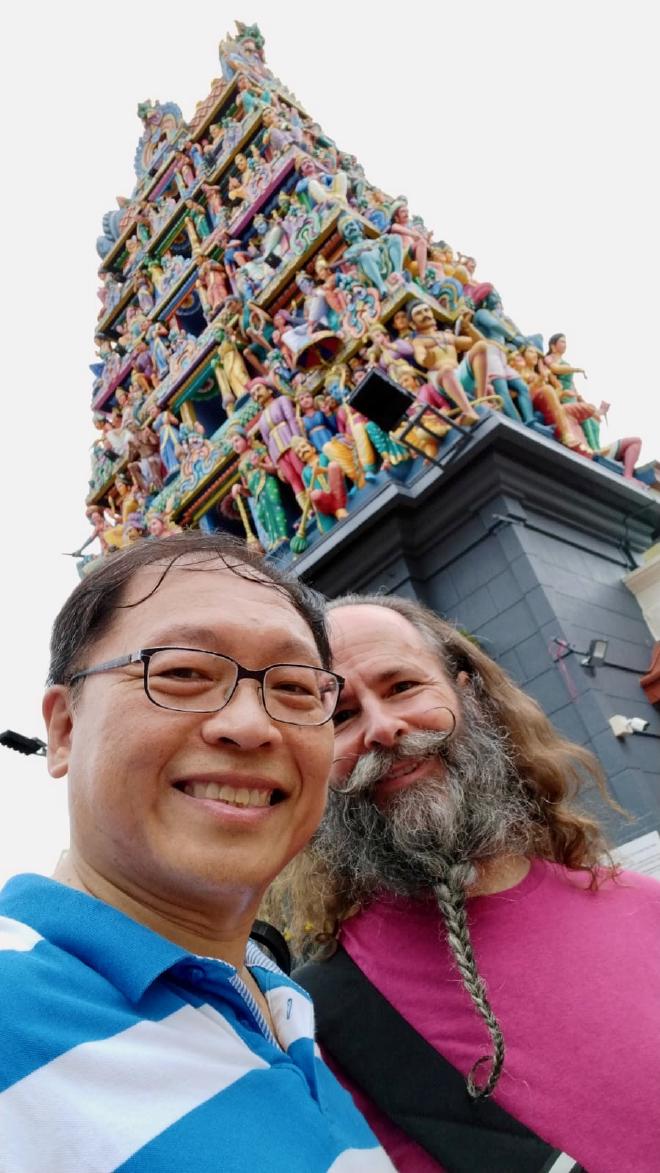
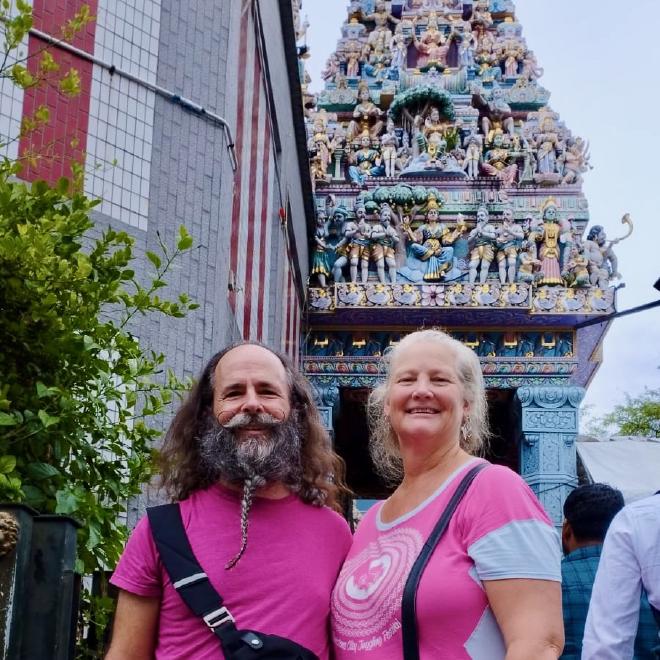
From Chinatown we continued the religious theme and visited the Sri Mariamman Hindu Temple in Little India. The population of Singapore is roughly 9 percent Indian, 14 percent Malay, and 75 percent Chinese. (LKF)
The temple dates from 1827. It was nice having someone else to take our photo, rather than always doing selfies! (LKF)
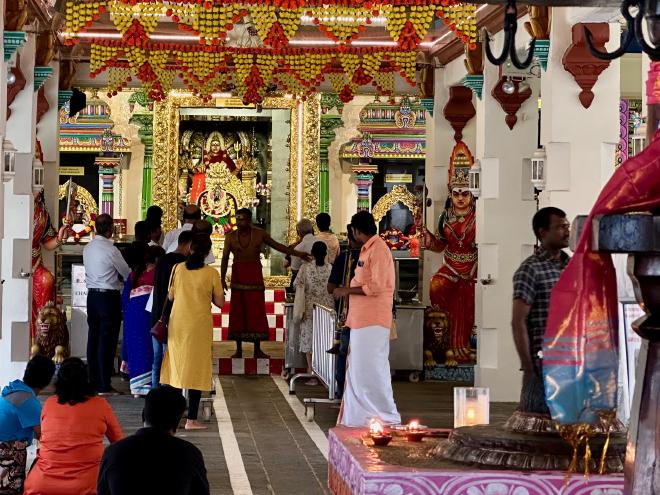
The inner temple was very crowded with worshippers and priests making offerings to the gods. (LKF)
As we were leaving Sri Mariamman, Di Hong joined us. He’d had a family obligation in the morning, and another later in the afternoon, but managed to carve out some time in the middle to spend with us. We all went for a walk together through Little India, which is a noisy commercial sector with many small shops at which you can buy almost anything.
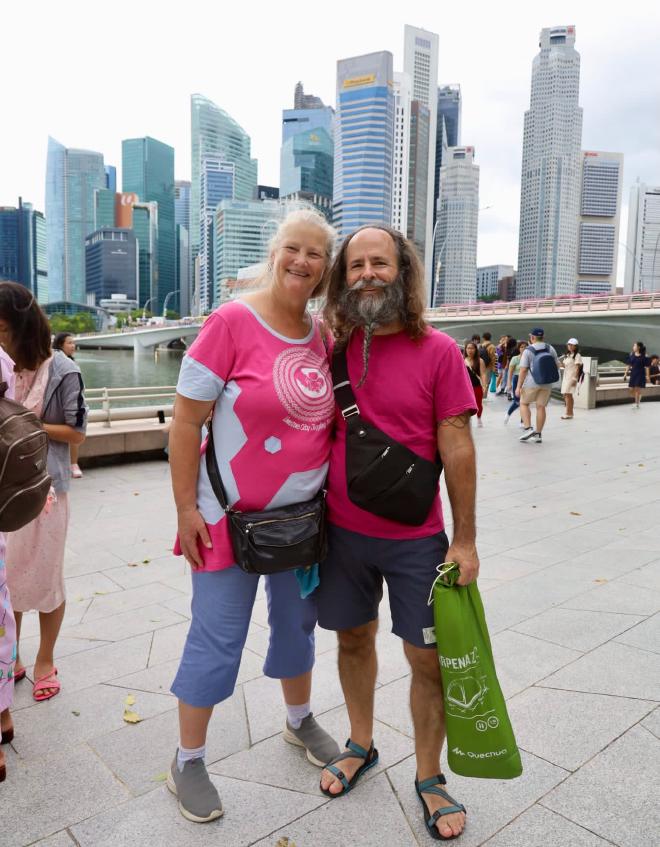
From Little India we went to the Esplanade, a large performing arts centre. This gave us a good view of the Singapore skyline. (LKF)
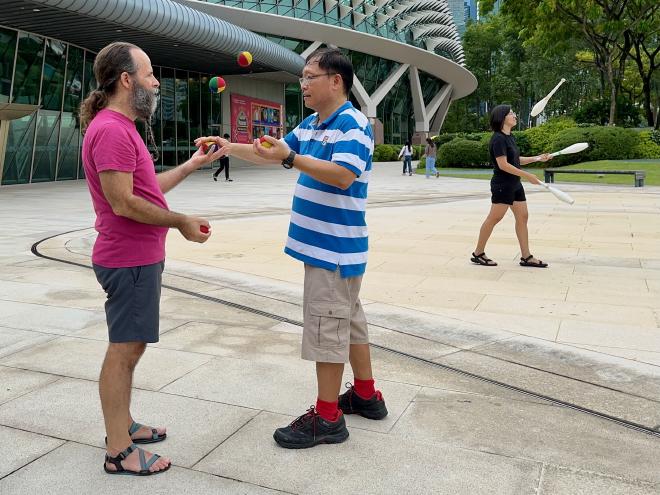
The main reason for our visit to the Esplanade is that it’s a nice spot to juggle, and in fact the juggling club has performed in the main building on several occasions. This is Koah Fong teaching Greg a simple five-ball “mini” passing pattern, which was a lot of fun. For the jugglers: Prechac 3331p. Behind us, Chia passes with Di Hong (off camera).
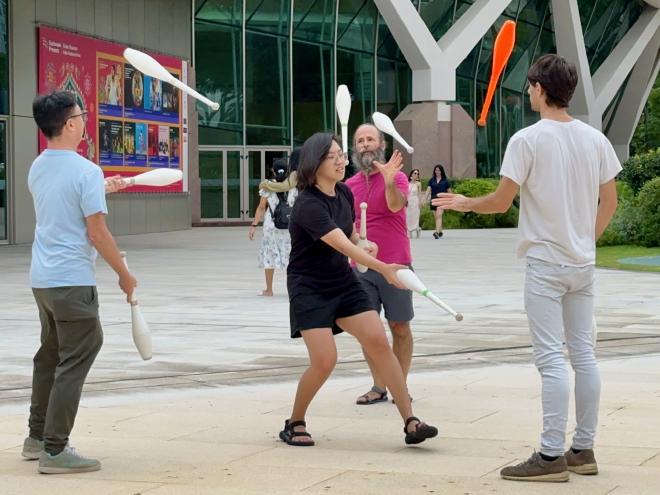
Di Hong, Chia, Greg and Cyril passing Scrambled V. At this point Greg is A, Cyril is B, Di Hong is C, and Chia is the manipulator.
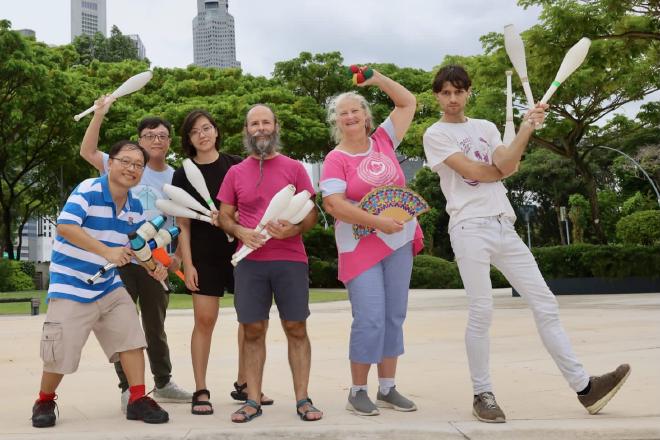
Can you spot the artsy French juggler? (LKF)
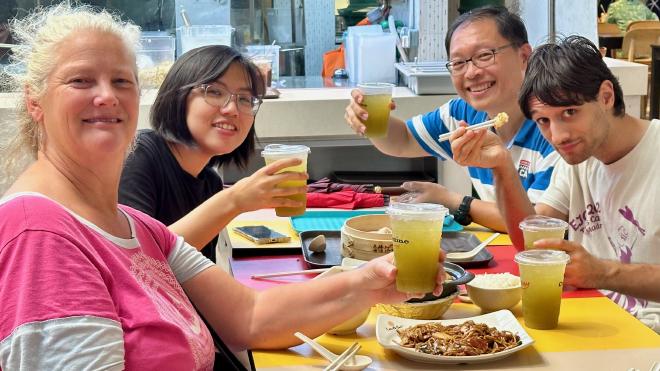
Sadly, Di Hong had to leave after juggling. The rest of us went to Lau Pa Sat, which is a really amazing food court with about thirty restaurants covering a wide range of Singapore’s Chinese, Indian and Malay cuisine. The two of us held down a table while Chia, Cyril and Koah Fong went and bought dishes from about six different places including noodles, soup, dumplings, and a fried omelette. Koah Fong got us all fresh-pressed sugarcane juice, which we’d never had before. Strongly recommended if you can get it.
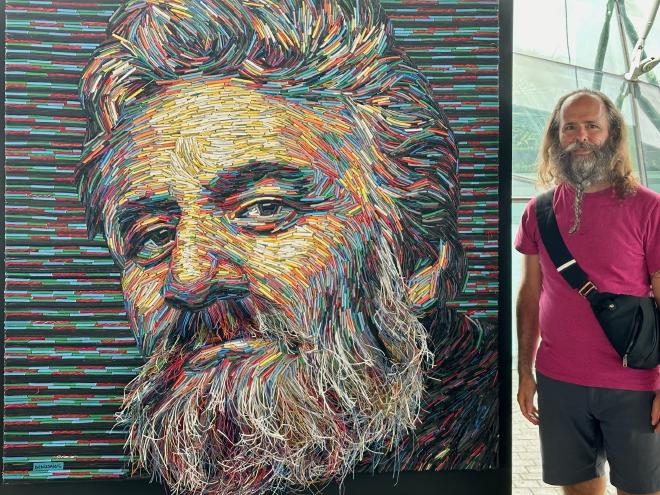
After lunch we went to the Gardens By the Bay, which is a large park and botanical gardens. In the lobby area was an art exhibit called Ready Remade, consisting of portraits made from waste materials. This one is by Deniz Sağdiç, from waste cable pieces.
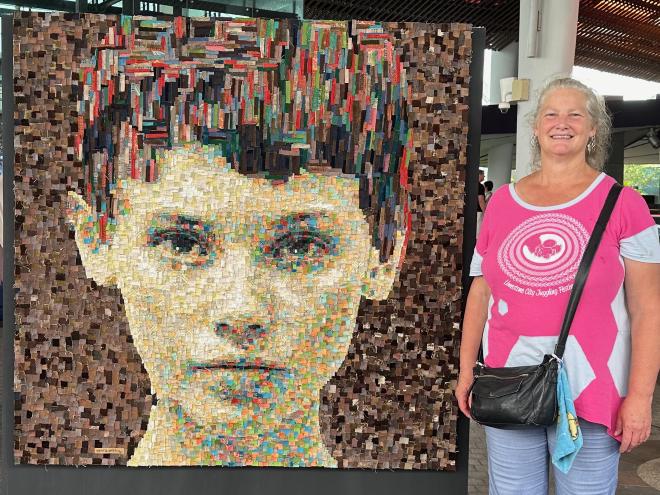
And this one, also by Deniz Sağdiç is from waste fabric.
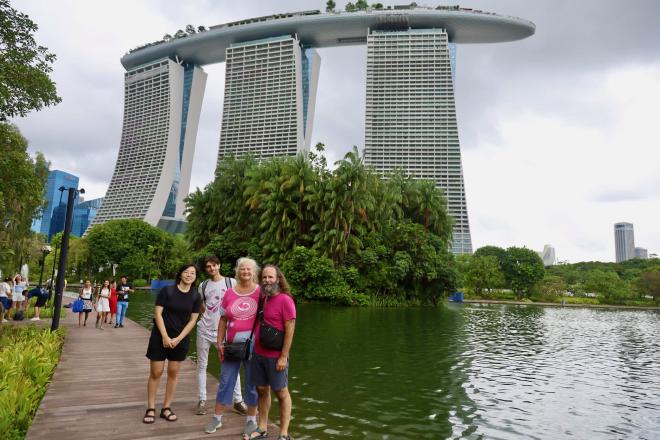
From the gardens we had a great view of Singapore’s iconic Marina Bay Sands, designed by Moshe Safdie. Yes, it does look like someone parked a ship on top of three hotels. (LKF)
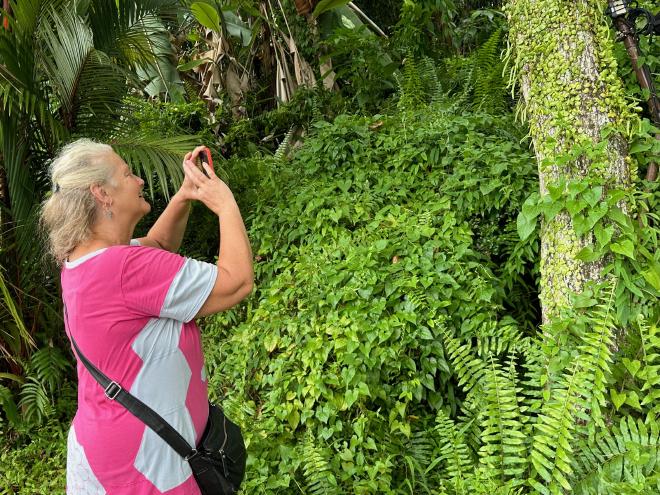
In the botanical gardens there were lots of plants (surprise, surprise), so here’s your regular dose of “picture of Karen taking a picture of a plant”.
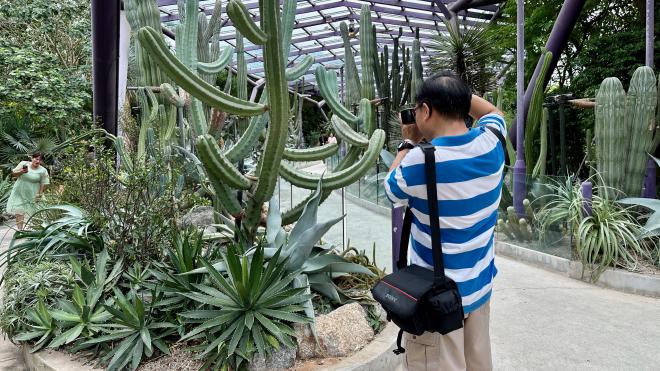
And here’s a picture of Koah Fong taking a picture of a plant, in the desert section of the gardens.
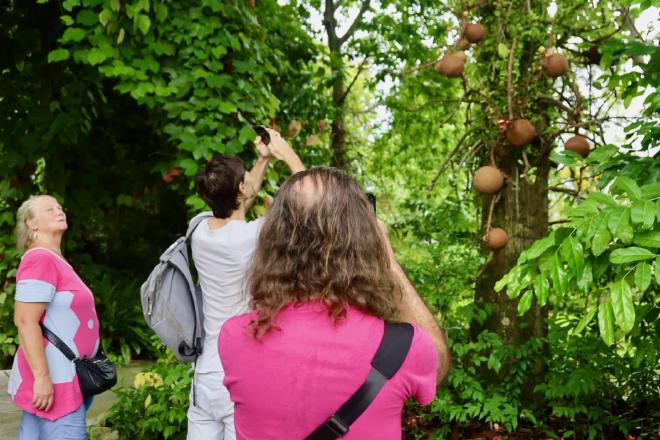
And here’s a picture of Karen watching Greg take a picture of Cyril taking a picture of a plant. This is the aptly-named cannonball tree. (LKF)
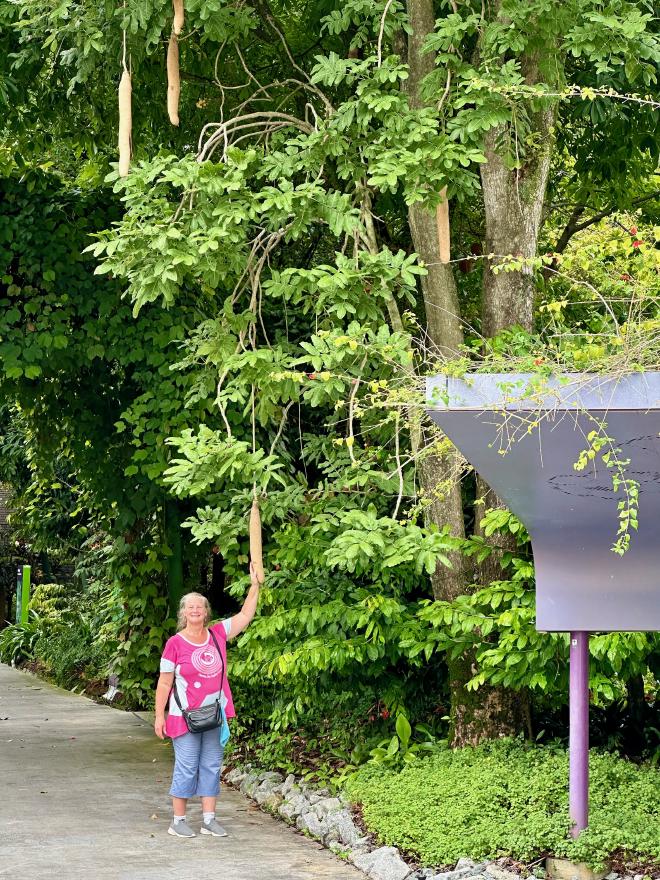
And this is the also aptly-named sausage tree.
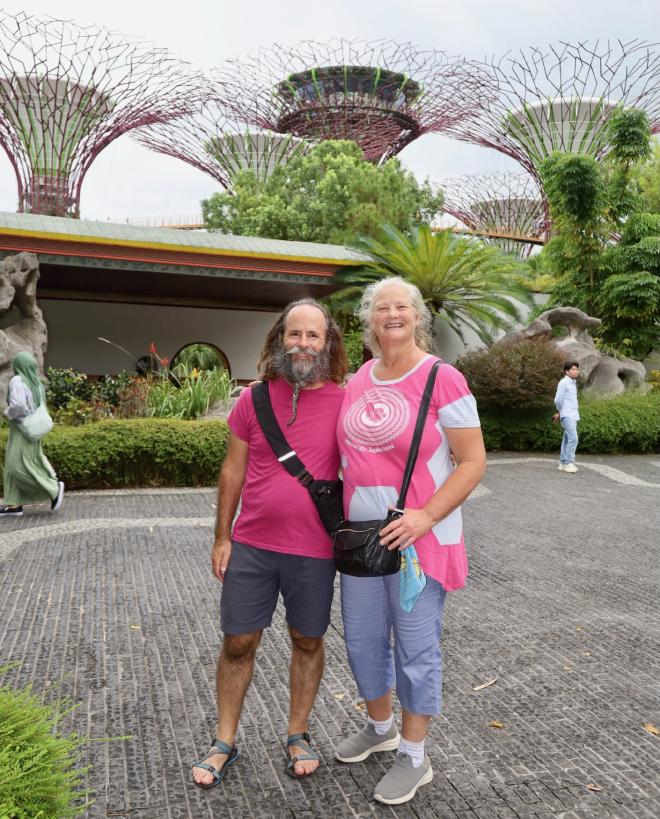
One of the really neat features of the Gardens are its “supertrees”. These are combination solar panels, water collectors, cooling towers, ventilation shafts, and planters. Among other things, they help control the temperature in the Gardens’ greenhouses. At night they’re part of a spectacular light show; unfortunately we had to be back on the ship before dark so we couldn’t see it.
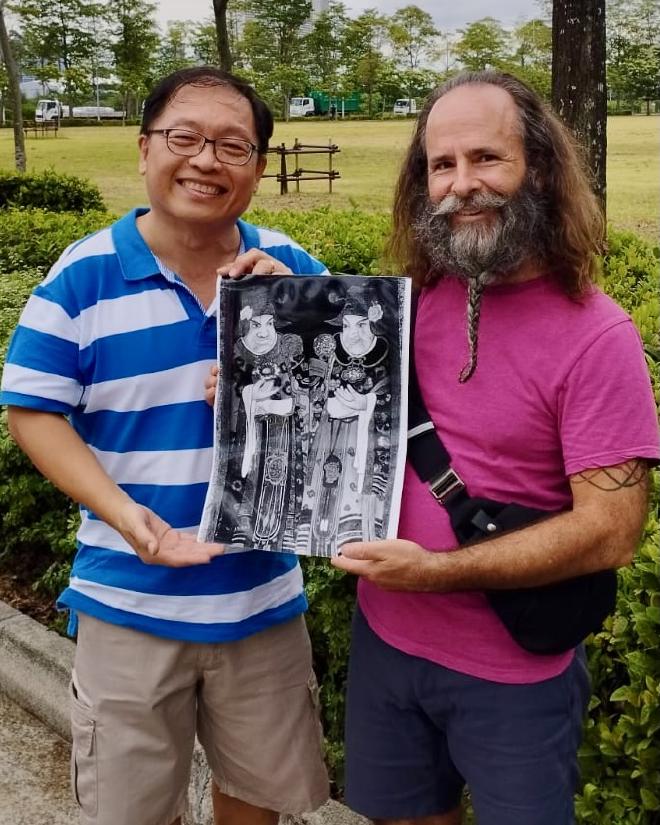
And speaking of back on the ship, that (sadly) was our next destination. Before we left, Koah Fong gave us a packet of a unique Singaporean treat, Irvins Salted Egg Fish Skin. He also gave Greg this photograph, which he took, and printed in a darkroom, about thirty years ago. It shows the two Menshen or Door Guardians on doors at Thian Hock Keng. In this depiction, which has since been painted over (boo!) it appears as though the Guardians are juggling lotus flowers.
We really had a terrific day in Singapore, and can’t thank Chia, Cyril, Di Hong, and especially Koah Fong for such a fun time!
The ship pulled out of harbour as we were having dinner, and we were on our way to Jakarta.