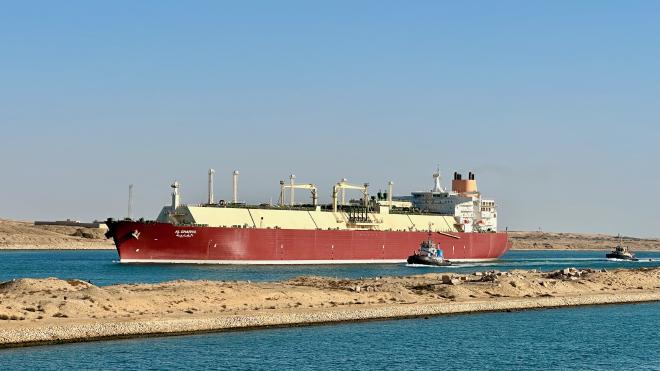
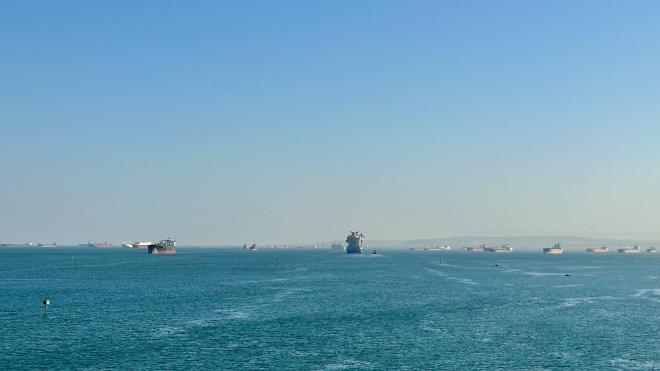
Suez Canal (4 November)

After Heraklion, the next major event on the cruise was transiting the Suez Canal.

The current Canal, dug between 1859 and 1869, is just the most recent of many attempts, going back 4000 years, to connect the Red Sea to the Mediterranean in a way that was useful for shipping.

Unlike the Panama Canal, the Suez traverses relatively flat ground and connects two seas of about equal levels. As a result, it has no locks. This simplified construction of the Canal and speeds transit; however, it has had consequences unforeseen at the time the Canal was planned. Principal among these has been the movement of invasive species in both directions, which has had a particularly detrimental effect on the Mediterranean ecosystem.

Much of the Suez Canal is only wide enough for a single vessel, so traffic has to be tightly controlled. All ships travel in convoys for the transit, normally two southbound and one northbound each day. Each ship has two pilots aboard and is accompanied by tugs. Our convoy formed up in the wee hours of the morning and entered the canal shortly after dawn.
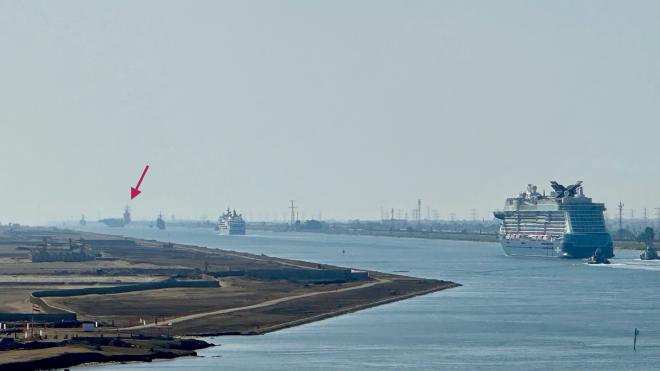
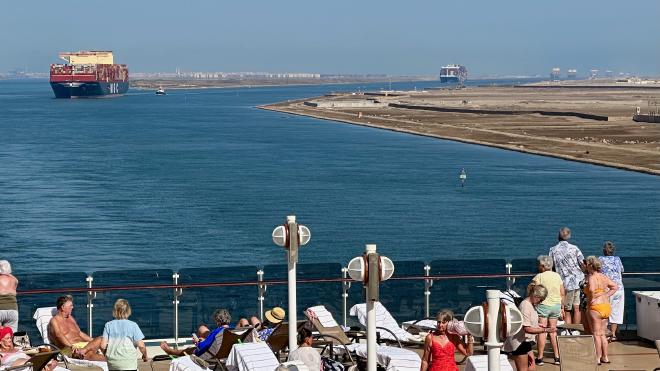
We were sixth in line. Leading the convoy was an American naval task group consisting of two frigates escorting the USS Dwight D. Eisenhower aircraft carrier (indicated by the arrow) which was redeploying from the Mediterranean to the Persian Gulf. The task group was followed by two other cruise ships, then us.

We were able to count at least eight vessels behind us, all container ships. Vessels are spaced according to a ten-minute stopping distance.

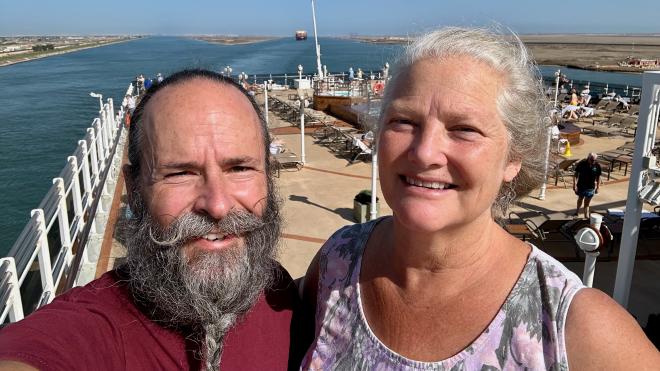
Here we are, transiting the Suez.

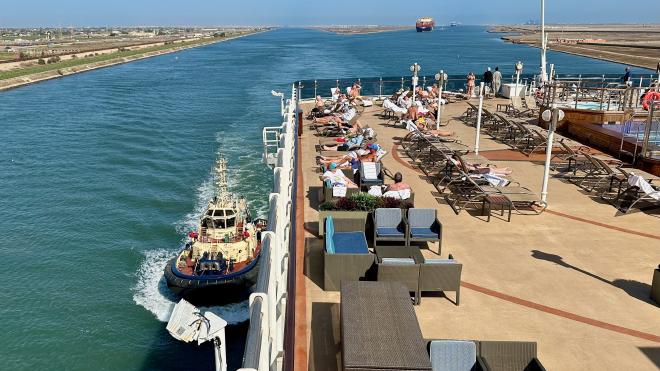
And here is one of our accompanying tugs.

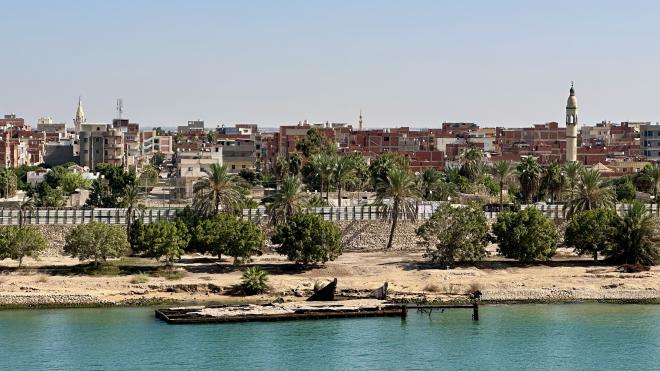
Much of the Canal is lined by desolate desert, but we did pass several fair-sized cities. The wall you can see in the foreground is part of a defensive work that runs almost the entire length of the Canal on its eastern side.

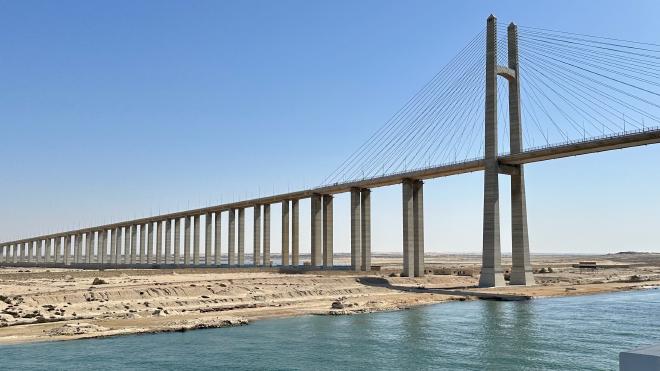
This is the Suez Canal Bridge, also known as the Egyptian–Japanese Friendship Bridge, among other names. It was built with assistance of the Japanese government between 1995 and 2001.

A few parts of the canal have been twinned, allowing bidirectional traffic. The twinning was a controversial move, since it increased water flow and provided greater opportunity for the movement of invasive species between the two Seas.

Towards the southern end of the Canal is the Great Bitter Lake. Before the Canal was constructed, this was a salt basin. Now it is a relatively deep lake, used as a staging area for traffic control. After the Six Day War in 1967 a number of ships were trapped in the Great Bitter Lake, waiting for the Egyptians to give them permission to move. Known as the Yellow Fleet, they remained on the Lake until 1975. Greg’s favourite podcast, 99 Percent Invisible has a terrific episode about the sailors who were trapped and how they spent their time.

We completed the transit in the evening and began sailing south through the Red Sea towards the Egyptian port of Safaga.