We had visited Venice, Naples, and Rome with our then-teenage kids back in 2009 when we were living in Toulouse on Greg’s first sabbatical. For this trip to Italy we decided to focus on the north-east. Greg had been to a conference in Bologna in 1994 and had fond memories of the food there, ’though he hadn’t been able to see much of the city because the conference program was jam-packed, so that was our first stop.
After the slow trains in Romania and Turkey (excepting the high-speed from Istanbul to Ankara) it was nice to be back in a land of reliable, high-speed trains. We covered the 670 kilometre distance from Bari to Bologna very comfortably and in just under six hours.
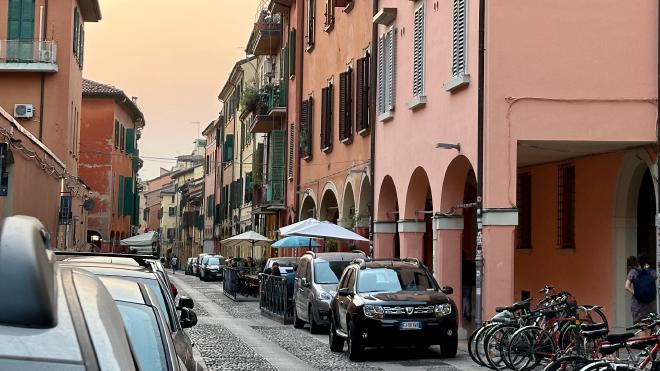
From the Bologna train station we took a bus south into the old city, then walked the rest of the way to our AirBnB. This was our street. As you can see, porticoes are a distinctive feature of Bologna architecture, and they’re most welcome on hot sunny days or when it rains.
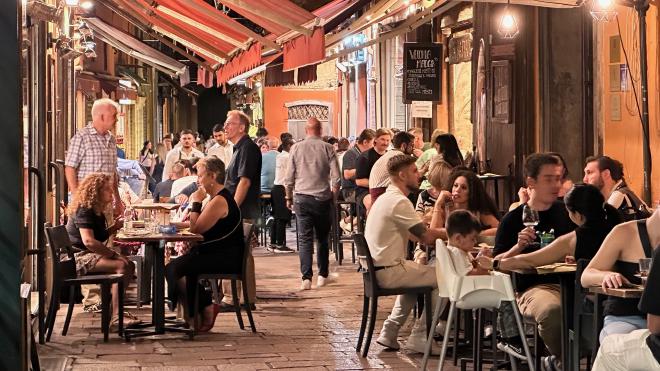
After settling in to our apartment we walked to an area called the Quadrilatero, which is just east of Piazza Maggiore, Bologna’s main square. The Quadrilatero is full of shops, bars and restaurants and really comes alive in the evenings.
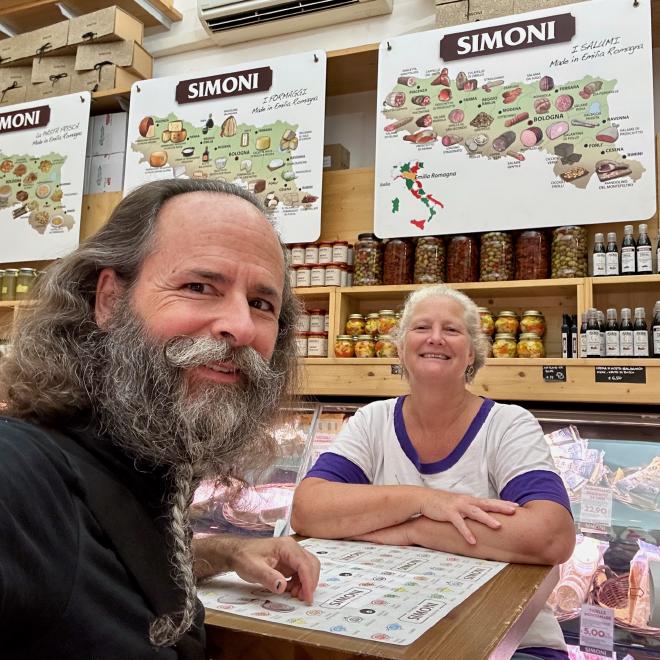
Based on a recommendation from a food blog that Greg had found, we headed to Salumeria Simoni to take our first meal. Simoni is a combination factory, delicatessen and restaurant, featuring its own products plus others from around Emilia Romagna, the province in which Bologna is found. Food culture in Italy is very regional, with each province, city and town having its own specialties.
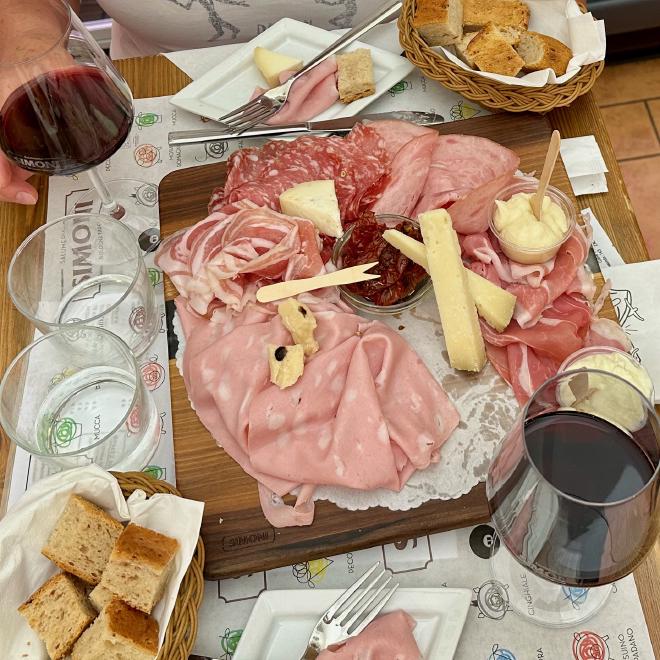
This was listed on the menu as a “large appetizer platter for two” but it seemed like a meal to us. The platter featured a selection of meats and cheeses from around the region, highlighting Bologna’s and Simoni’s specialty, mortadella, at the lower left of the photo. Mortadella is the progenitor of the luncheon meat commonly known as bologna or baloney in North America – except that real mortadella is rich, savoury and delicious.
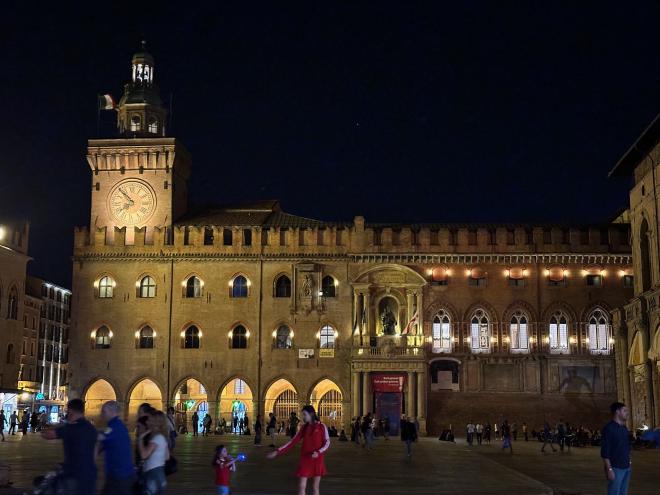
We walked back through the Piazza Maggiore, which was bustling on a Monday night.
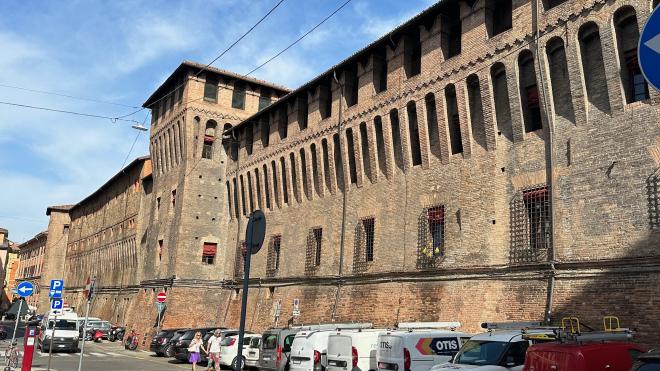
The next morning we retraced our steps back to the Piazza Maggiore before heading south on an extended walk through the city. Most medieval public buildings in Bologna look like fortresses. This is the Palazzo d’Accursio, which started out as the home of the jurist Accursius in the 13th century and was expanded to include a number of civic offices. It is now the town hall of Bologna and houses an art museum. This is the south wall of the building; the east wall, which looks much more welcoming, is in the previous picture.
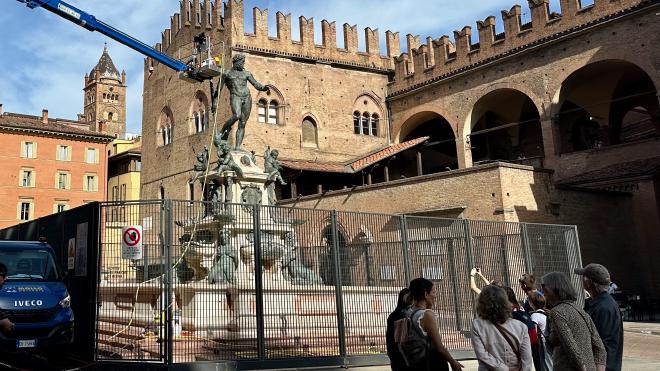
There’s a famous statue of Neptune in the Piazza. When we visited he was being washed; I guess even gods need a bath from time to time.
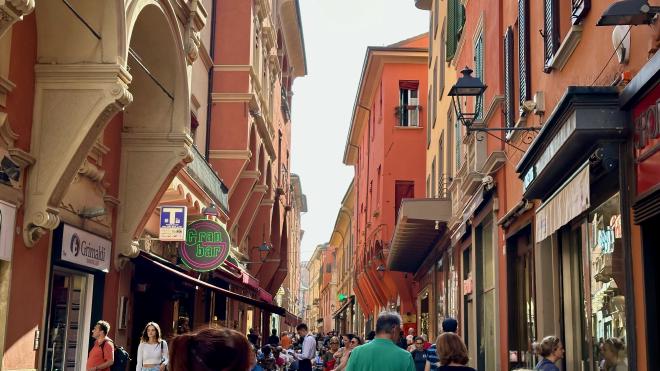
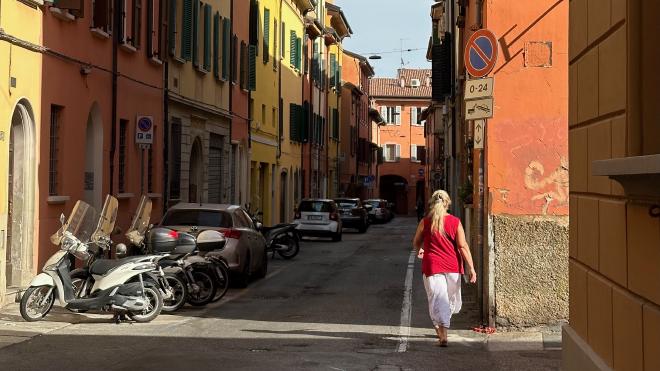
Where it isn’t exposed brick, the old centre of Bologna is mostly painted in orange and yellow tones. Many of the buildings jut out over the street from the second story up, making the streets feel even narrower than they really are.
Even outside the touristy area, the orange and yellow colour scheme continues.
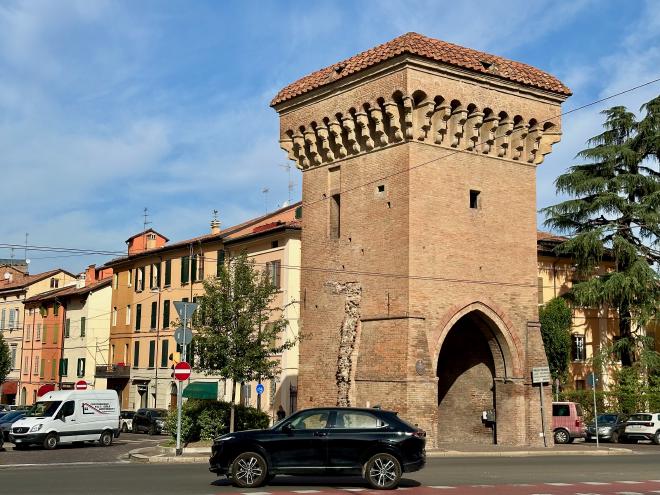
At the south east edge of the old city is Porta Castiglione, built in the late 13th century, one of the remaining gates that once anchored the medieval city’s long-gone fortifications.
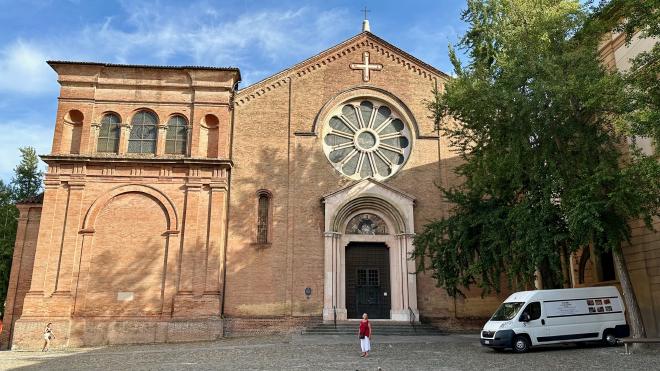
Basilica di San Domenico was constructed between 1228 and 1240, then modernized 1728-32. Like other Bolognese buildings of the era, it has an austere, fortress-like exterior.
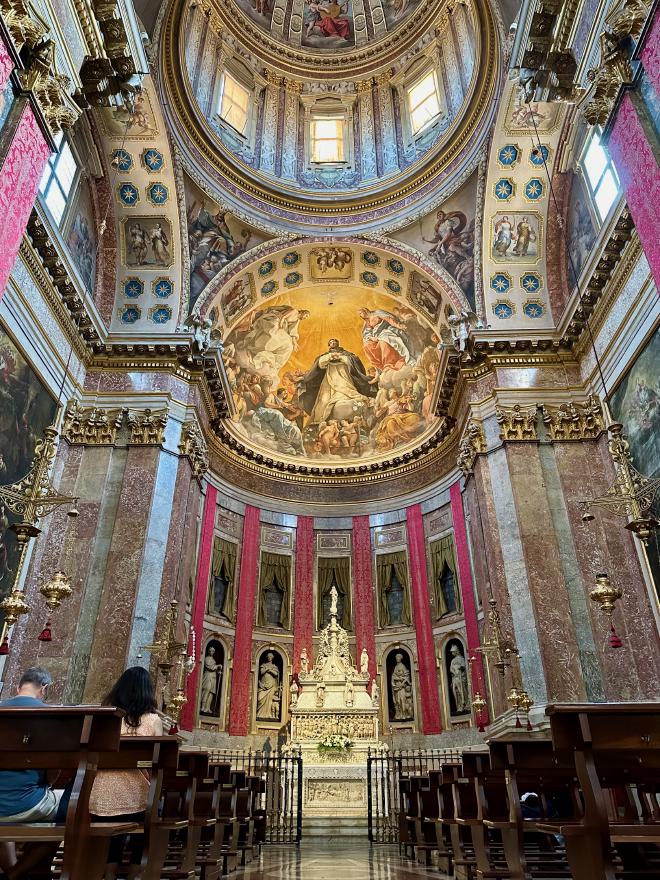
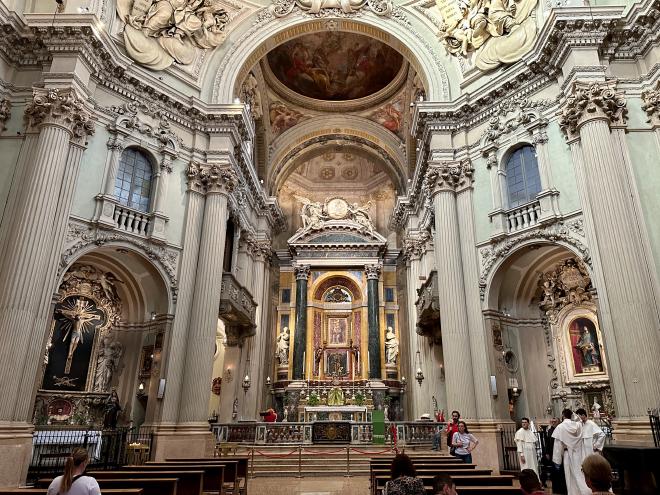
The interior is another matter, being richly decorated in baroque style, with many beautiful Renaissance frescoes.
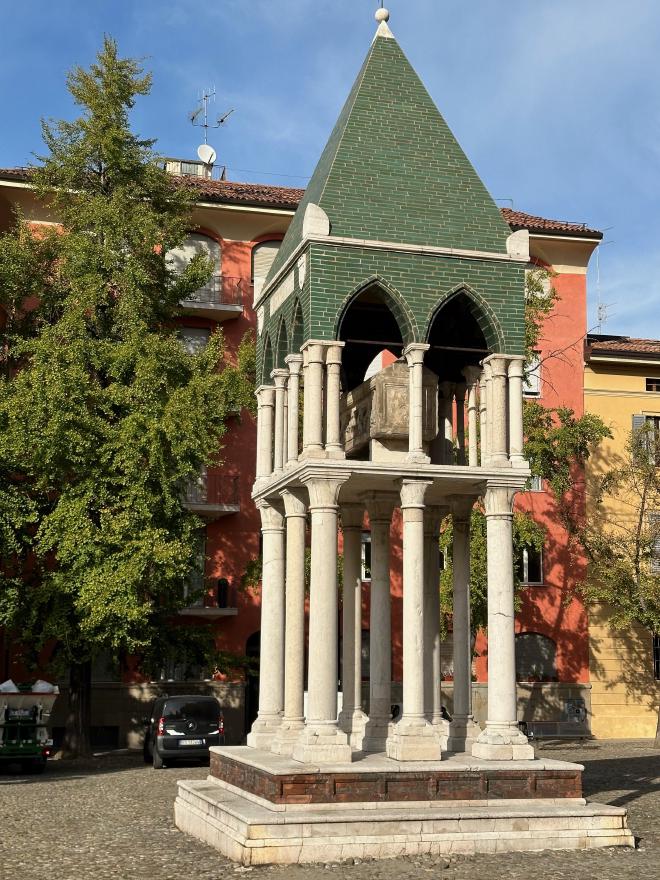
The elevated tomb of Rolandino de’ Passeggeri is in the courtyard of the Basilica. We found several other examples of elevated tombs at churches around Bologna.
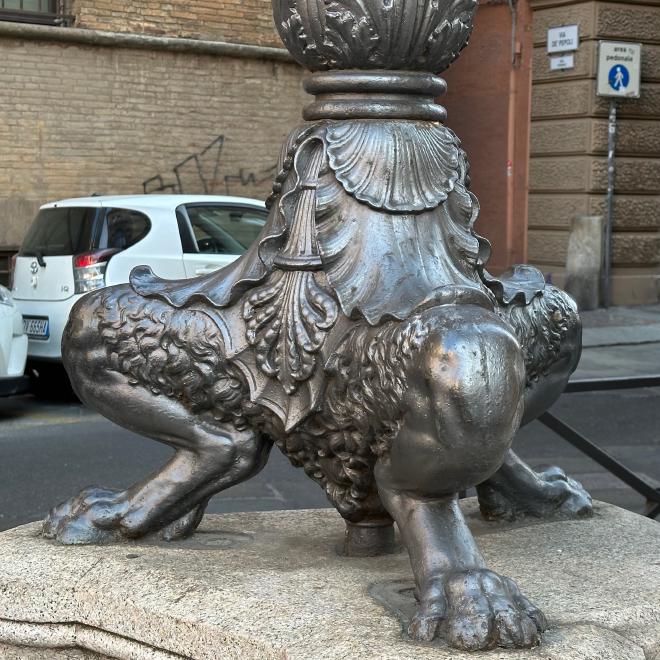
This whimsical light post in the old city caught our fancy.
We had managed to book a (free!) tour of the old library at the University of Bologna on the Wednesday afternoon. Since the University is in the north east of the old city, which we hadn’t visited yet, we decided to make that the anchor of a walking tour.
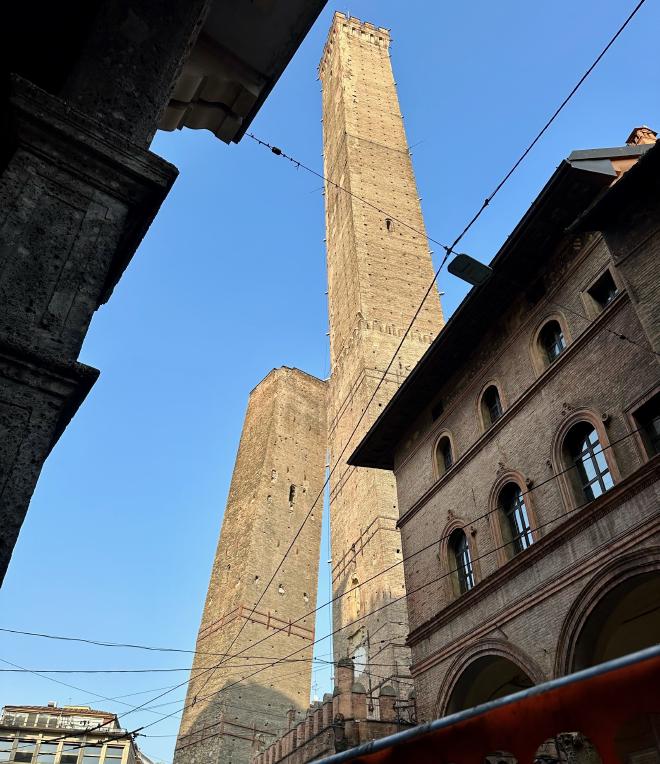
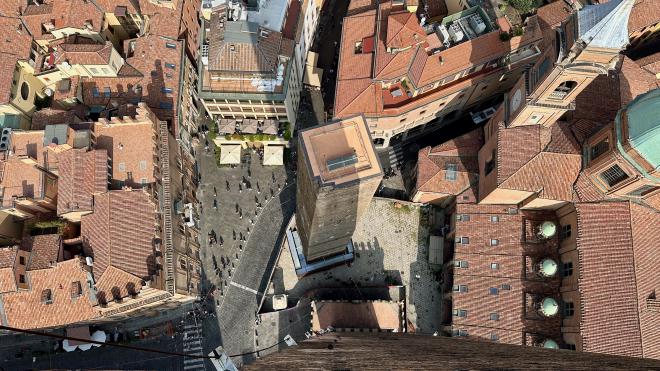
On the way to the University we visited Bologna’s Torre degli Asinelli and Torre Garisenda, two of the twenty-four medieval towers remaining in the city’s core. Once, there were approximately one hundred towers in Bologna, each constructed as an urban fortress and to advertise the wealth and power of the family that owned it. The shorter tower is Torre Garisenda, constructed between 1109 and 1119. As you can see, it has a pronounced lean, currently about four degrees, due to subsidence of the soil during construction. It was originally sixty metres tall, but was reduced to its current forty-seven metres for safety reasons. (The famous Leaning Tower of Pisa is just a few metres taller than Torre Garisenda and leans slightly less, 3.9º.)
The taller tower, Torre degli Asinelli, is open to the public and has a viewing platform. It was also constructed between 1109 and 1119, and it also leans, but “only” about 1.3º. Getting to the top is a strictly climb-it-yourself affair.
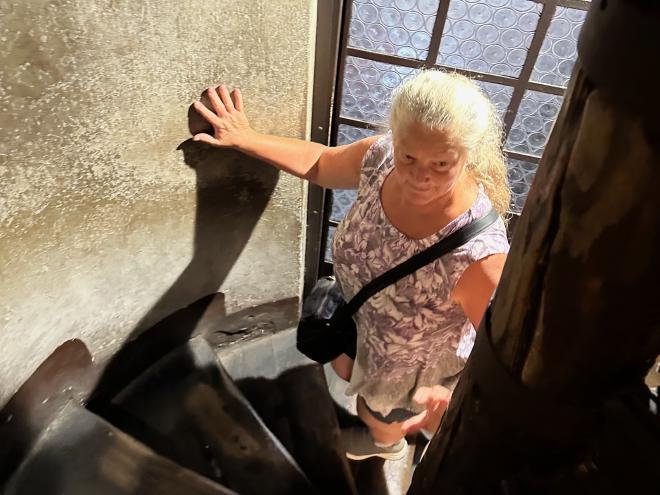
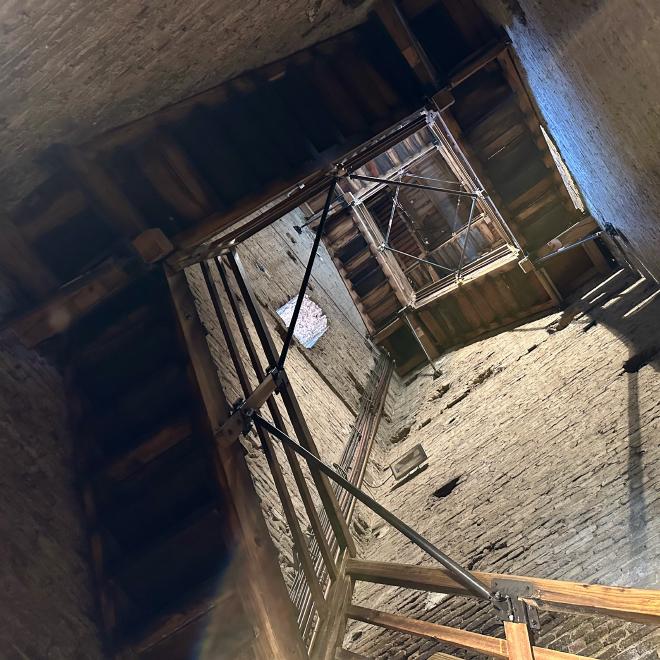
And climb we did, all 498 steps and just under 97 metres. You can see the holes in the wall that would once have supported beams, dividing the tower into many floors and providing living, working, and storage space for the family Asinelli.
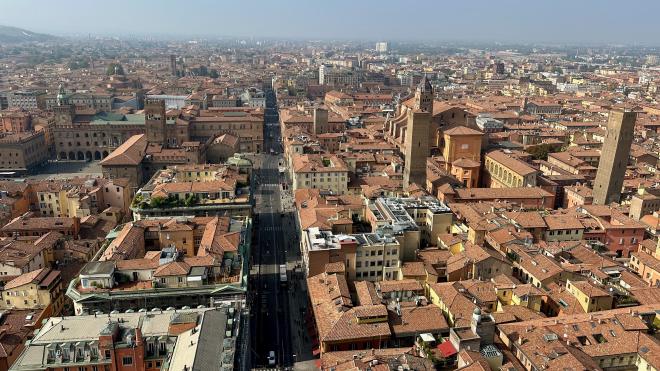
The view from the top was more than worth the ticket and the climb. In this shot you can see three of the other remaining urban fortress towers. The Piazza Maggiore is at the upper left.
This is the view straight down to the top of the Torre Garisenda.
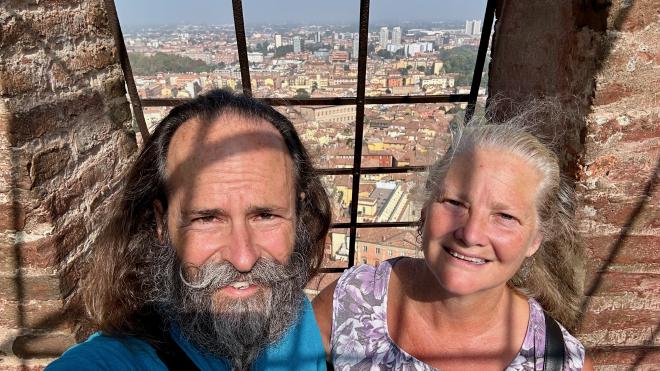
And here’s us on the tower, with some of the more modern parts of Bologna in the distance.
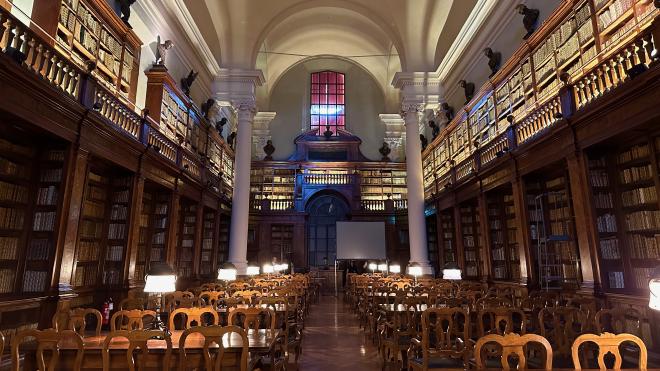
As we mentioned, we’d booked a tour to visit the library of the the University of Bologna. Bologna is the oldest university in continuous operation in the world, having been founded in 1088. This is the Great Hall of the Biblioteca Universitaria di Bologna in the Palazzo Poggi, which opened in 1756.
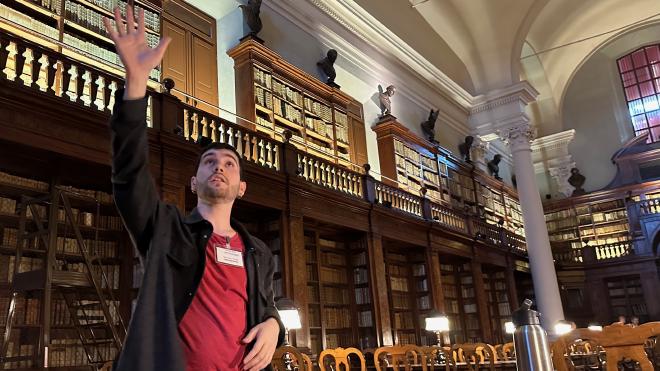
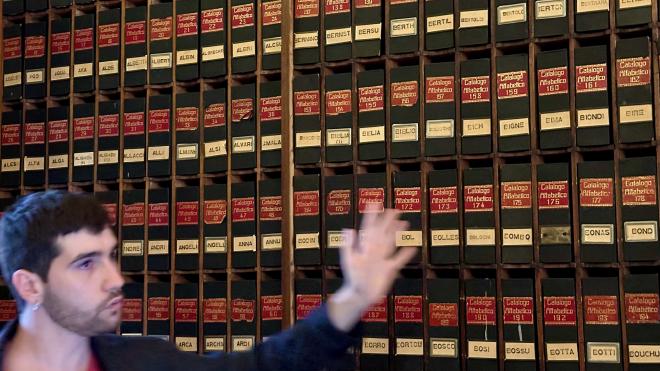
Our guide was Nikolaos, a student from Athens pursuing a Masters in Art History at the University. He acts as a tour guide on a part time basis to help fund his studies, and was very knowledgeable about the library and clearly enjoying himself.
The library is organized thematically, with, e.g., “Historia Italica” (Italian History) all shelved together, books in order from oldest to newest. This is reasonably good for browsing, but not so good for systematically finding something. So, like any good library, this one has an alphabetical catalog.
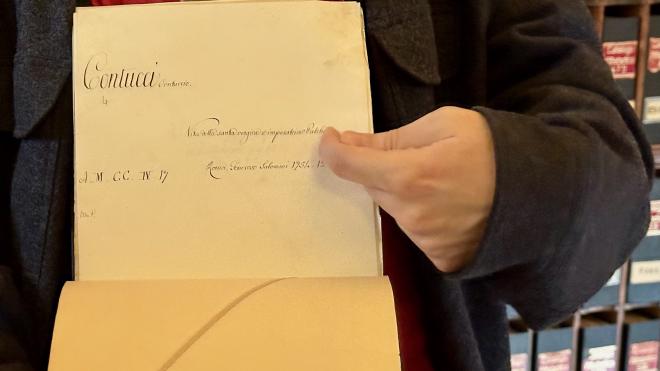
Compiling the catalog was the life’s work of one man, who allegedly went blind in the process. This is an example catalog entry.
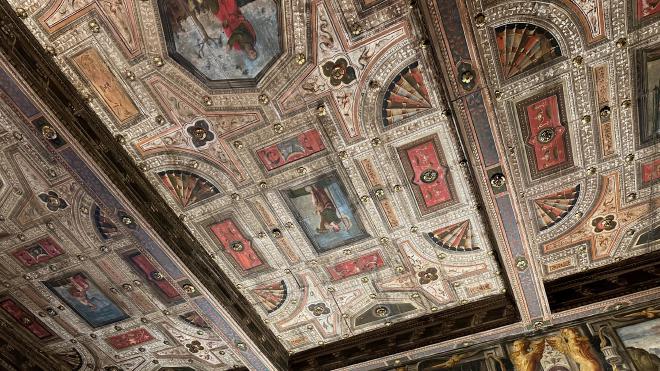
The entire library is richly decorated. This is the ceiling of the catalog room, the Sala of David.
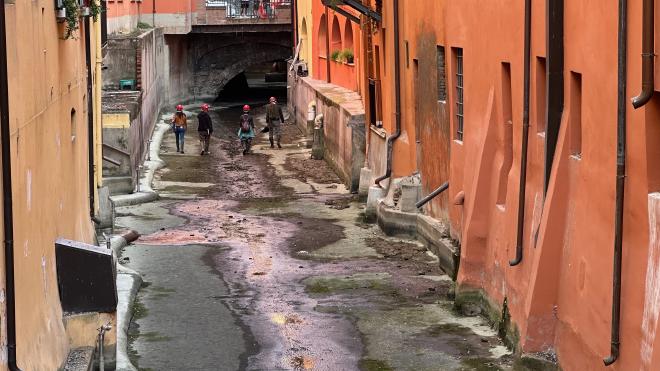
We walked north from the University through the old city. Bologna once had an extensive canal system, dating from the twelfth century. Most of the canals have long since been filled in and converted to roads, but a couple of them still remain, partly hidden between rows of buildings. During our visit they had both been drained, and it looked like teams of civil engineers were conducting inspections.
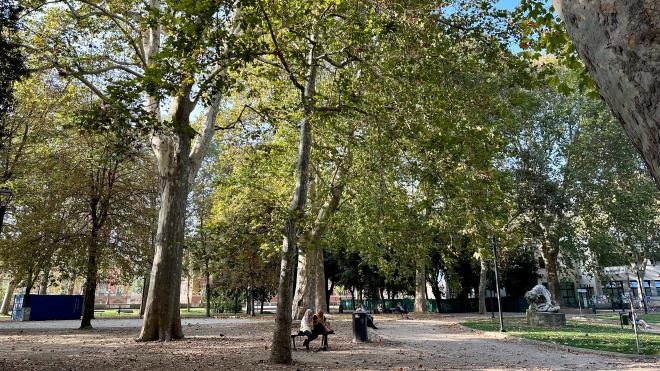
Just to the north of the old city is Parco della Montagnola, which is pleasantly shaded by plane trees, some of which date from the Napoleonic era.
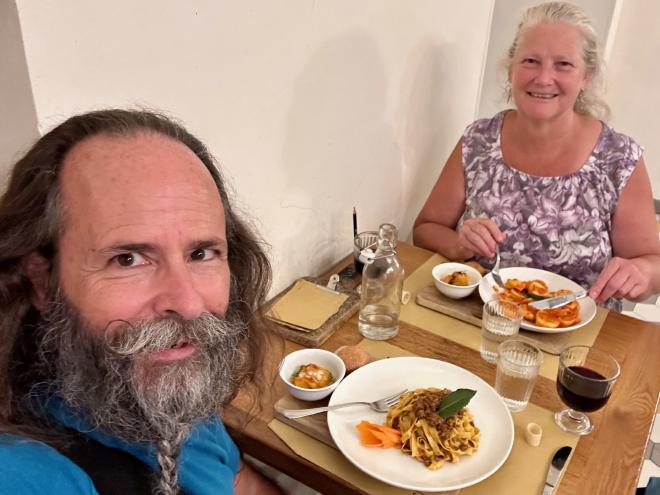
We walked back to the Quadrilatero for an early (by Italian standards) dinner. The same blog that had recommended Simoni for meats and cheeses had recommended Sfoglia Rina as one of the best places for pasta in Bologna, a recommendation we were happy to take.
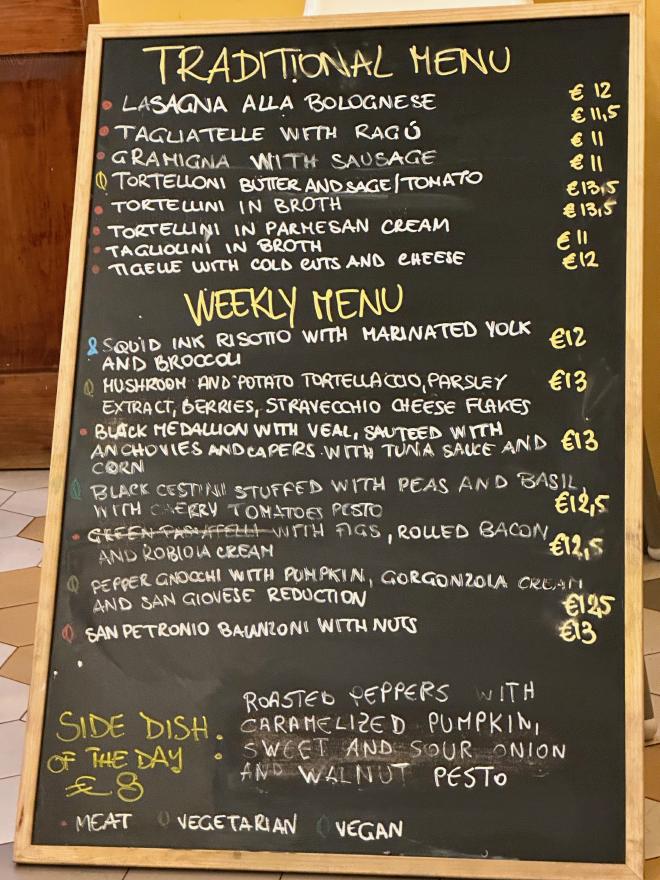
Surprisingly, pasta Bolognese is not considered the quintessential local dish. Instead, that honour goes to tagliatelli with ragú, which is what Greg had. Karen had the tortelloni with butter, sage and tomato. Of course, we shared with each other, and both dishes were excellent. We also split the side dish of the day (see the previous photo), which didn’t arrive until later.
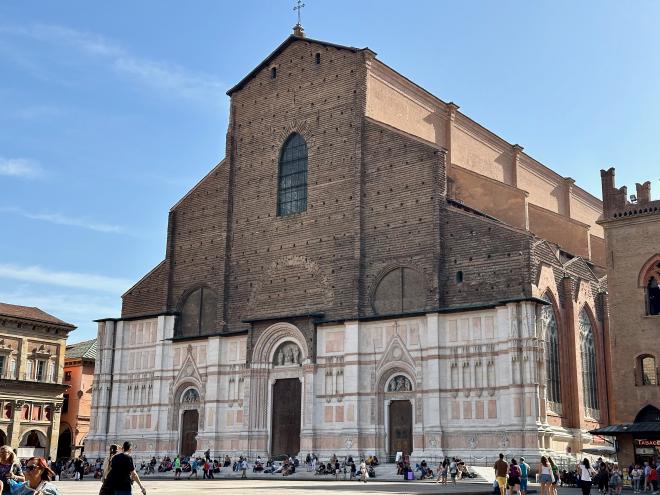
We walked back to the apartment via the Piazza Maggiore. On the south side of the Piazza is the Basilica di San Petronio, famous for its unfinished façade. The story is that part-way through the Basilica’s construction the marble originally intended to cover it was be redirected to another project. Construction of the Basilica started in 1390 and it was declared “finished” (less the façade) in 1663.
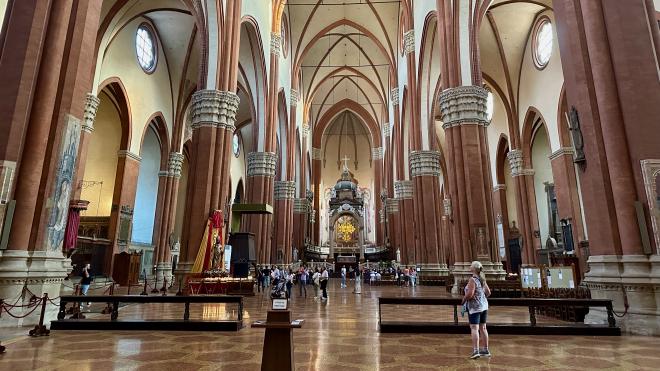
Previously, when we’d walked past the Basilica, it had been closed (as in the previous picture, which was taken the day before). This time it was open, so we joined the queue to visit. We were glad we had; the interior is an enormous, breath-taking space, simply but beautifully decorated.
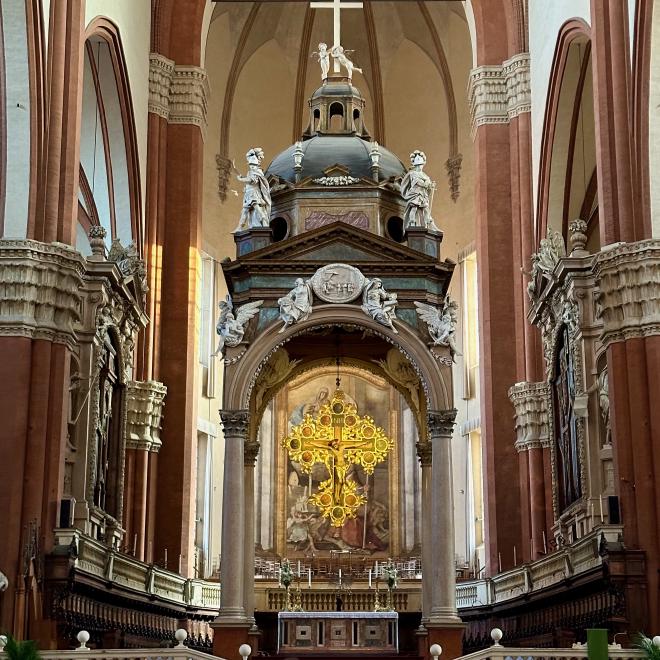
Here’s a closer view of the main altar.
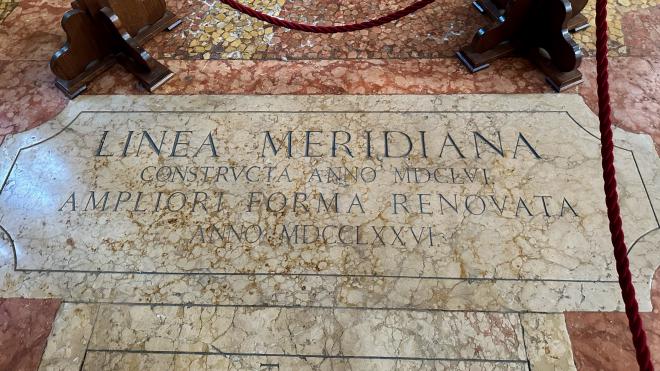
The Basilica houses Cassini’s Meridian Line, installed in 1655. Sunlight enters through a small hole located in the church wall, and at exactly noon every day projects onto the line, allowing the elevation of the sun to be precisely calculated.
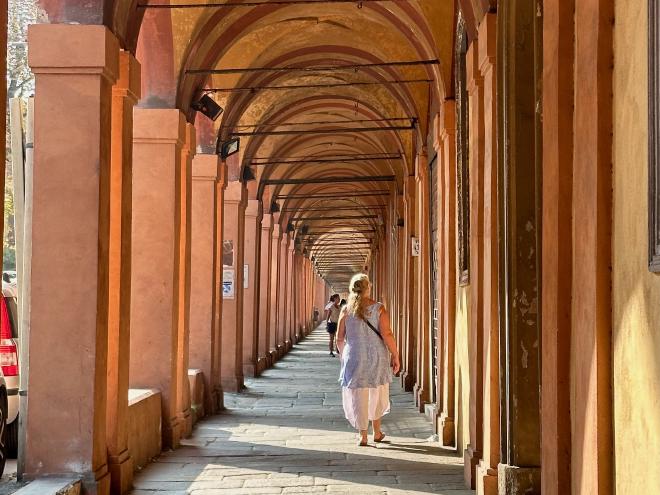
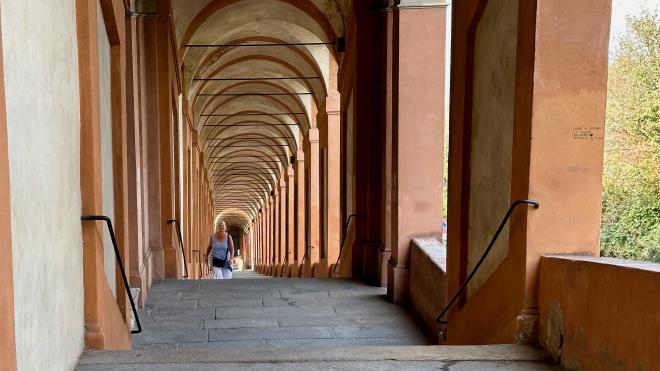
For our last day in Bologna we decided to walk the longest covered portico in the world, the Portico di San Luca, almost five kilometres long.
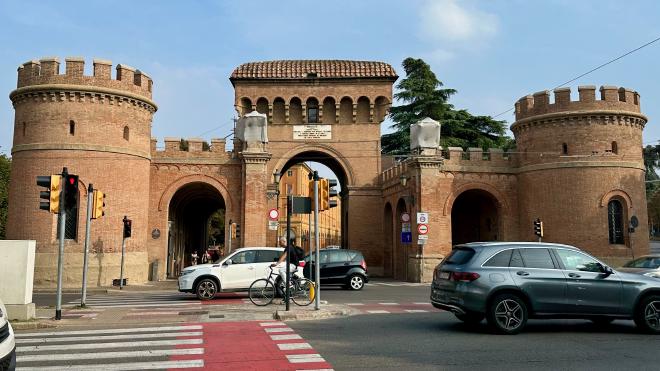
The portico starts at the south west corner of the old city, across from the Porta Saragozza.
It runs westwards for about one and a half kilometres on the north side of the street…
… then turns south, crossing the street in an overpass through the Meloncello Arch, and continuing up the side of a hill for another two and a half kilometres with about two hundred metres of climb.
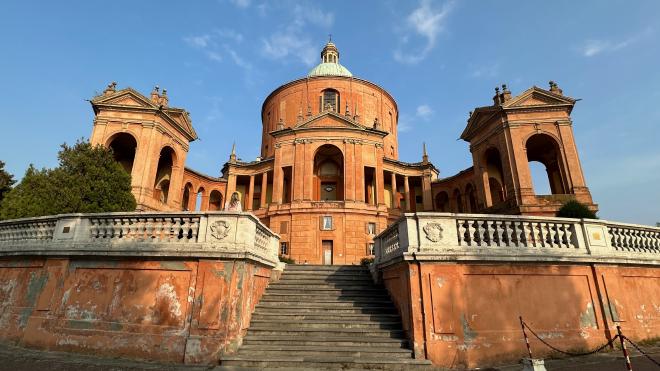
The portico’s destination is the Santuario della Beata Vergine di San Luca. Unfortunately, our arrival coincided with a religious service, so we just took a discreet peek inside and no photographs of the interior.
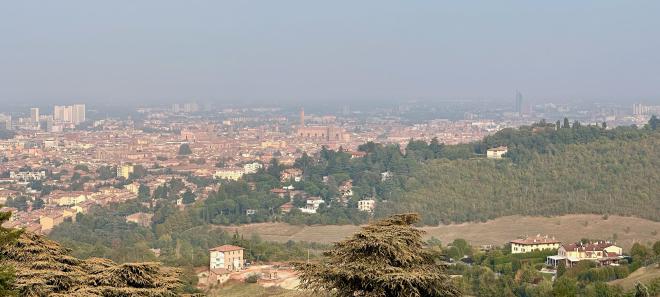
The view of the city from the hilltop was lovely, despite the haze.
We walked back down and into the old city for our final dinner, at an undistinguished and mildly disappointing restaurant in the Quadrilatero. It didn’t help that we were seated outside and pestered every few minutes by street vendors. However, overall we had a wonderful time in Bologna and would definitely return.