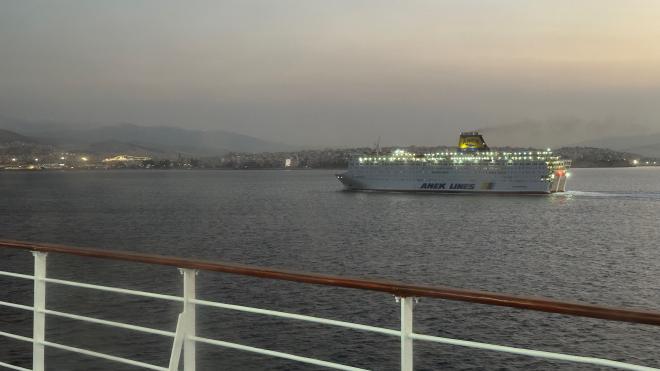
Once aboard the Nissos Samos, service was excellent. We were whisked quickly up to reception where we were issued our keys, then one of the stewards escorted us to our cabin. We’d booked a “deluxe double” for this trip as it was just a few euros more than a regular cabin and gave us a double bed rather than two singles. The room was surprisingly large and came with soft drinks, snacks, and a small case of toiletries which Greg immediately appropriated to store electronics cables. We stood out on deck while the ship was clearing the harbour, then went back to the cabin and slept most of the ten-hour voyage.
We arrived in Piraeus, the port of Athens, around dawn the next day. Piraeus is a large port, not really designed with foot passengers in mind. We’d hoped to be able to walk to the nearby subway stop but there was no safe pedestrian route from the spot we’d docked at. In the end, we took a cab to the subway. Naturally the driver tried to convince us to let him drive us all the way downtown (hard no), and overcharged us for the very short trip.
Fortunately our AirBnB had been empty the night before our arrival and our host was happy to let us check in early. However, we arrived downtown much earlier than we’d expected, even with the delays getting out of the port. So, we stopped for a nice breakfast near the subway station before continuing on the short walk to the apartment.
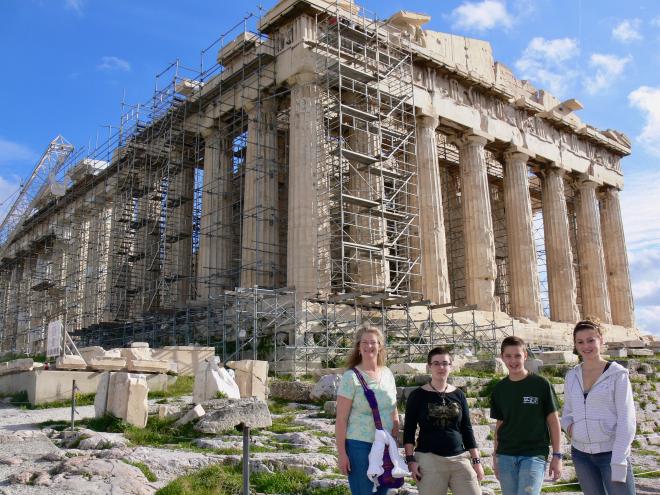
We were in Athens with the kids in December of 2009. Here’s a throwback photo from that visit – apparently we were all younger back then! Since we’d visited the Acropolis where the Parthenon is on that trip, we didn’t feel a burning need for a repeat, and decided to do other things with our two days in the city.
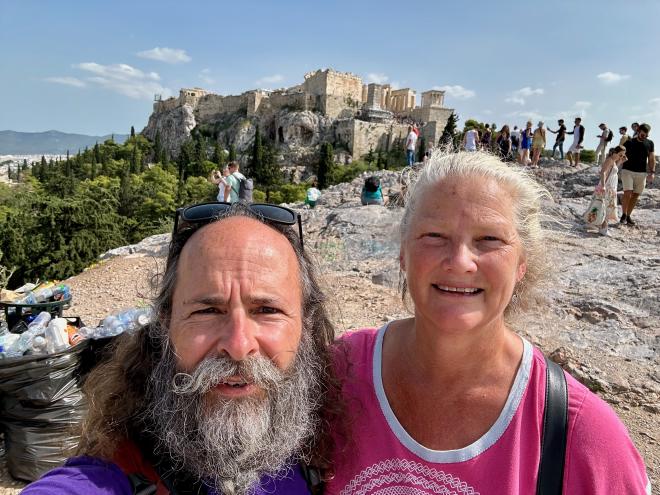
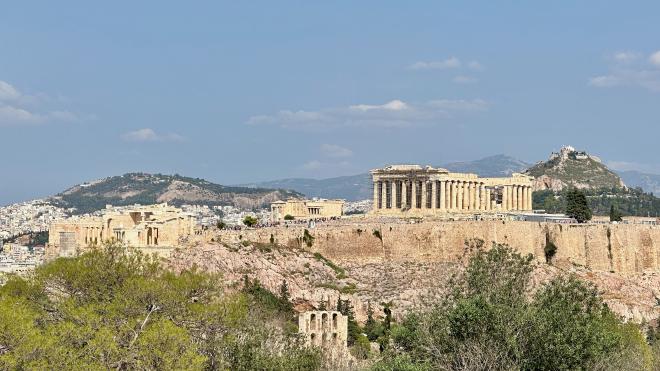
The Acropolis is on one of the main hills in Athens. Just to its west is a smaller hill, the Areopagus, which has been variously a cemetery, a residential neighbourhood, and the site of the Church of St. Dionysios the Areopagite, which was built in the mid-16th century and destroyed by an earthquake in 1601. It offers a fine view of the Acropolis…
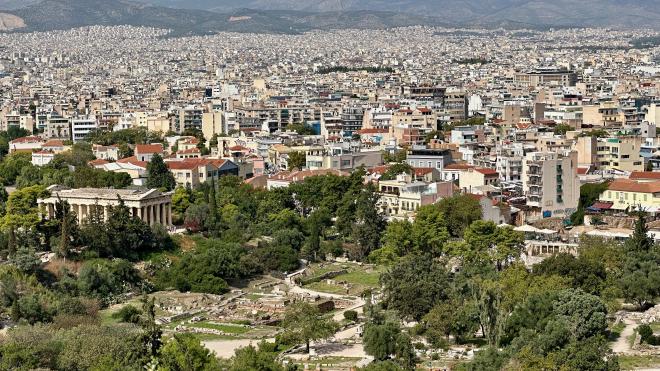
… and also of the northern part of Athens.
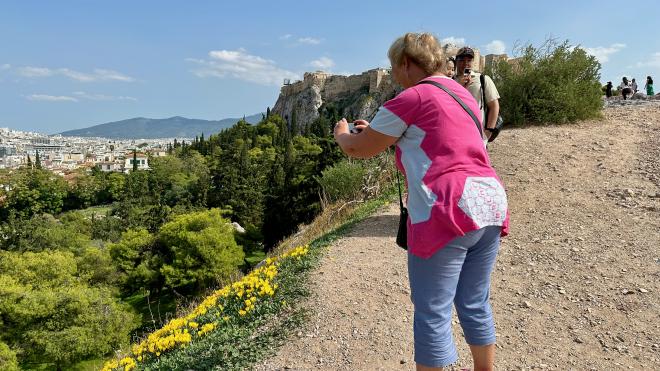
The hill had some nice yellow flowers, so here’s another in our series of pictures of Karen taking pictures of plants.
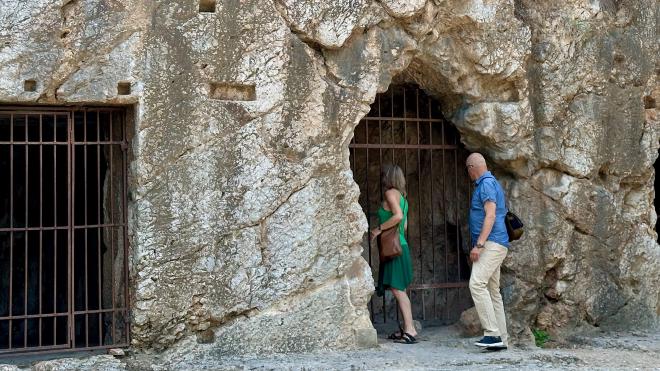
From the Areopagus we continued south, past the Acropolis, to the Hill of the Muses and the Pnyx Hill. On the near side of the Hill of the Muses is the so-called “Prison of Socrates”, ’though it’s considered unlikely this is the actual spot where he was held captive. During World War II these caves were used to store antiquities for safe-keeping, with the cave mouths being concreted shut.
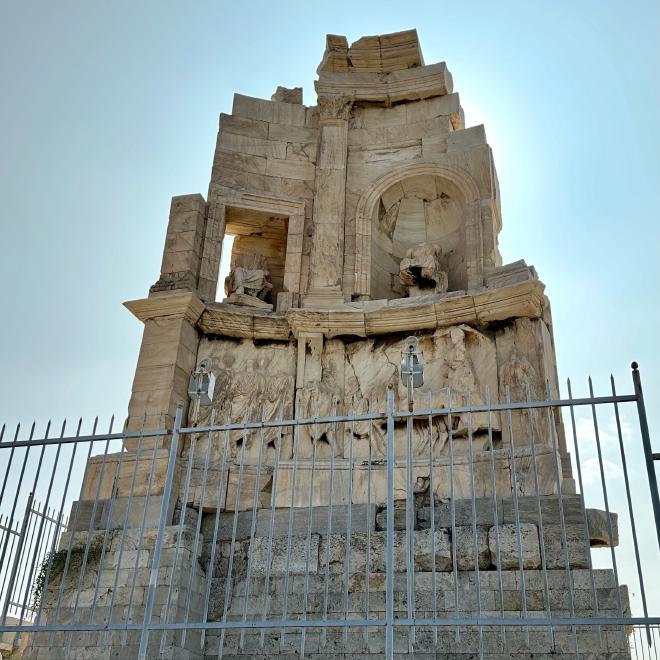
Near the top of the the Hill of the Muses is the twelve metre high Philopappos Monument, constructed in the 2nd century AD and partially restored in 1904.
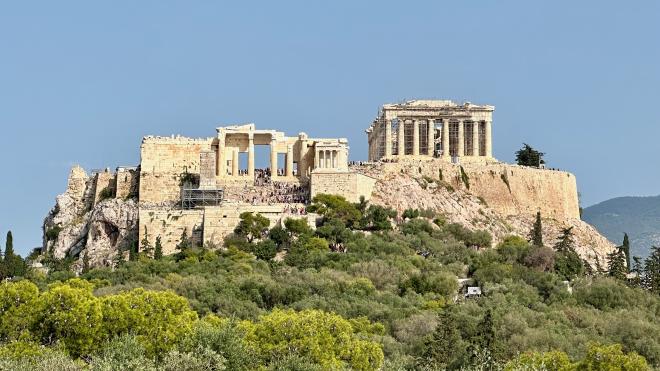
The Hill of the Muses offers one of the best views of the Acropolis.
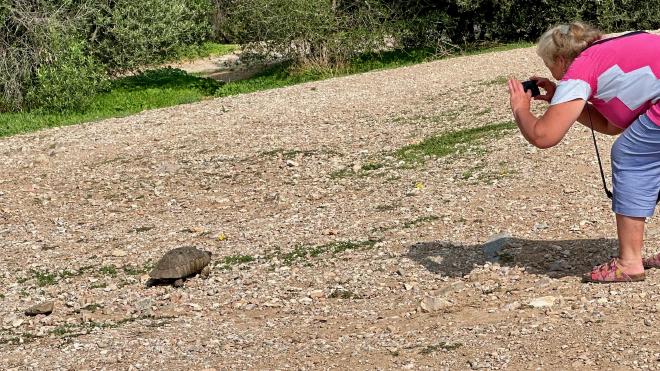
Near the Philopappos Monument we came across this Athenian citizen, out for a slow stroll. So, for a change of pace, here’s a picture of Karen taking a picture of a tortoise.
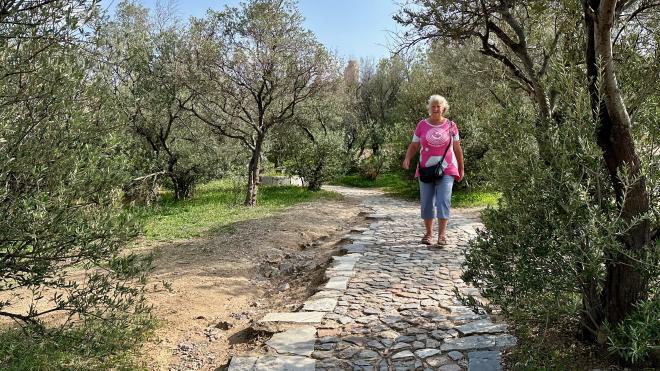
The path down the Hill of the Muses towards the Pnyx Hill is partly built on the route of an ancient fortification wall. It was nicely lined by olive trees, whose shade was welcome in the heat.
The Pnyx was the assembly place for the citizens of Athens from about the 6th through the 4th centuries BCE. It’s not much to look at, being mostly an open area near a short cliff, but it does offer yet another excellent view of the Acropolis.
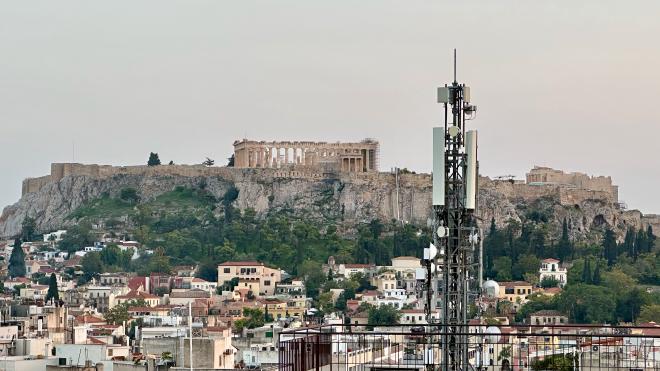
And here’s one last view of the Acropolis, taken from the rooftop balcony of our apartment building.
The next day we decided to visit the Kotsanas Museum of Ancient Greek Technology and the Museum of Ancient Greek Musical Instruments and Toys, which are housed together. We took a circuitous route to get a better sense of Athens and see a few other sights along the way.
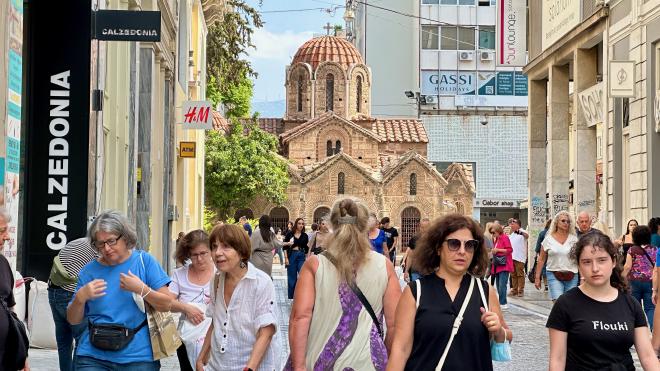
This is the Church of the Panagia Kapnikarea, built about 1050 CE, which is located right in the middle of a major downtown shopping street.
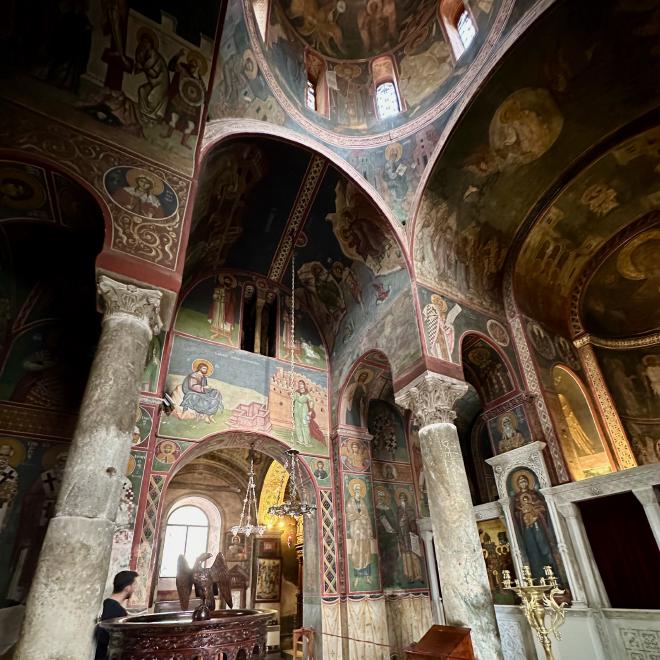
The interior of the church is entirely decorated in frescoes.
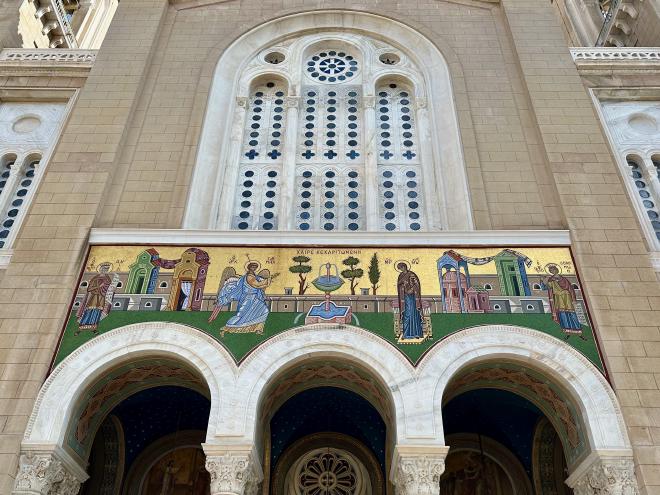
A few blocks further along we came to the much larger Church of Theotokos Gorgoepikoos and Ayios Eleytherios, which features this mosaic above its entrance.
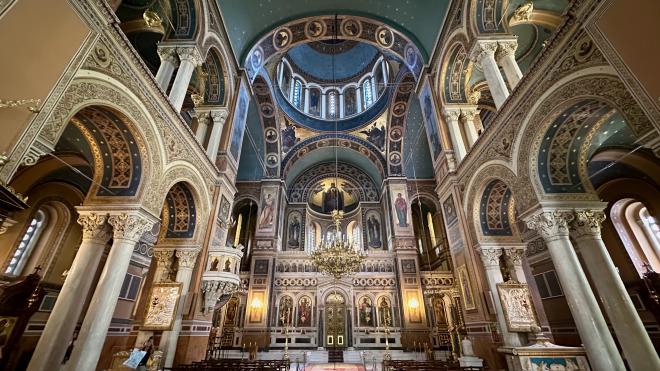
Its interior is richly decorated.
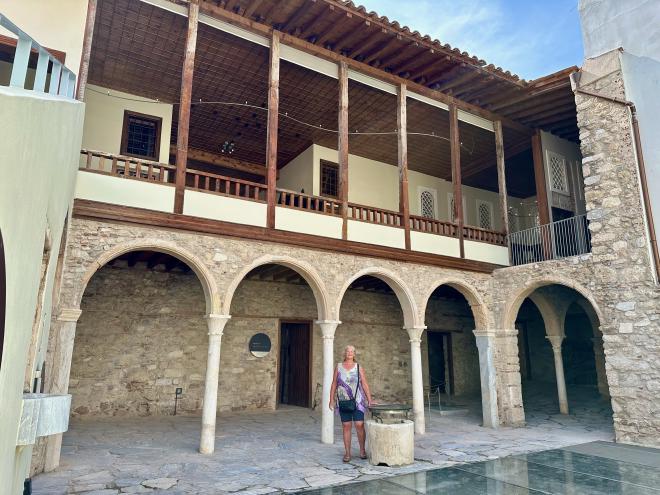
From the churches we went to the Benizelos Mansion, also known as The Oldest House in Athens. This is the oldest remaining example of the konaki or “urban mansion” style of home, common in the Ottoman Empire from the middle of the 17th century. This is the front courtyard. The lower level is mostly storage and utility spaces; the main living quarters are on the upper level.
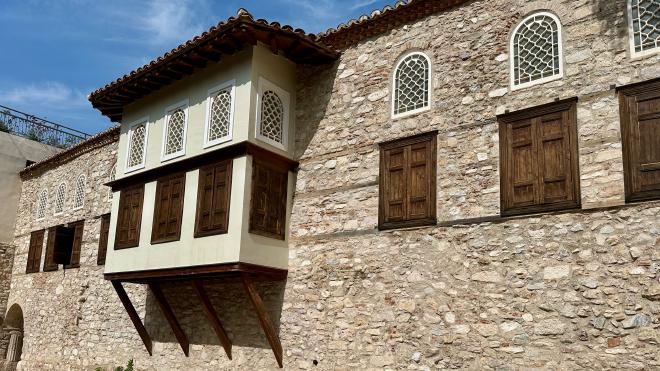
This is the rear of the house.
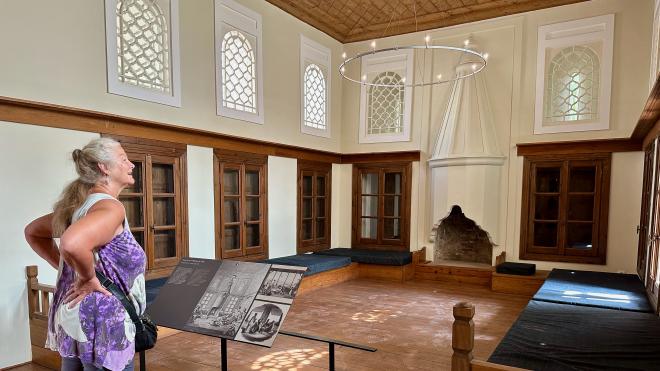
The upper floor of the house featured several spaces similar to this, which could be rearranged throughout the day to meet different needs. Some, like this one, were interior spaces suitable for heating in the winter. Others were shaded exterior spaces, for use in the warmer weather.
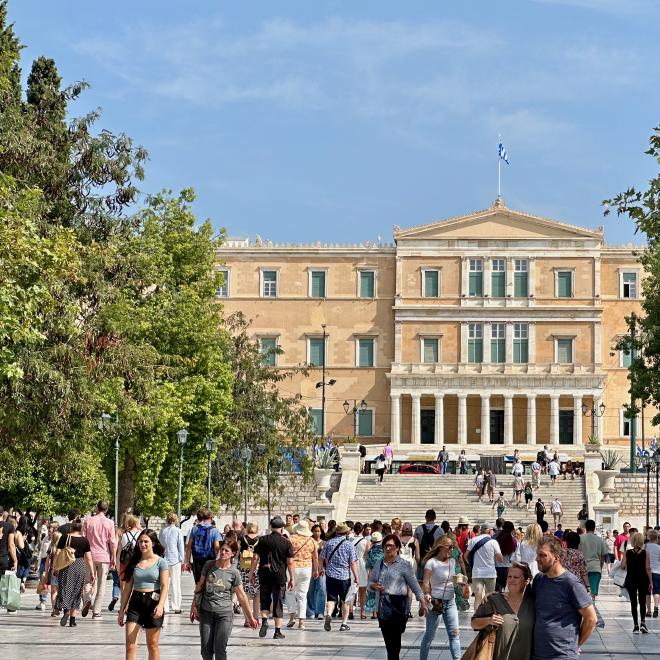
Our route from Benizelos House to the Museum took us past the Hellenic Parliament.
Kotsanas Museum of Ancient Greek Technology and the Museum of Ancient Greek Musical Instruments and Toys were passion projects of Kostas Kotsanas, who established them “to reveal an unknown aspect of ancient Greek civilization and to prove that the technology of the ancient Greeks, just before the end of the ancient Greek world, was extremely similar to the beginning of our modern technology.” The Museums are aimed at both adults and kids, which suited us just fine. Exhibitions from the museums have toured worldwide and Kotsanas has presented scholarly papers on ancient Greek technologies at a number of international conferences. Each item in the museums included citations of the original Greek writing in which the item was described.
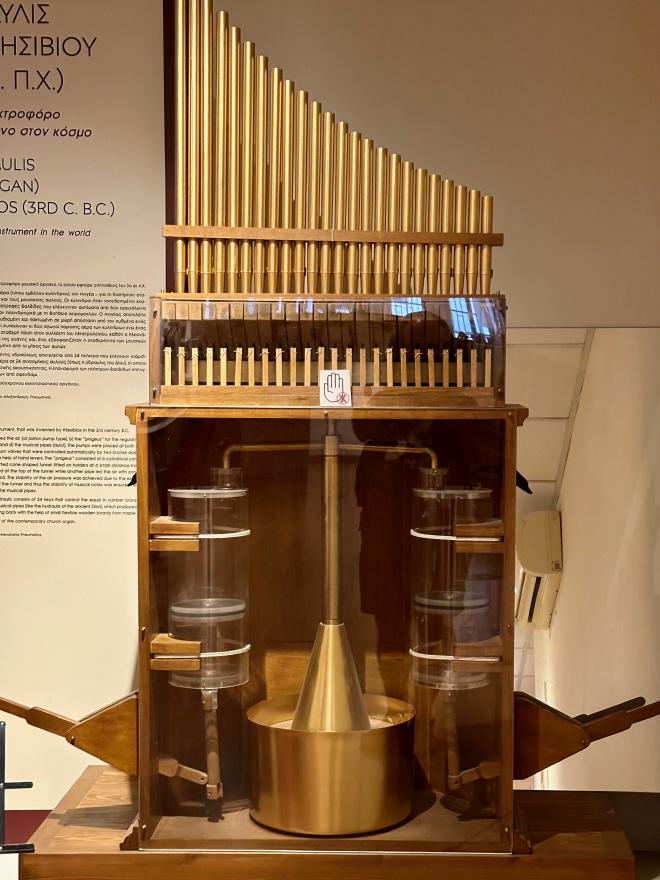
We visited the museum of instruments and toys first. This is a reproduction of the Hydraulis, the first known keyboard instrument, invented by Ktesibios in the 3rd century BCE. It is a precursor of the modern pipe organ that uses a hydraulic system to ensure constant air pressure. In order to play it, two people need to pump the levers on either side of the organ. The museum included a video of the Hydraulis in operation, playing from an ancient Greek score that was allegedly musical. Perhaps something was lost in transcription.
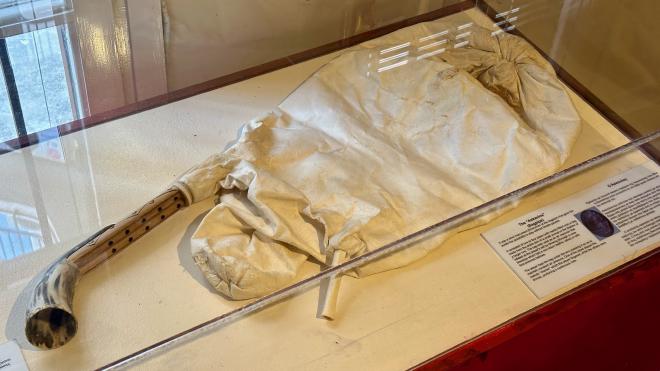
This is the Askaulos, a forerunner of the modern bagpipe. So you don’t have to blame the Scots any more.
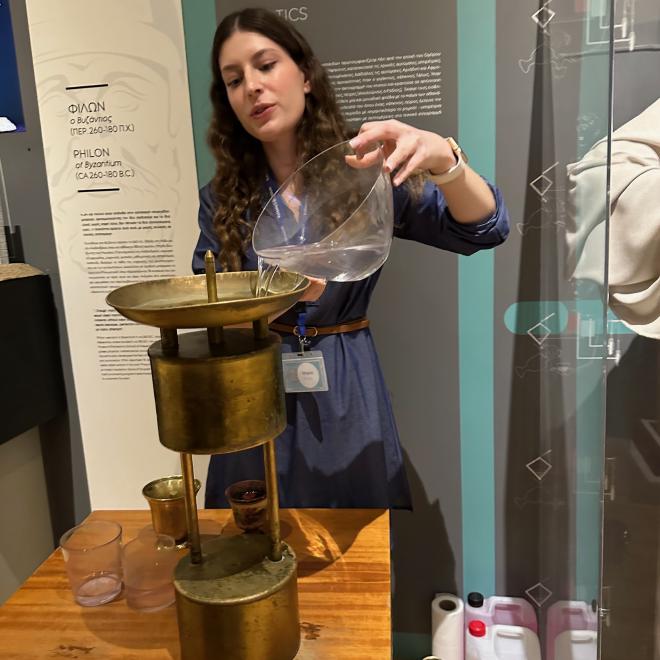
The Museum of Ancient Greek Technology was staffed by an enthusiastic cadre of demonstrators, all of whom seemed to be university students. This is Maria, explaining the oldest known vending machine, which dispensed a small quantity of holy water in return for a five drachma coin.
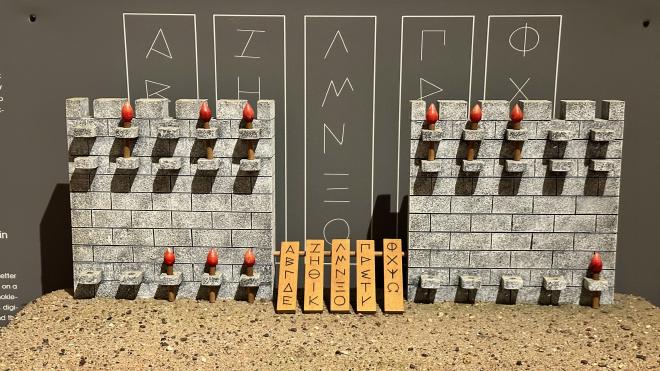
Greg enjoyed this early digital signalling system, dating from the 2nd century BCE. Operators on two adjacent mountain tops would first synchronize by raising and lowering two torches. Then the sending operator would put torches up on each of the two walls. The number of torches on the left-hand wall indicated which letter panel was to be used, and the number of torches on the right signalled which row from that panel. So, for instance, four on the left and three on the right signalled Σ. By repeating this process, arbitrary messages could be sent, albeit slowly.
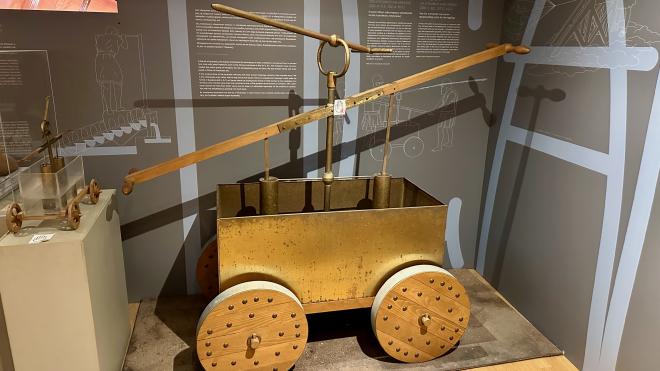
This is a pump from the 3rd century BCE, which had a clever reciprocating mechanism and non-return valves that allowed a continuous stream of water to be sprayed in order to assist putting out fires. There was a small version, shown at left in the photo, that we got to play with.
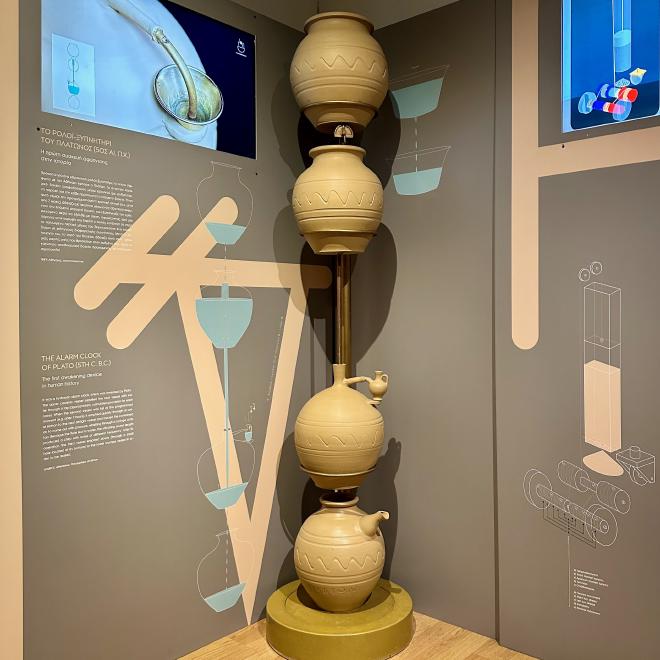
This is Plato’s alarm clock from the 5th century BCE, the oldest known example of an automatic waking device. The top vessel was filled with water, which was allowed to drip slowly into the second vessel at a predetermined rate. When the second vessel filled this triggered an axial siphon that rapidly emptied the water into the third vessel. This vessel was airtight other than a whistle, so that as the water rushed in, air rushed out and the whistle sounded. Maria demonstrated this for us as well and we can guarantee you wouldn’t sleep through the noise.
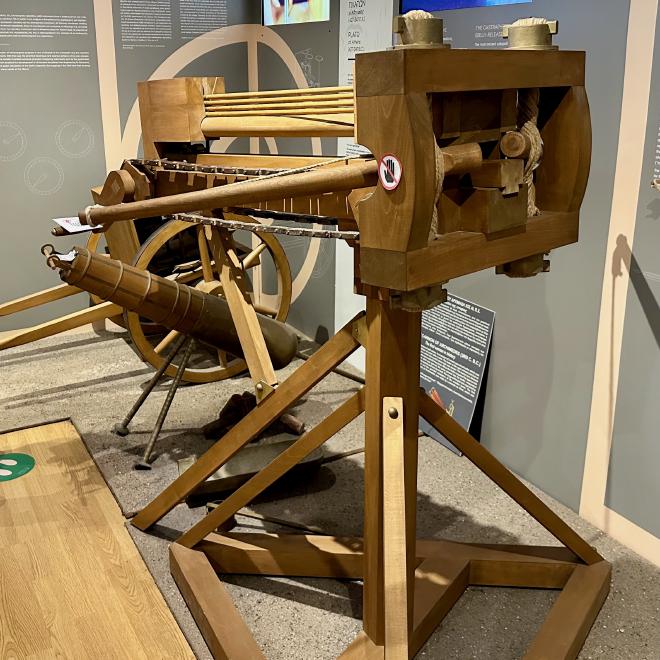
This is a cleverly-designed automatic repeating crossbow from the 3rd century BCE. The operator simply had to crank the handles back and forth to cause the string to be tensioned, an arrow to be slotted on the string, the arrow to fire, and the process to begin anew. Whether this was actually more effective than a traditional crossbow is left as an exercise for the student.
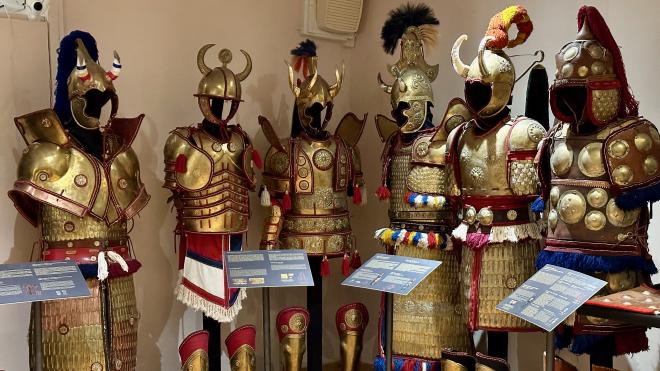
The basement of the museum included a display of replica armour from ancient Greece.
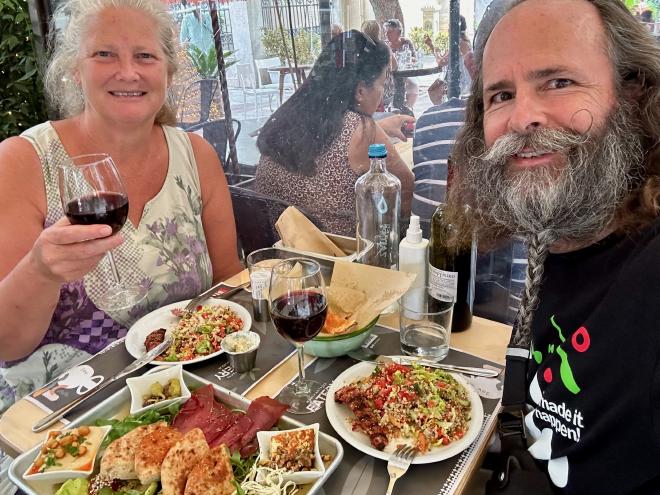
From the museums we headed back to our apartment via the Eatery Bairaktaris Aiolou 29, where we had a very nice meze dinner including salad, souvlaki, a variety of spreads, cheeses and vegetables, and some excellent Greek wine.
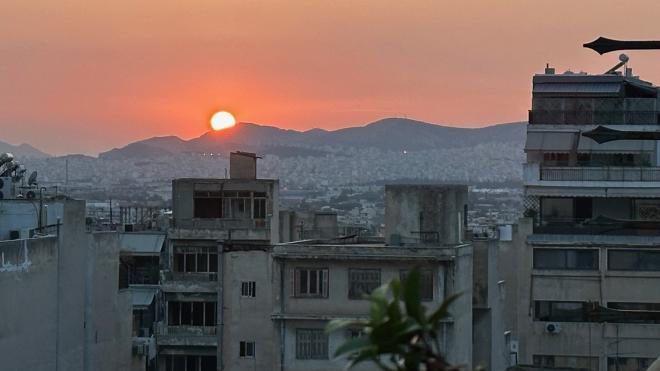
By the time we got back to our apartment, the sun was setting.
The next morning we boarded a bus from Athens to Patras so we could catch our next ferry, to Italy.