In our Istanbul part 1 diary entry, we mentioned that our seven-day stay in that city was partly the result of an offer that was too good to pass up. Our original plan for Türkiye had been to stay in Istanbul five days, then move to Izmir, and then to Çeşme. However, Allan Poston saw a Facebook post mentioning we were in Türkiye, asked whether we’d be coming to Ankara, and invited us to stay with him and his wife Arabella if we did. Allan was at RMC at the same time as Greg, one year behind him, and their careers in the Canadian Army more or less overlapped; Greg was Signals, Allan a Military Engineer.
So, we changed our plans! Because of Allan’s work travel schedule, the only days that lined up for us started seven days after our arrival in Istanbul, so we had a couple of days to fill. Izmir was in entirely the wrong direction, so we looked into visiting another city between Istanbul and Ankara, but Funda (our wonderful host in Istanbul) insisted that we spend those days with her. And since we were having a great time, and there was no end of things to do in the big city, that’s what we did.
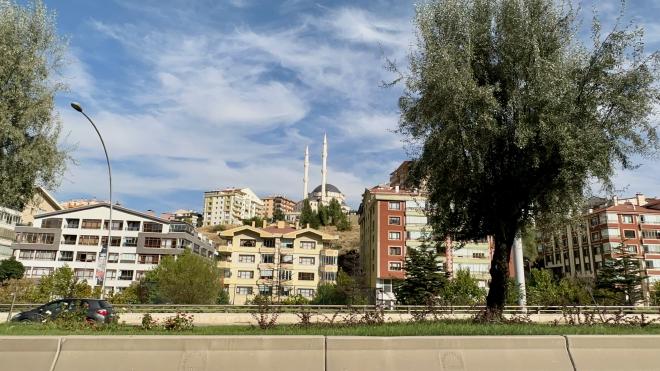
Getting from Istanbul to Ankara couldn’t have been easier. There’s a very modern high-speed train that runs between the two cities several times a day and takes less than four hours. It leaves from Söğütlüçeşme station, which would have been an easy walk from Funda’s even if she hadn’t insisted on driving us with our bags – thanks, Funda! On arriving in Ankara we took a taxi to Allan and Arabella’s place, since they don’t have a car (in Ankara) and there were no reasonable public transport options. Taxis in Ankara are ubiquitous and cheap; all the longer trips during our visit were by taxi. This is a typical view from the highway heading south out of the city centre. Most of Ankara is very new, modern, and distinctly western looking.
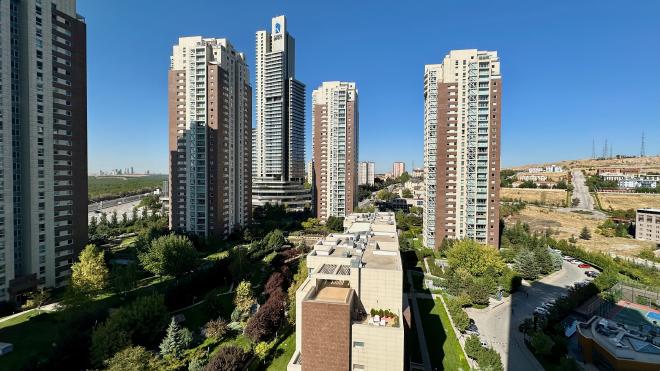
Allan and Arabella live in a large gated apartment complex at the southern edge of the city.
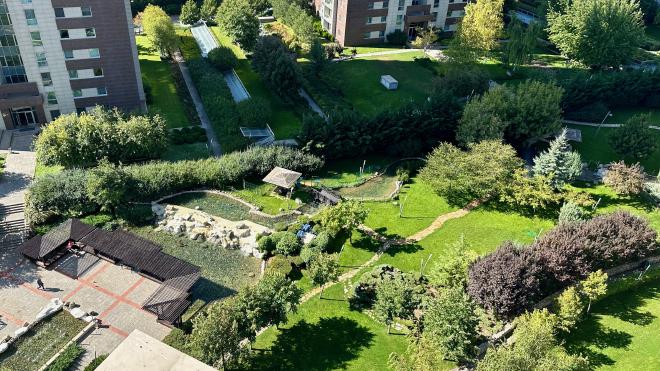
It features beautifully-maintained gardens…
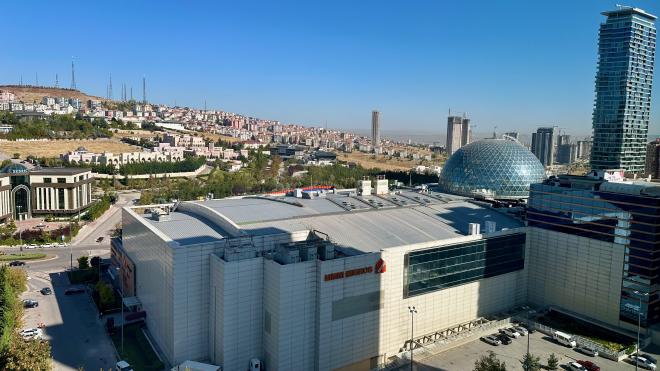
… and is adjacent to a couple of large shopping malls. The contrast with Istanbul (at least the parts we saw) couldn’t have been starker. Both nice, but in very different ways.
We spent the early evening chatting in their apartment, catching up on families and careers and enjoying Allan’s excellent Negronis. Then we walked to dinner at an upscale kebap place in one of the nearby malls and continued the conversation. (Their teenage son stayed home and ate takeout sushi.) Since leaving the Canadian Army Allan has been working for the United Nations Development Programme doing a variety of engineering, project management, and government support work, in countries all over the globe. For the last few years he’s been coordinating a mine-clearing project on Türkiye’s eastern border with Iran. He works part-time in Ankara, which is the capital of Türkiye and local headquarters of the UNDP, and the rest out at the project site.
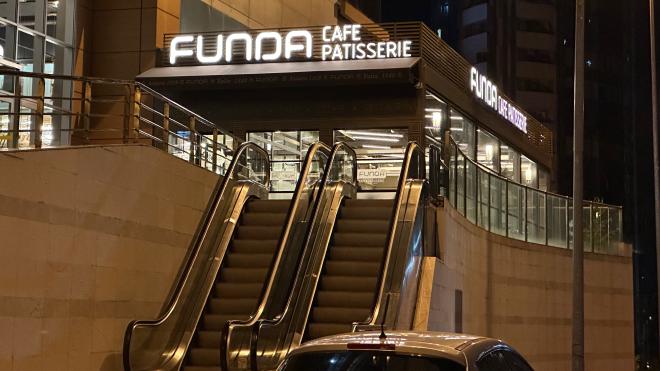
On our way back from dinner we passed this cafe and pastry shop – it seems Funda is everywhere! When we sent the photo to Funda (who grew up in Ankara), she replied “I think I know where you are 🤓”.
After a leisurely breakfast we piled into a taxi and headed out to visit the old heart of the city.
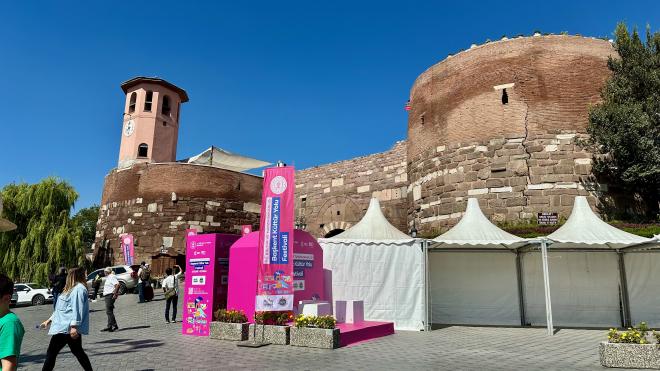
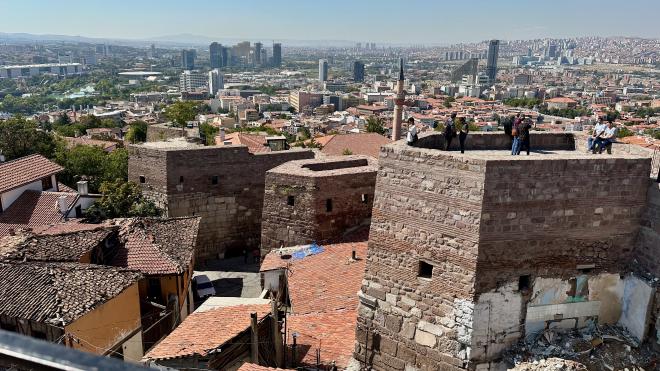
The core of the old city is Ankara Kalesi (Ankara Castle), whose ramparts extend around the hilltop on which it’s sited. The current castle dates from sometime after 622 CE, but there have been fortifications on the site going back to at least the 8th century BCE.
The castle has a commanding view of modern Ankara. The city has been the capital of Türkiye since the establishment of the Republic in 1923. In previous centuries it was the capital of Celtic and then Roman Galatia, and also played a key role in the governance of the Ottoman Empire. The current population of Ankara is about 5.1 million, and it’s the largest city in Türkiye by land area.
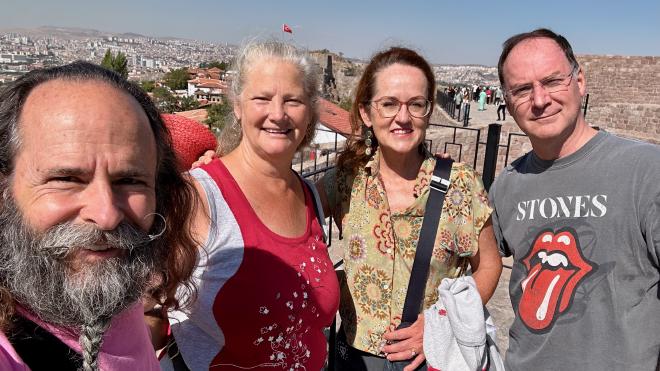
The obligatory group selfie from the ramparts.
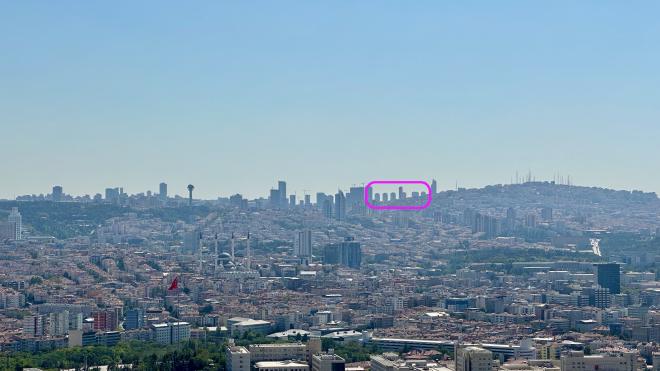
From the castle we could see Allan and Arabella’s apartment complex (circled) way off to the south.
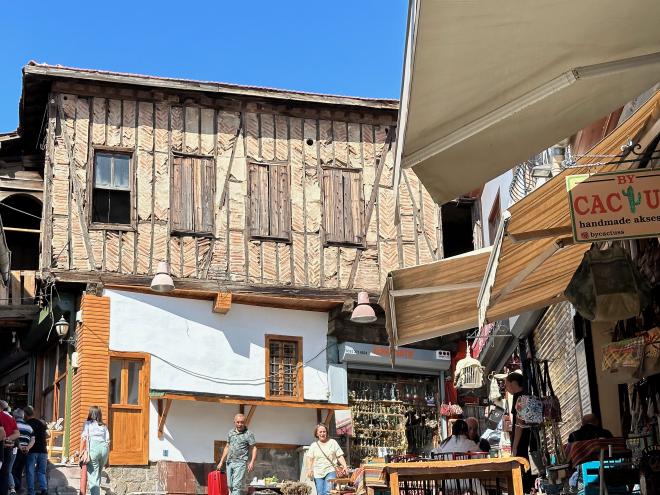
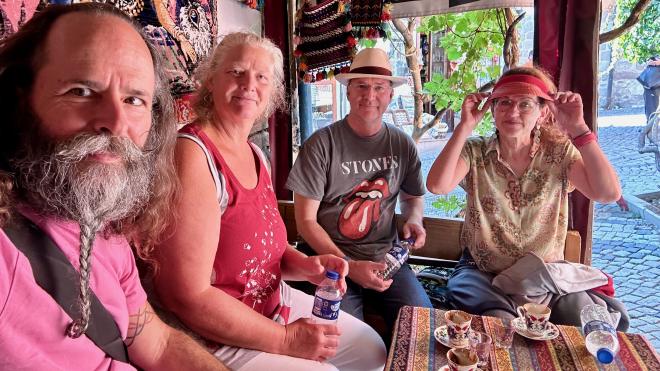
After our visit to the castle we stopped at a tiny cafe in the old city for some coffee and much-needed water.
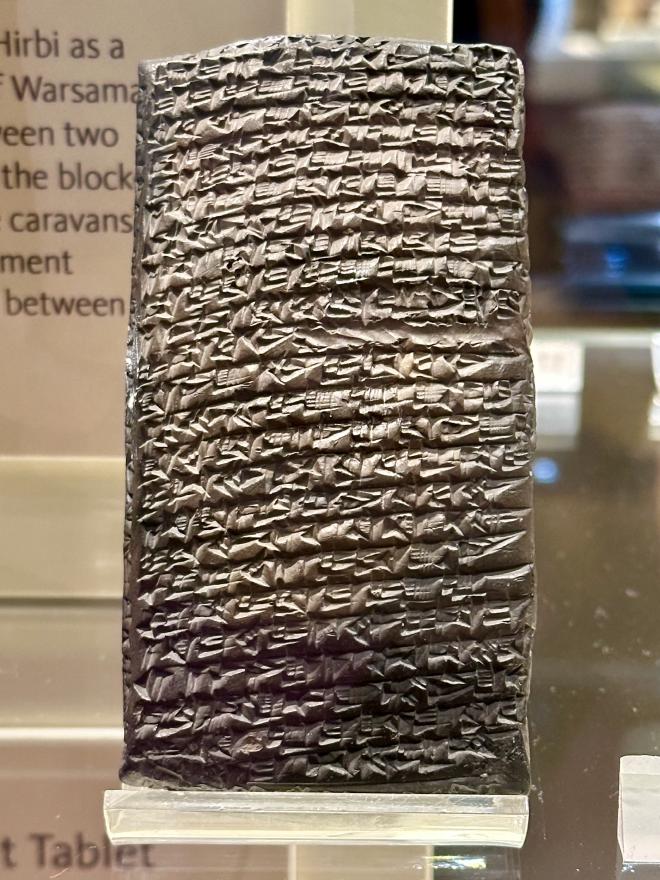
From there we walked to the nearby Museum of Anatolian Civilizations, which was fascinating. Anatolia is the large peninsula that makes up most of modern-day Türkiye. One of the wonderful things about early Anatolian civilizations is that they made their writing on clay, which they baked, so many examples have survived. This is a letter, written in cuneiform, from Anum Hirbi, King of Mama, to Warsama, King of Kanesh, dating from the 19th or 18th century BCE. From the Museum’s description: “The letter addresses to Anum-Hirbi as a response to the earlier letter of Warsama stating that ‘a new treaty between two countries should be made and the blocked roads should be opened to the caravans’, which is the only written document describing the political events between the kings of Mama and Kanesh.”
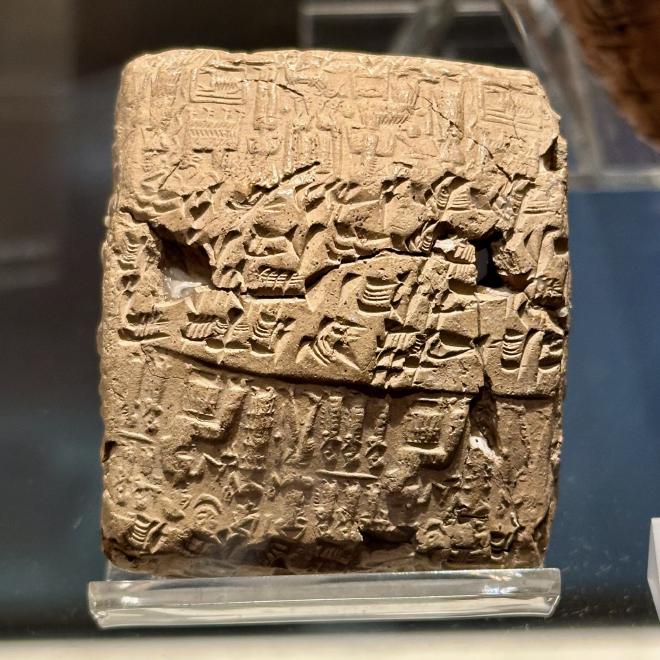
Most of the cuneiform samples in the museum record much more prosaic matters, such as loans and interest, or inventories. This one is a marriage contract, also from about 4000 years ago, between the Assyrian Idi-Adad and the Anatolian Anana, in which they agree that “… Idi-Adad could not take another wife in Anatolia; if he did and divorced Anana he had to pay her 5 minas silver.”
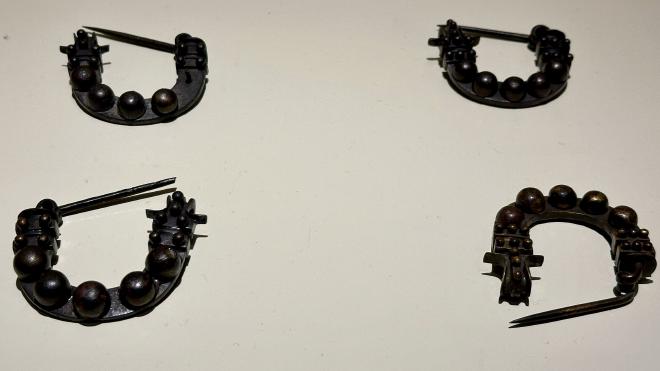
These are bronze fibula made by the Phrygian people and characterized by distinctive hobnail decorations. Essentially large ornamental safety pins, they were used to hold clothing together and were often included in grave goods.
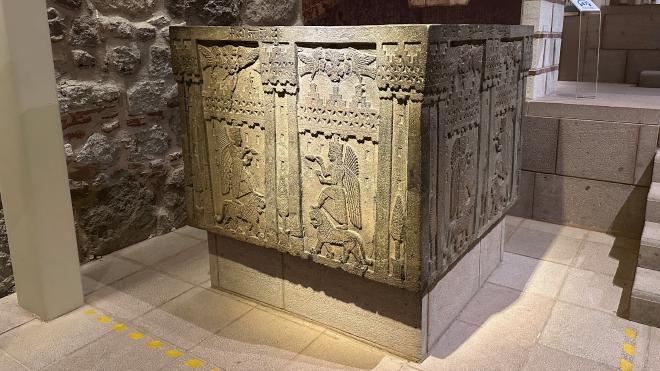
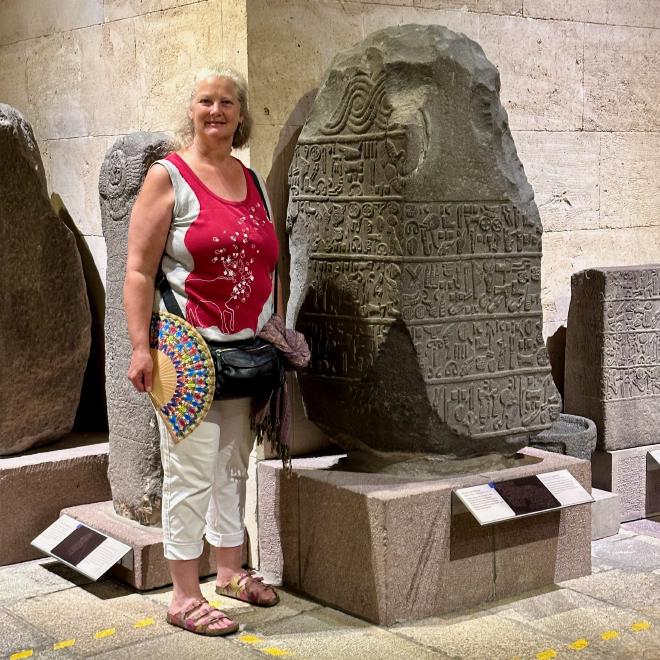
This is the base of a column, dating from about the 7th century BCE and found in in Kef Citadel, Adilcevaz. The inscription that wraps around the top has been translated as “Thanks to magnitude of God Haldi, Rusa son of Argisti, built this cult place, the victim of drink. The floor was in a neglected condition. I did all of the things Haldi ordered that any where else the kings did not. Rusa says: Whoever destroys this inscription, May Utu, the Sun God damns him.”
This fragment of a stele from about 800 BCE “narrates that the Ruler Katuwas, son of Suhis and Lord of Kargamis forwarded the chariots to and occupied the places where his grandparents had not gone but Tarhunza, Karhuhas and Kubaba had walked on.”
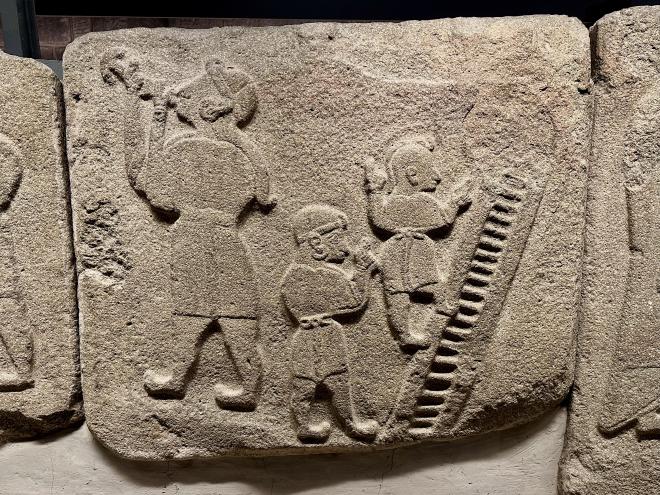
Greg was delighted to find this circus-themed relief from about 3400 years ago featuring sword-swallowing and (maybe) freestanding ladder. “The juggler facing towards left, with long hair and a short dress, swallows a dagger; the smaller acrobats behind go up the stairs without holding on.”
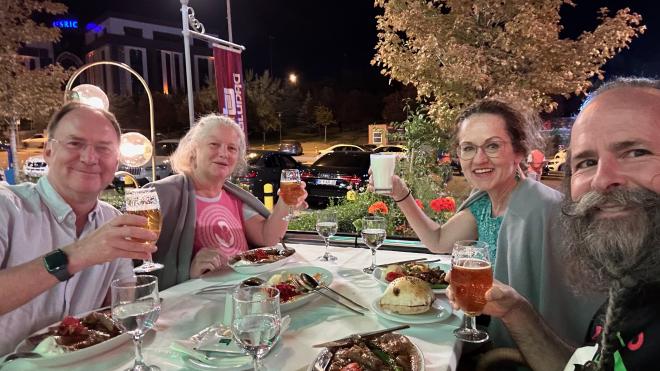
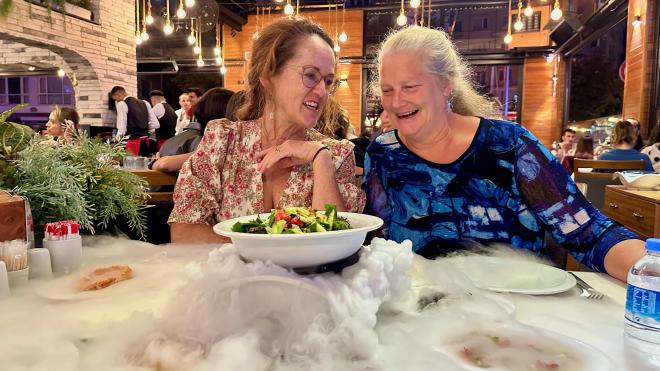
That evening we went to the Masabasi Kebapçisi kebap restaurant in one of the bustling downtown entertainment districts. Allan and Arabella hadn’t been there in a while and had only a vague memory of where it was, so we (deliberately) wandered the streets until we found it. The food was very good, but the presentation was amazing, particularly the salad which was served over dry ice.
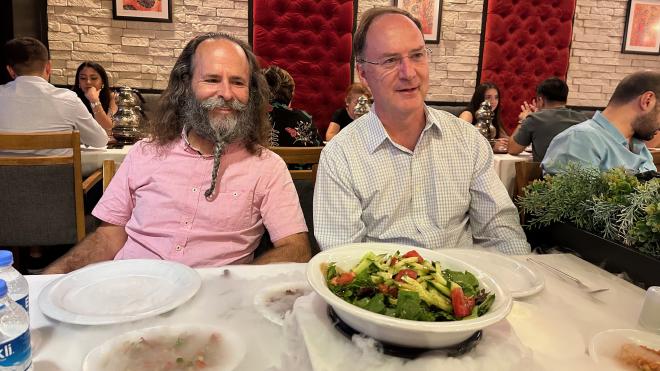
And here’s a shot of the guys. Just over Greg’s shoulder you can see a traditional Turkish samovar, a combination stove, kettle, and teapot, which featured at the end of our meal.
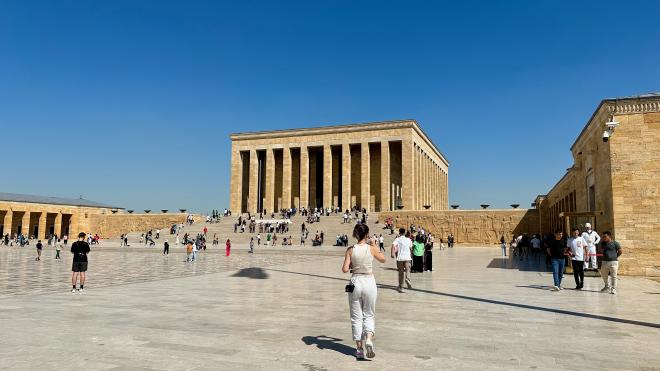
For our outing on Sunday we went with Allan to Anıtkabir, the Atatürk Mausoleum Complex. This houses the tomb of the founder and first President of Türkiye, Mustafa Kemal Atatürk, as well as the Atatürk and The War of Independence Museum. There is a symbolic, empty sarcophagus in the Hall of Honour (the large square structure) with the actual sarcophagus located in a Tomb Room, not open to the public, on a basement level. The Museum is U-shaped and starts in the building at right of this photograph, goes below the Hall of Honour, and ends just past the far left.
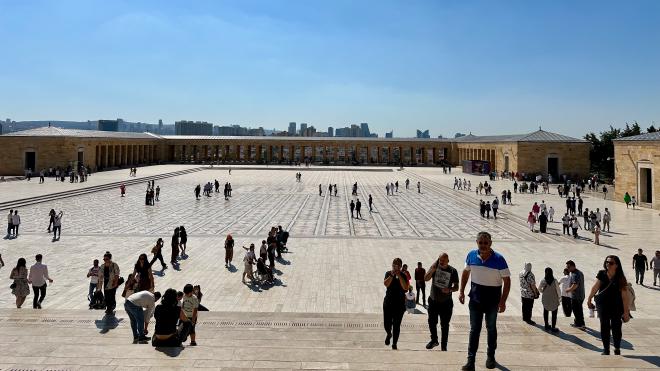
This is the view from in front of the Hall of Honour showing the Ceremonial Square. As you can see, the complex (of which this is just part) is enormous.
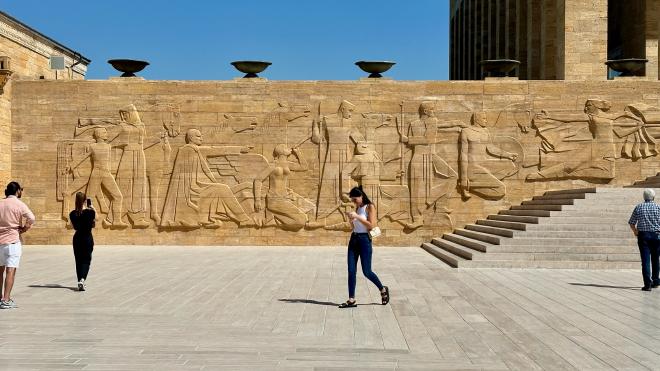
The monument is decorated with reliefs in a style that seems to be an art nouveau take on the traditional Anatolian carvings we saw the previous day in the museum. For an example, see the decorations on Rusa’s column.
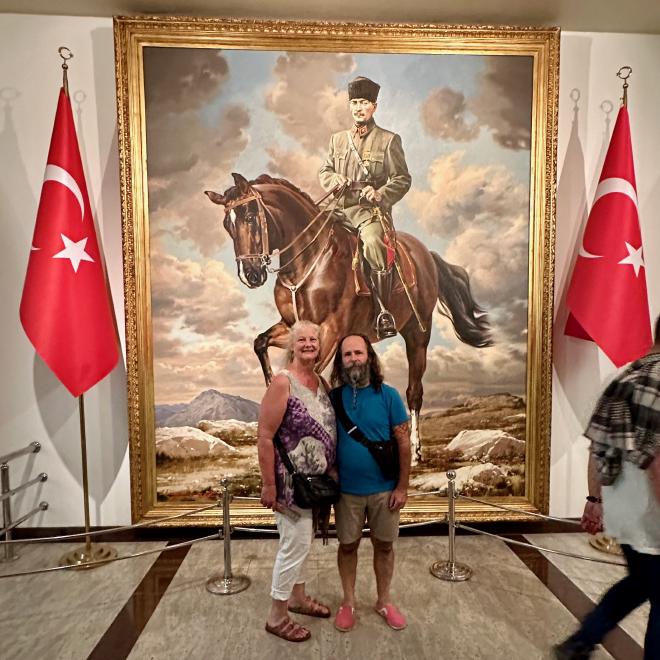
As the Museum’s name suggests, it’s partly a memorial to the life of Atatürk, and partly about the Turkish War of Independence. Since Atatürk was a principal figure in the War (some would say the principal figure), there’s considerable overlap. This painting depicts Atatürk in his role as Commander in Chief of the Turkish forces during the war.
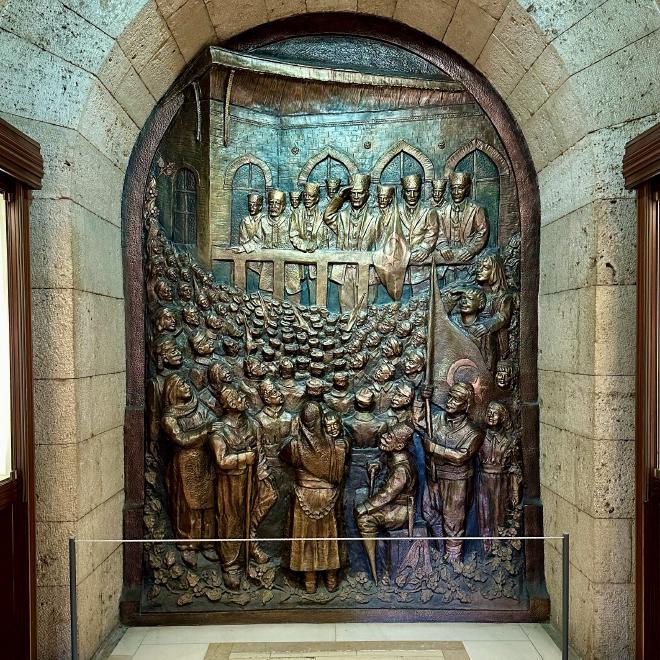
This is one of eighteen galleries in the third section of the Museum, which depict the War of Independence and the reforms of Atatürk. Each gallery has a large bronze relief representing its theme, and there are over 3000 photographs displayed. Atatürk’s major reforms included educational reforms, restructuring the primary, secondary and post-secondary systems; historical reforms, including the creation of many museums; linguistic reforms, including design of the modern Turkish alphabet and compilation of the first Turkish dictionary; and surname reform, requiring that every Turkish citizen have a surname. Law 2525 passed by the Turkish Grand National Assembly required that surnames be Turkish and not refer to rank, position, foreign races or nations, or be “immoral or ridiculous”. Law 2258 gave Atatürk his surname, meaning “Father of the Turks”, to express the nation’s gratitude, and prohibited the use of “Atatürk” by any other person.
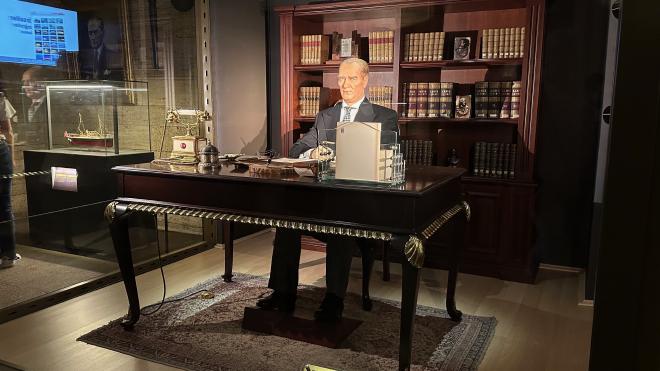
This wax effigy of Atatürk is displayed in a recreation of his office. All the objects in the display belonged to Atatük other than the effigy, its clothes, and the bookcase.
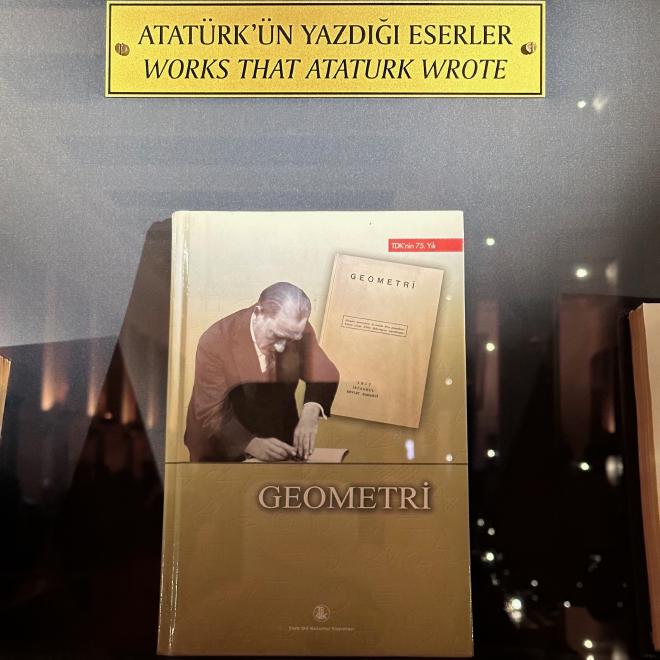
Aside from his military career and his role as founding President of Türkiye, Atatürk was also an author. Copies of the books he wrote are displayed towards the end of the museum, together with the contents of his extensive library. To our surprise and Greg’s delight, one of the books he wrote is a high school geometry textbook.
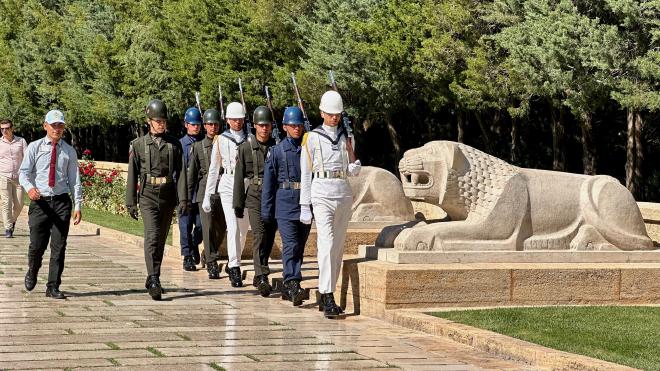
There are symbolic guards from the Turkish Army, Navy and Air Force stationed throughout the Mausoleum complex. A very low-key changing of the guard was taking place towards the end of our visit.
That evening Allan and Arabella hosted a dinner party at their apartment for us and a couple they’d met through the school their children had attended, both of whom are history professors at an Ankara university. The food and drink were excellent and the conversation was wonderful – a terrific way to wrap up our time in Ankara. We can’t thank Allan and Arabella enough for the invitation to visit them and for their wonderful hospitality during our stay.
On Monday morning it was into a taxi to the bus station, and on our way to Çeşme.