We were a little concerned about our transportation arrangements from Hannover to Prague. We were travelling on a Eurail pass and had booked seats on the trains; but there was a train replacement segment by bus from Dresden, Germany to Ústí nad Labem, Czechia, we couldn’t make a reservation for that, and it wasn’t 100% clear that was actually included with Eurial. Worst case, we could have been stuck in Dresden overnight.
As it turned out, everything was completely seamless and we needn’t have worried. Well, almost completely seamless: after getting all the Prague-bound rail passengers on the bus in Dresden, the station staff decided it was the wrong bus and we had to get back off and transfer ourselves and all our luggage to a different one. But we still arrived in Ústí nad Labem in good time for the train to Prague.
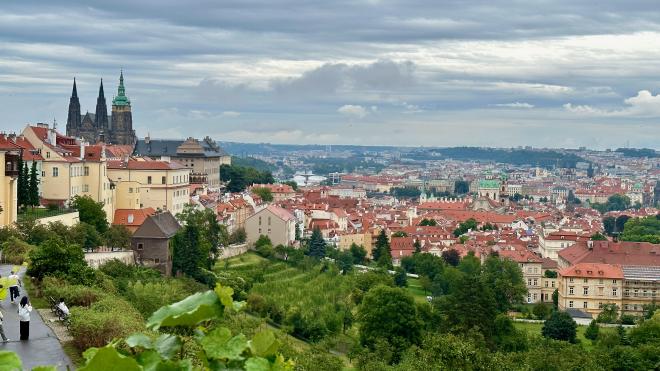
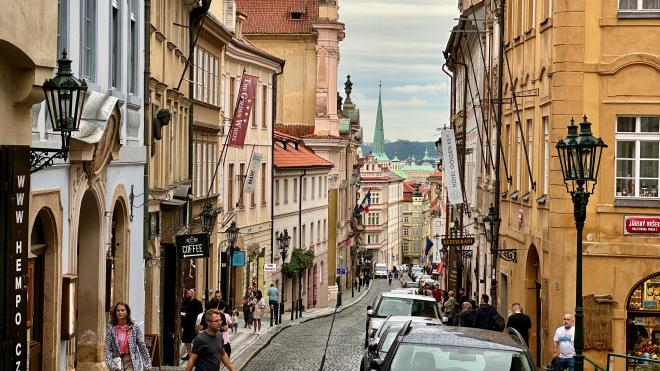
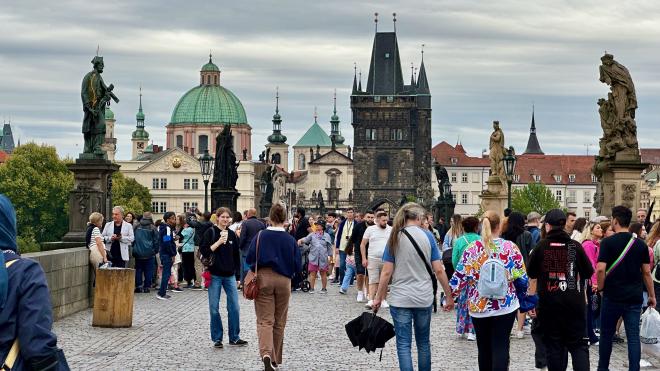
Let’s just say this now: Prague is relentlessly beautiful. Every time you turn a corner there’s another incredible vista full of architecturally-stunning buildings, wonderfully clean and lovingly maintained. As a result, there are rather a lot of pictures in this diary entry.
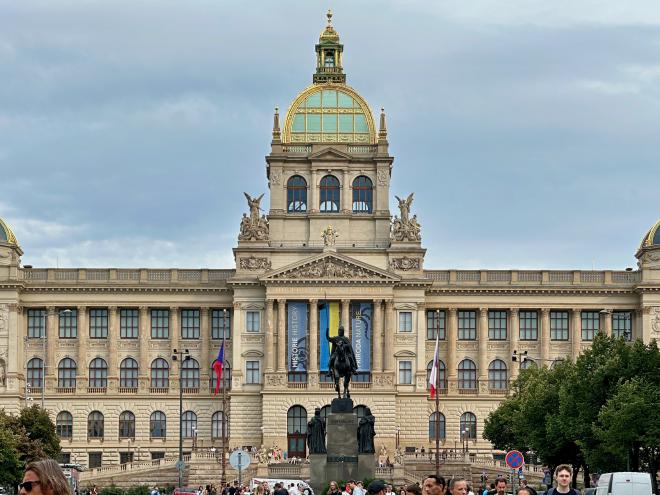
Our first stunning vista in Prague, the Národni Museum, seen on the walk from the train station to our apartment.
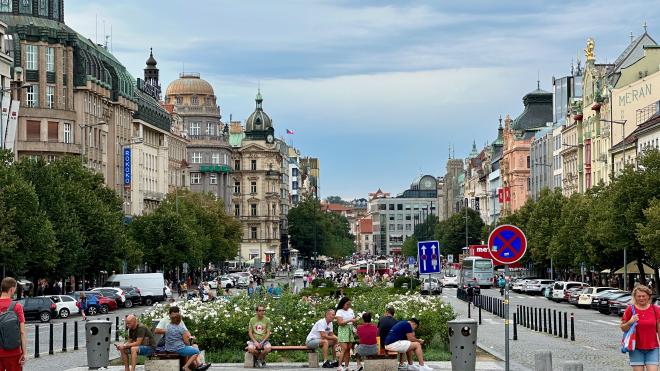
And our second: Wenceslas Square: same spot, opposite direction.
We were to learn during our walking tour that Prague’s beauty is partly because it was largely spared bombing during World War II. Under the 1938 Munich Agreement most of what was then Czechoslovakia, including Prague, was handed over to the Nazis in an ultimately-unsuccessful act of appeasement. This meant that Prague was never invaded by Germany, and only attacked by the Germans at the end of the war, during the 1945 Prague Uprising, with very little damage. And, because it wasn’t considered strategically important, it was relatively lightly bombed by the Allied Forces, at least once when a navigation error had it mistaken for Dresden. (That’s “lightly bombed” compared to other cities. I’m sure that was scant comfort to the loved ones of the estimated 1200 dead from the bombings that did occur.) As a result, almost all the beautiful buildings survived.
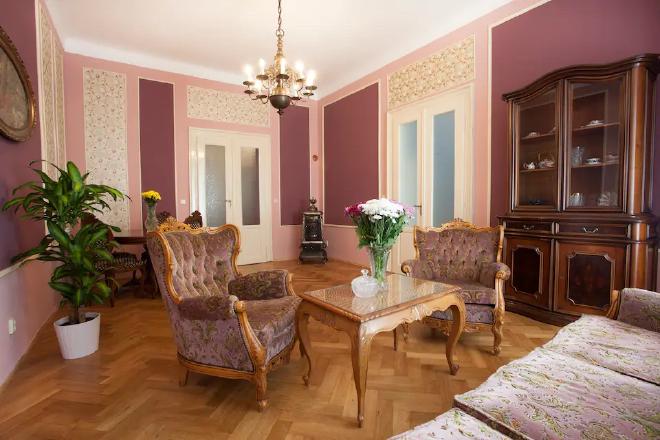
Even our AirBnB was spectacular. It was a very large one bedroom apartment, with this beautiful living room.
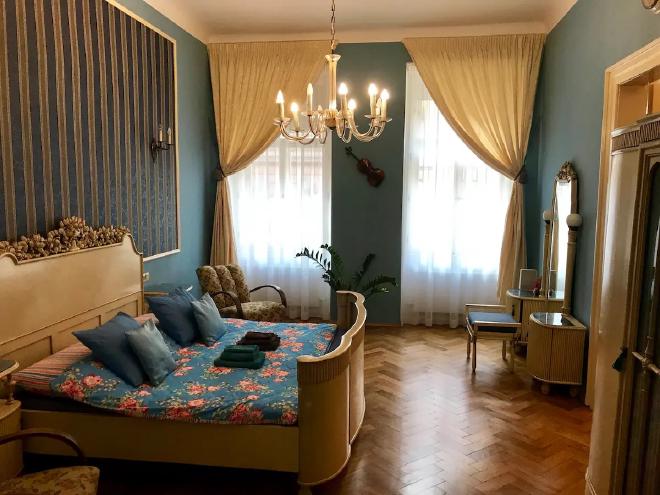
The bedroom was also lovely.
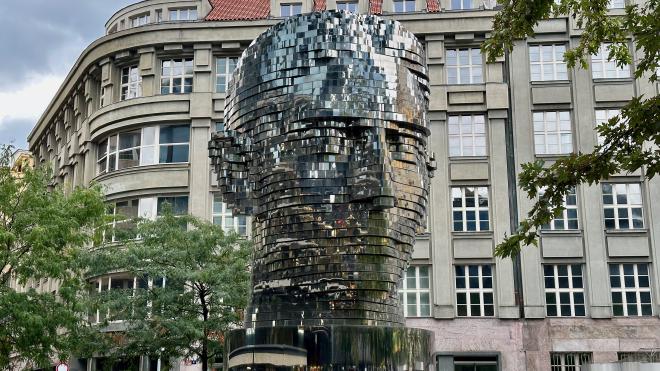
Once we’d settled into our apartment we headed out for dinner. On our way we walked past this moving sculpture of famous Prague author Franz Kafka’s head, by artist David Černý. It was just outside the shopping centre where we bought groceries during our stay. There’s a good timelapse video on YouTube showing its movement.
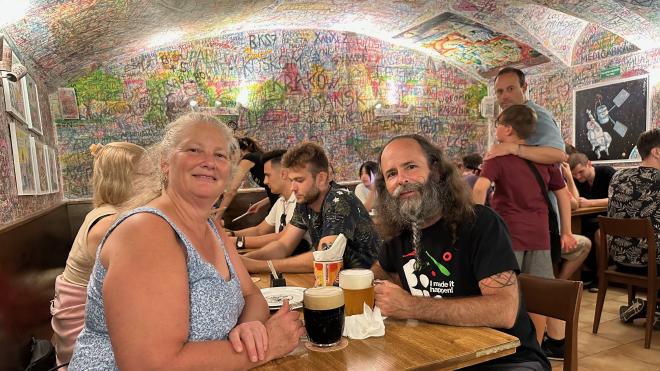
We had dinner at U Pivernce Maiselova, which is a restaurant that simply has to be experienced. If you book ahead, you end up in the very calm, stylish, modern-looking upper level. We didn’t, so we ended up in the noisy, crowded, beerhall basement, where every surface is covered with graffiti left by previous patrons. We loved it.
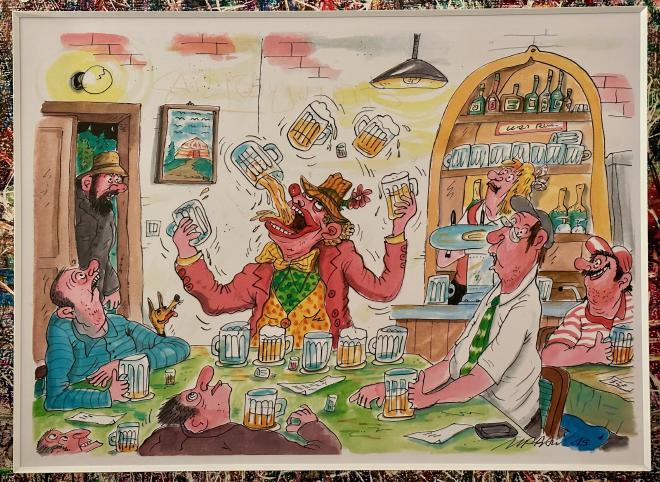
This picture of a beer juggler was just behind Karen’s seat. If you look at the previous photograph you’ll see the frames of many other cartoons by artist Petr Urban, all commissioned by the restaurant. But of course this was our favourite.
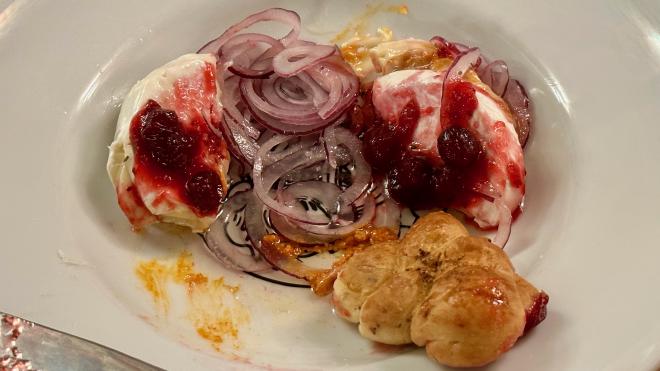
Our appetizer: pickled Brie, which is apparently a common thing in Czech bars just like pickled eggs in the UK. It’s not usually presented quite this fancy. The taste was a bit unusual (pickled cheese, really?) but actually quite good.
After dinner we walked back via Staroměstské náměstí, the Old Town Square.
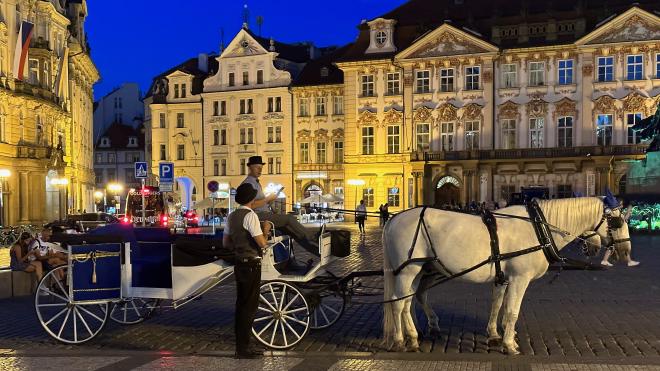
A row of carriages with nattily-dressed divers was waiting on the square for willing victims customers.
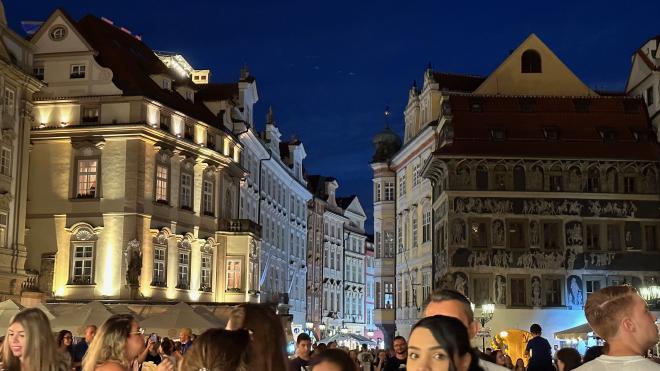
Since we were nearing the striking of the hour, there was quite a crowd in front of the Astronomical Clock on the edge of the Square. More about the clock later. Also, beautiful buildings.
The next day we decided to do an afternoon guided walking tour of the Old Town. Even after a lazy morning featuring apple cake from Bettina’s birthday for breakfast, we still had a bit of time before the tour started. So, we decided to start by heading south from the apartment to see parts of the city that the tour wouldn’t touch.
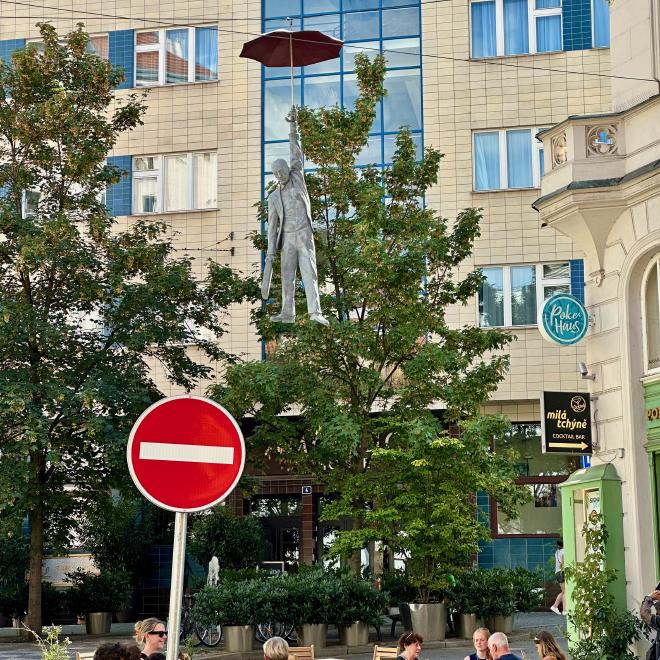
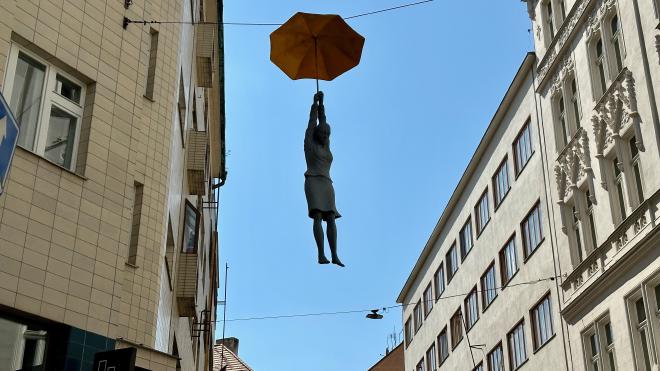
This is half of the art installation Slight Uncertainty by Michal Trpak, but of course it’s better known as The Umbrella Man.
And just around the corner is the rest of the piece, The Umbrella Woman.
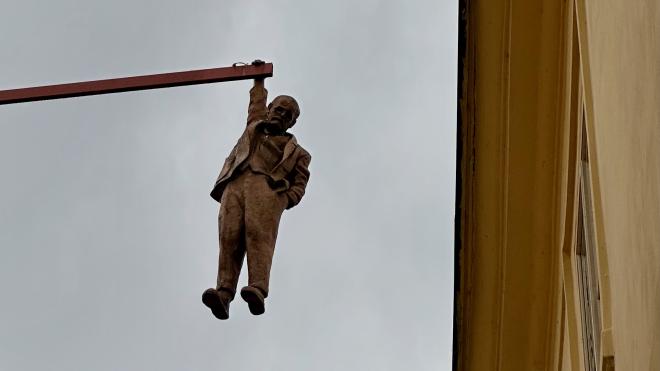
Elsewhere in the city is a third hanging statue, by David Černý, Man Hanging Out, of Sigmund Freud.
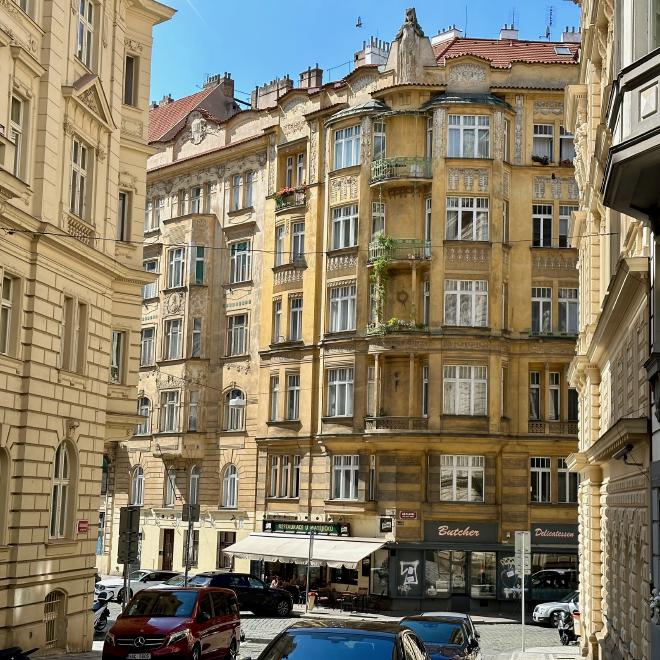
Did we mention the stunningly-beautiful architecture?
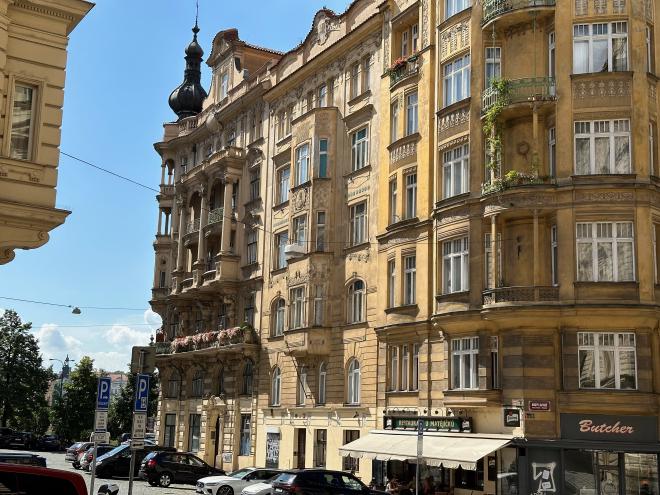
And then you walk around the corner and it just keeps coming.
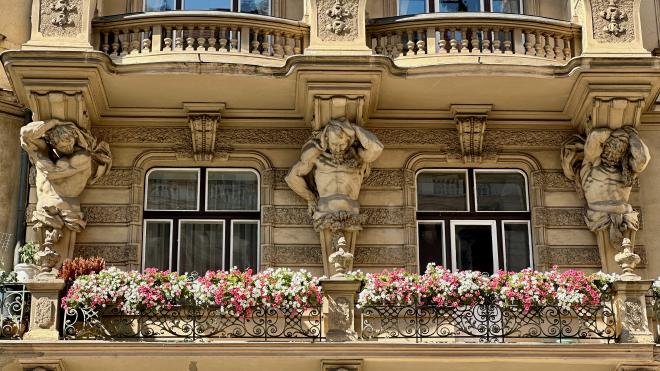
A detail from the building at the end of the row in the previous photograph. These are Atlantes, the male equivalent of Caryatids.
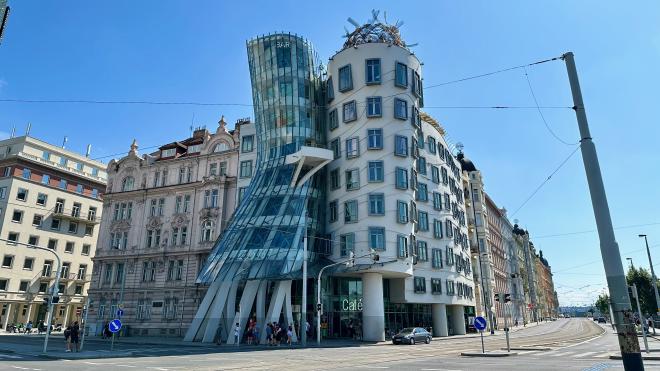
Our actual destination on this part of the walk was a more recent building, The Dancing House. It was designed by Vlado Milunić in cooperation with Frank Gehry. Gehry originally called it Fred and Ginger, but later decided it was inappropriate to import American “kitsch” to Czechia.
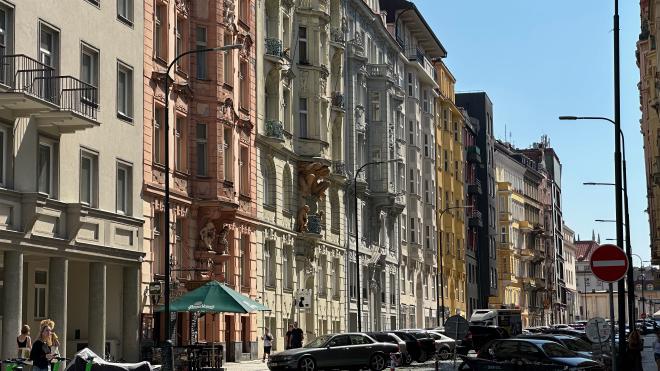
Just around the corner from the Dancing House there’s Yet Another Beautiful Street.
This building houses… a clothing store. Really. Don’t all the clothing stores in your town look like this?
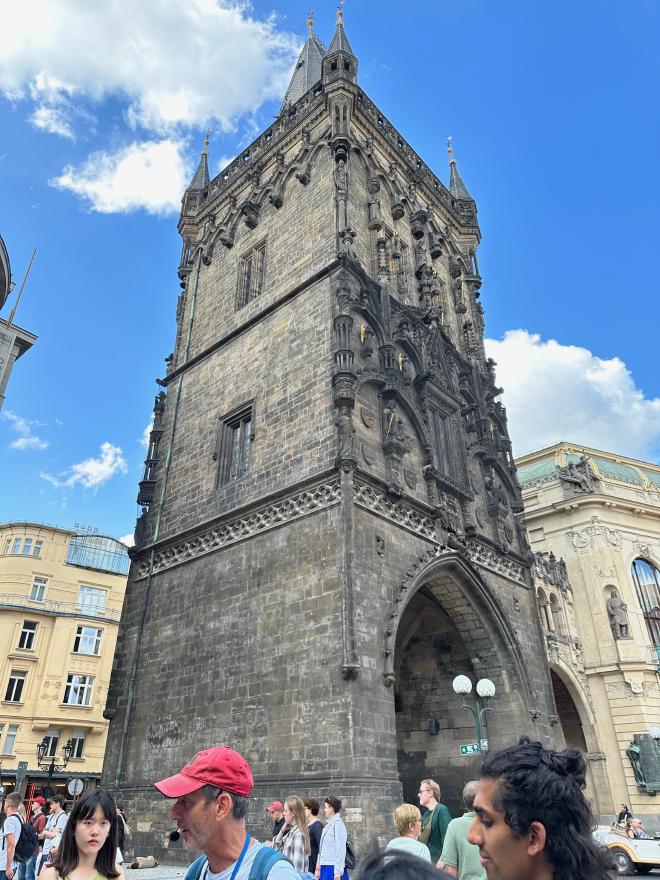
Eventually we made it to the meeting point for our tour, Prašná brána, the Powder Gate Tower. Built in 1475, Its name comes from its one-time use as a gunpowder store. Prague’s gate towers are just about the only buildings in the city that don’t look spotlessly clean. Constructed from soft sandstone, they absorb all the city dirt that touches them and can’t be effectively cleaned without destroying the architectural detail. The grime also acts as something of a protective layer, hardening the sandstone. Our guide, Jan, is in the red hat. A Prague native who lived for a couple of decades in California, he was delightfully entertaining.
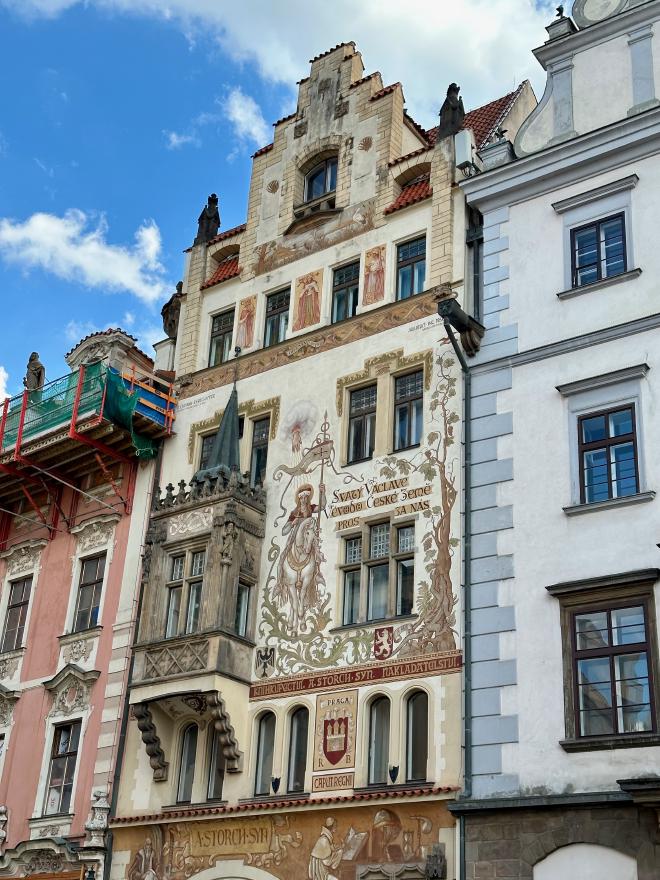
Štorchův dům (Štorch’s House) is just on the edge of the Old Town Square. Although it looks medieval, it was actually constructed in 1897. Formerly a bookstore, it now houses a Thai Massage Parlour. It was partially burned in the Prague Uprising, later restored. The painting is of Wenceslaus I, Duke of Bohemia, better known as Saint Wenceslaus or Good King Wenceslas.
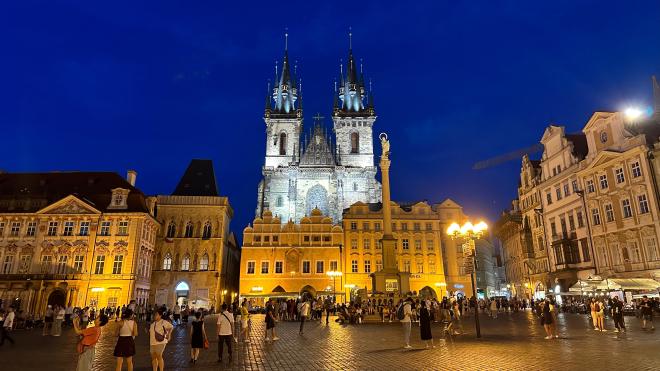
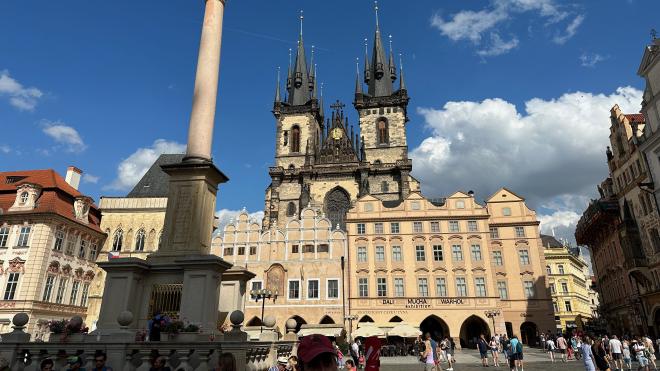
Our tour took us once again to the Old Town Square. The church you can see is Kostel Matky Boží před Týnem, the Church of Mother of God before Týn, built mostly in the 14th and 15th centuries on the site of two previous churches. The front and sides of the church are completely enclosed by buildings, so it’s actually entered through the pointed arch third from the left on this photograph, which is home to an Italian restaurant.
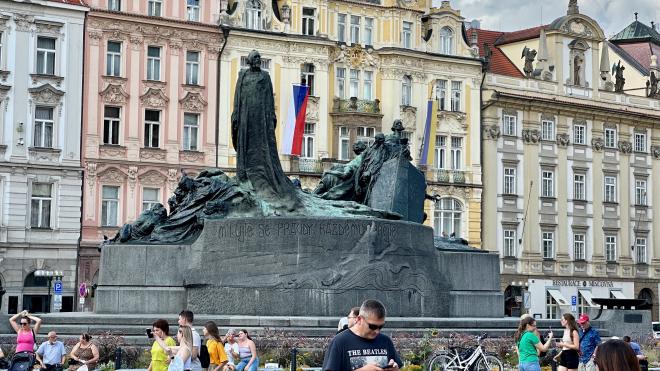
One of the main features of the Square is the massive Jan Hus Memorial. Jan Hus, born in 1369, was Czech theologian, philosopher and religious reformer who advanced many of the ideas that ultimately led to Protestantism, about 100 years before Martin Luther. The statue memorializes the Hussites and Protestants who were forced into exile during the Thirty Years War. It was completed in 1915, the 500th anniversary of Hus’s burning at the stake.
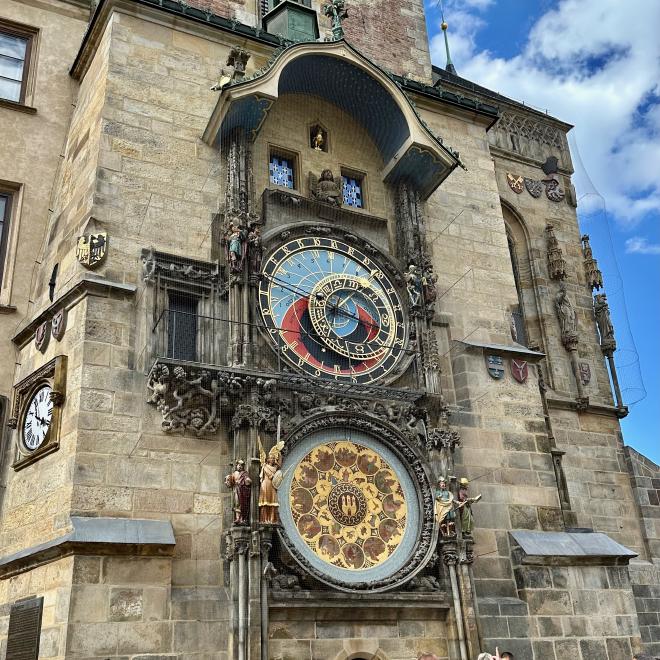
Our tour was timed to include the striking of the hour at Pražský orloj, the Prague Astronomical Clock. Initially constructed in 1410, it’s the oldest astronomical clock still in operation. Our guide warned us that despite the clock’s fame, its hourly striking is “the second most disappointing show in all Europe”. We’re not sure we’d go that far, and hey, what do you want for free? The clock displays a mind-boggling range of information on its two faces, all of which is very well described in the clock’s Wikipedia page.
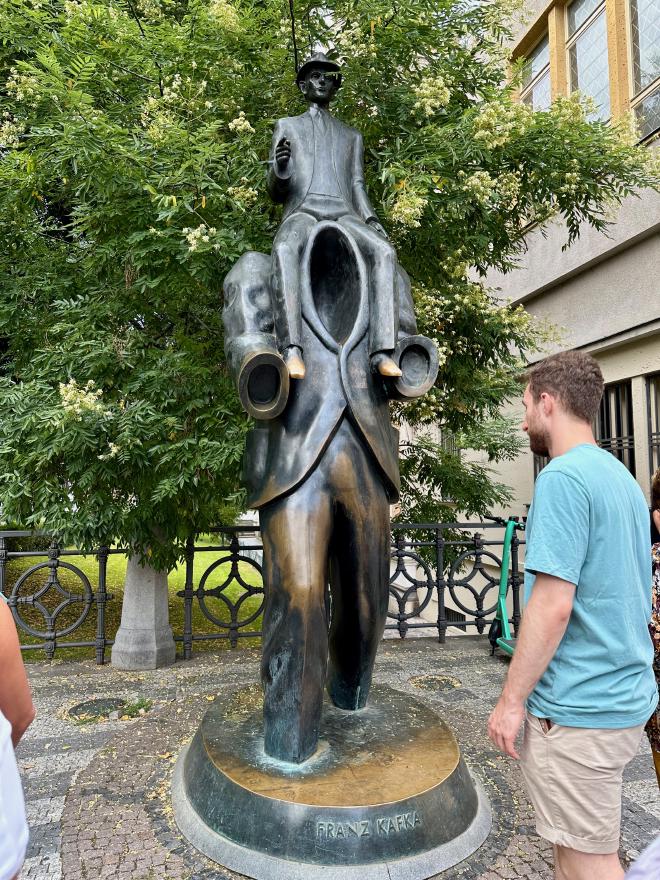
From the Old Town Square we headed north towards the Jewish Quarter. Right on the edge of the quarter is another statue of Franz Kafka, this one by Jaroslav Róna and installed in 2003. It’s based on Kafka’s 1912 story Description of a Struggle and the upper figure is Kafka. Greg has read a bunch of Kafka’s works over the years and agrees with our guide Jan that it’s some of the most surreal and depressing literature you can find.
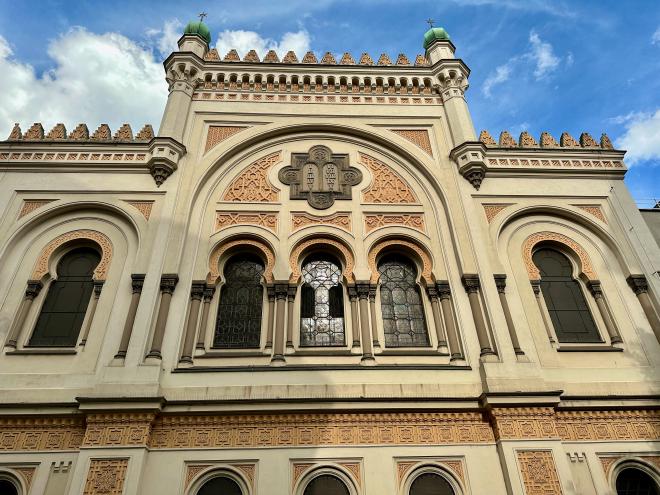
This is Španělská synagoga, the Spanish Synagogue, built in 1867-68 on site of a previous, smaller, synagogue. The name refers to the architectural style, Moorish Revival from Spain.
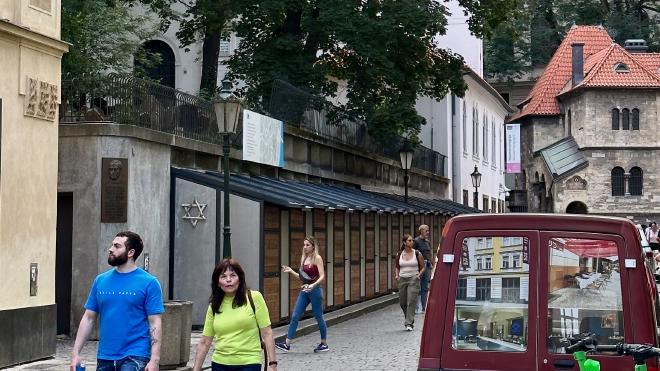
Around the corner is the Starý židovský hřbitov, the Old Jewish Cemetery, used from at least 1439 through 1786. The cemetery is quite small and Jewish tradition does not permit old graves to be dug up. The solution was to layer new graves over old ones, resulting in as many as twelve layers in some places and raising the current ground level about three metres higher than its surroundings. Most of the grave stones were raised up as new layers were added, giving it the crowding you can just see here, above the Star of David on the wall.
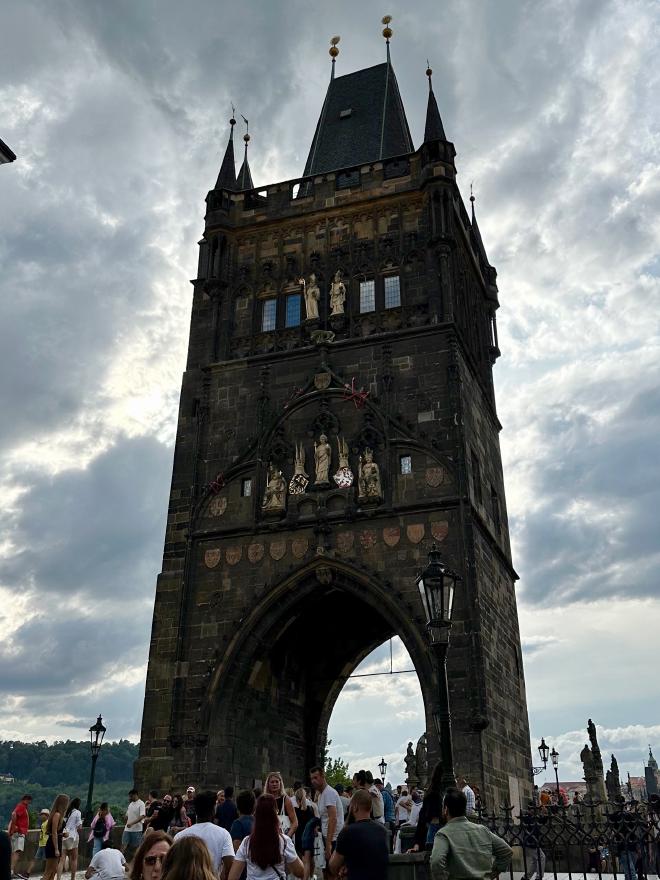
This is one of Prague’s other gate towers, Staroměstská mostecká věž or the Old Town Bridge Tower. It’s at the end of the Charles Bridge between the Old Town and the Lesser Town, which sits below Prague Castle.
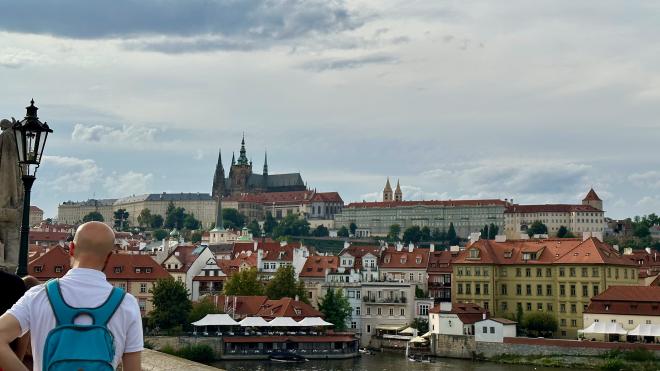
Speaking of which, here’s the view of Prague Castle from the bridge. More about the castle later.
Our tour ended near the Lennon Wall in the Lesser Town. No picture, because, frankly, it’s ugly – but it’s an important symbol of love and liberalization which played a role in the Prague Spring.
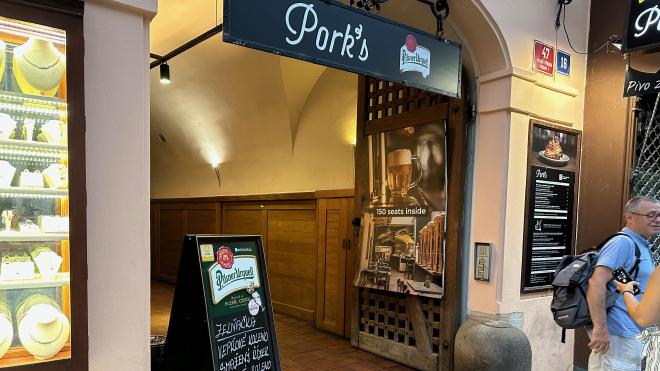
Following the tour we decided to have dinner in the Lesser Town. A bit of web searching led us to the aptly-named Pork’s, which specializes in crispy pork knuckles and Pilsner Urquell. We split one pork knuckle and a salad between us, which was more than enough.
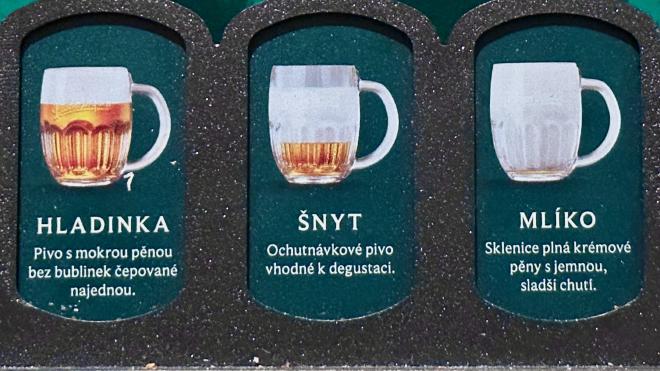
One thing we learned in Pork’s is that there are three recognized “pours” of Pilsner Urquell, each of which (allegedly) has a different taste. We went with the Hladinka, or standard, pour, which gives you the most beer for your money and “pairs well with rich food”, which is certainly what we were having.
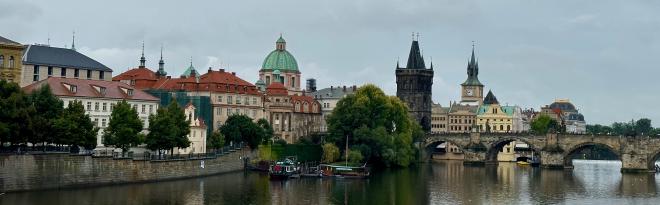
We walked back via a different bridge, allowing us to get this lovely shot including the Old Town Bridge Tower and the Charles Bridge.
We’d enjoyed our tour with Jan enough that we decided to book another guided walking tour with the same company, this time of Pražský hrad, Prague Castle. After meeting our guide at the metro station below the Castle, we all took a tram to the top of the hill where the tour began in earnest.
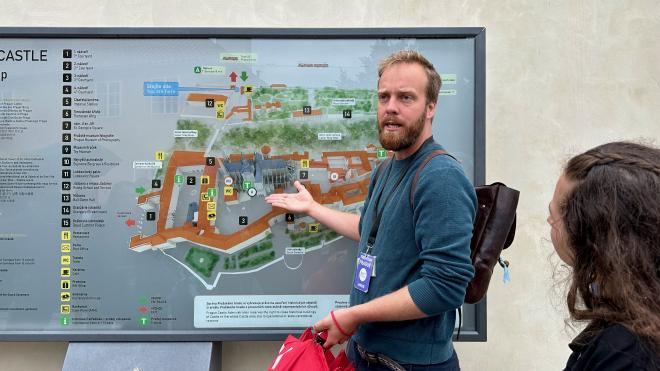
Our guide, Jakub, is a Prague native who lived for a few years in the US and Canada, including Toronto. Like Jan the day before, he was knowledgeable, funny, and a delightful story teller. Here he’s orienting us to the buildings that make up the castle complex. The castle dates from 870 CE, with several extensions and re-buildings over the centuries, most recently under the Empress Maria Theresa in the late 18th century. It functions today as the official office of the President of the Czech Republic.
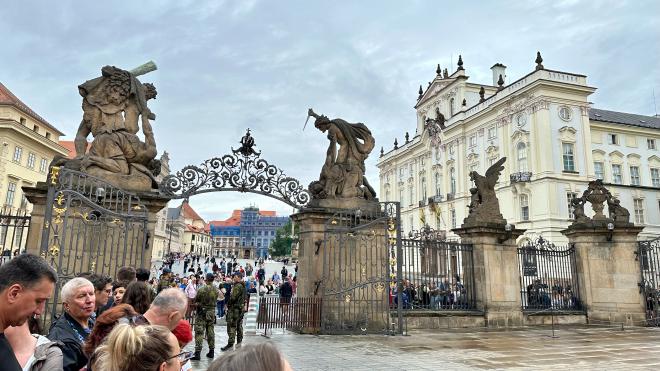
Our first destination was the courtyard at the western end of the complex, where the daily changing of the guard ceremony takes place. The courtyard is surrounded by heroic statuary, some of which you can see here. The white building at right is Arcibiskupský palác, the Archbishop Palace. As you can see, it was a rather wet day, raining on and off the whole time we were out.
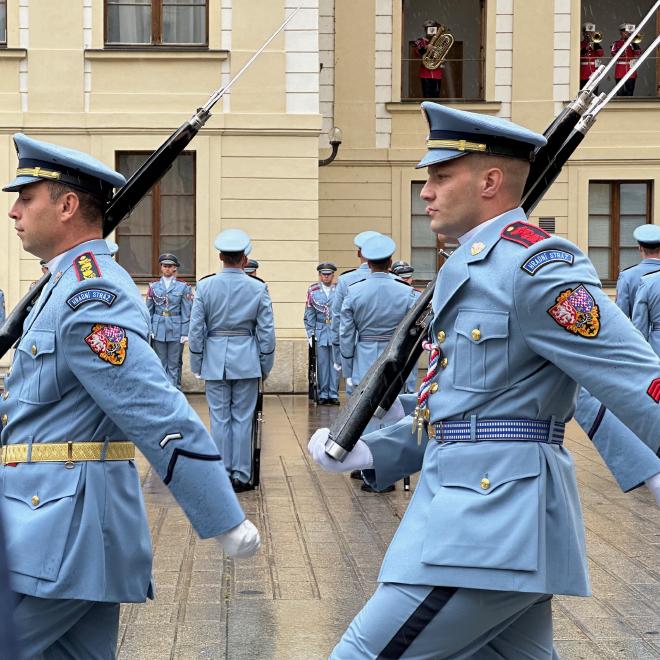
Here you can see the incoming guard, marching and also facing away from us; the old guard, facing towards us; and the musicians, cleverly out of the rain in the palace itself.
Our afternoon was in two parts. First was the guided tour with Jakub, which took us through the castle complex but not inside any of the buildings, because that requires a separate ticket and a lot more time. Following the tour, we bought tickets for the complex and visited the accessible interiors. To simplify the presentation, we’ll go building by building, exterior and interior, rather than the way we actually did it.
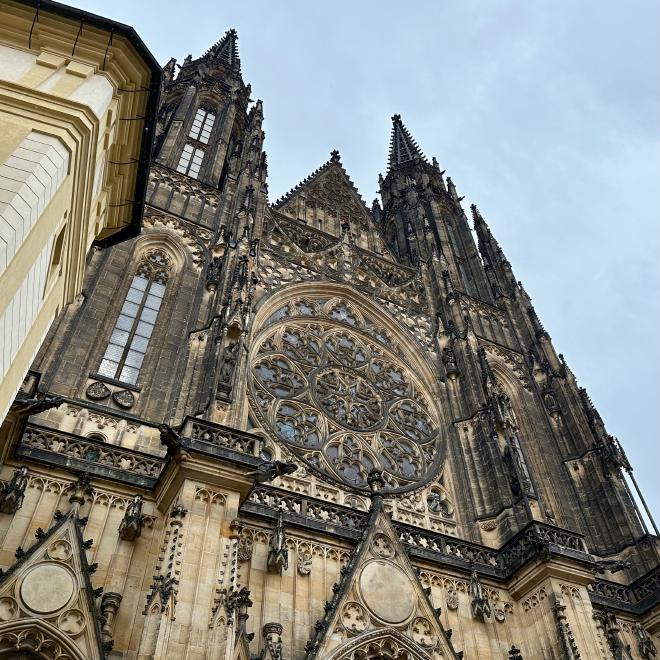
The largest and most imposing building in the castle complex is Metropolitní katedrála svatého Víta, Václava a Vojtěcha, The Metropolitan Cathedral of Saints Vitus, Wenceslaus and Adalbert, better known as St. Vitus Cathedral.
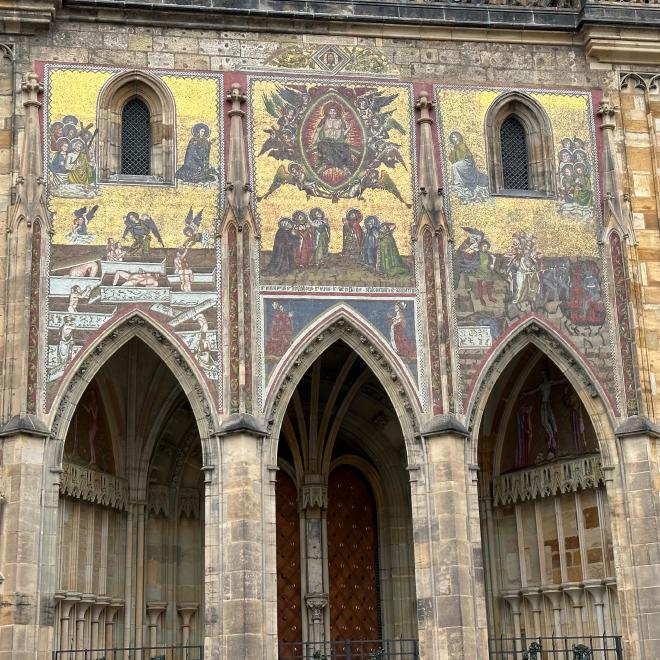
The Cathedral was constructed over an earlier rotunda, built in 930 CE by Wenceslaus I, Duke of Bohemia, better known as Good King Wenceslas, to house the arm of Saint Vitus, a holy relic. Construction of the current Cathedral was started in 1344 CE, and wasn’t finished until almost six hundred years later, in 1929. This imposing mosaic of the Last Judgement is on the courtyard side.
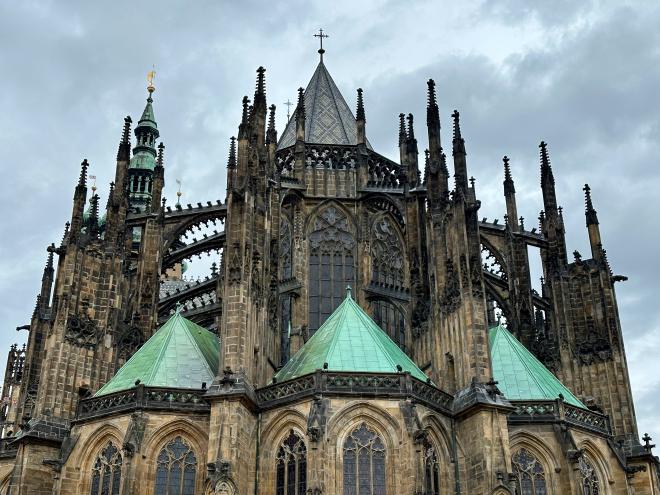
This is the Cathedral’s eastern facade.
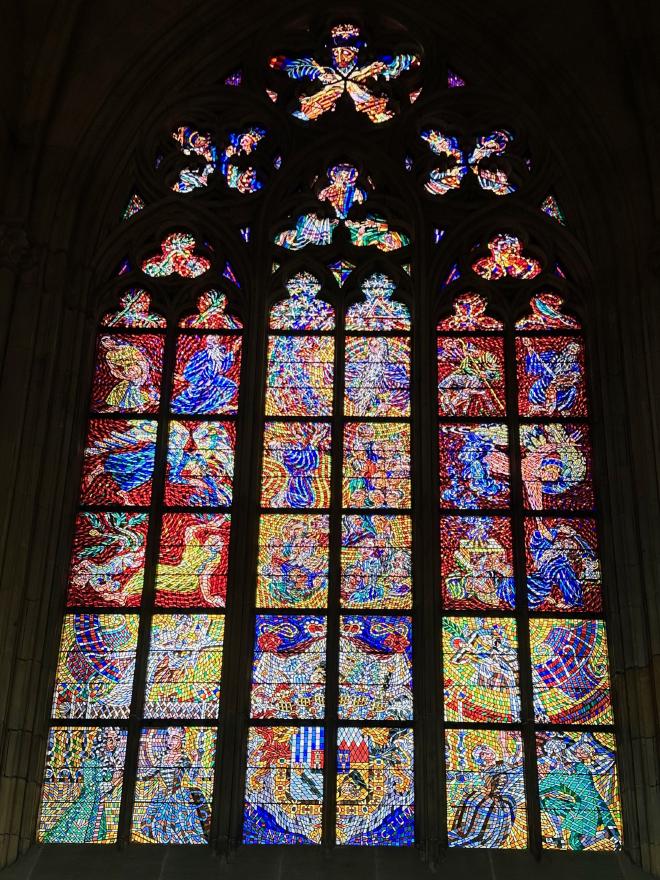
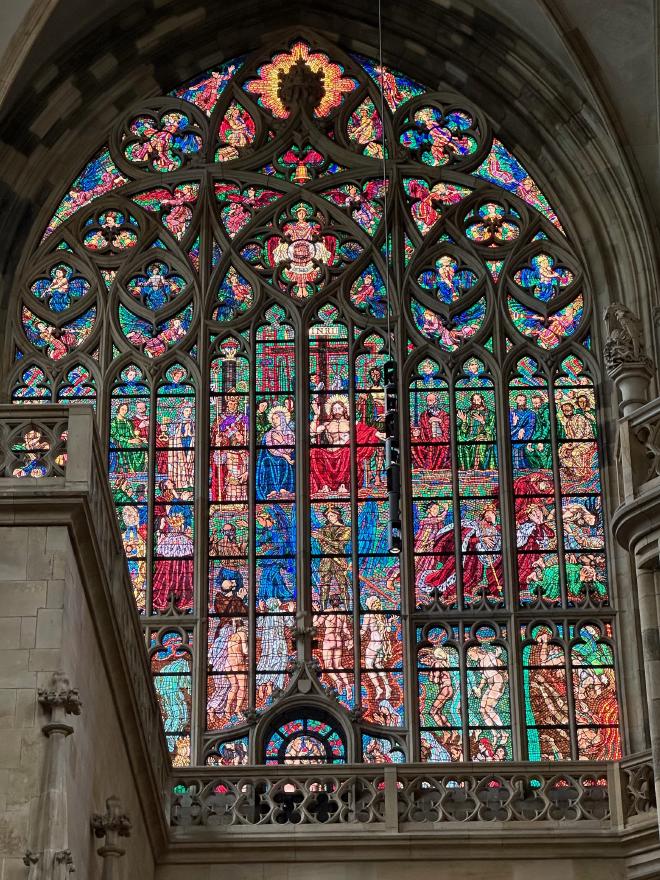
The Cathedral features some extraordinary stained glass. This piece is in Greg’s favourite style, fully mosaic, rather than the more common painted panels. The picture does not do it justice.
This piece is an interesting hybrid, fully mosaic except for the faces and the unclothed figures, which are painted.
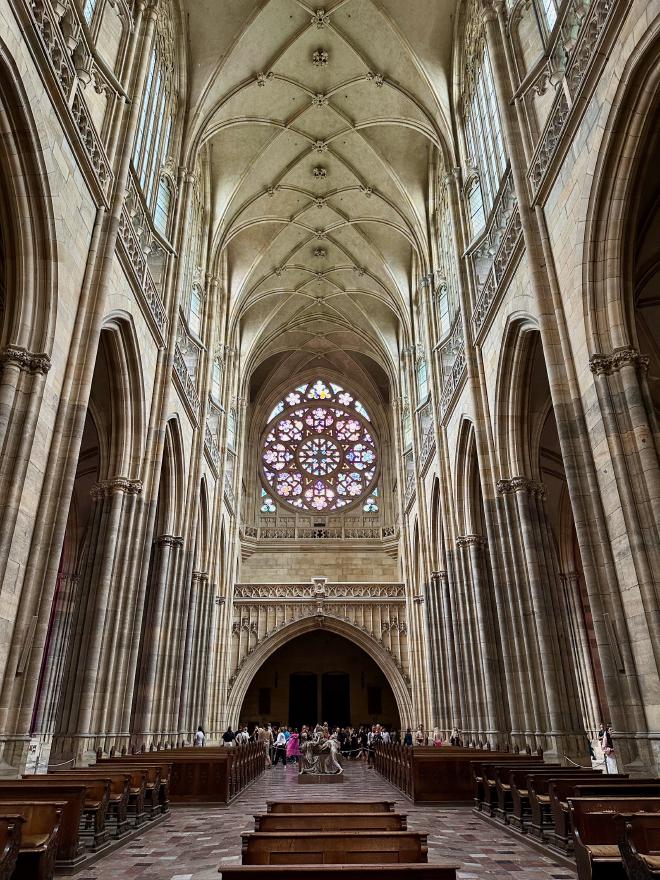
The perpendicular walls and the net vaulting of the Cathedral is believed to have influenced the architects of many other Gothic cathedrals constructed around the same time, particularly in England. However, there is some controversy as to who influenced whom.
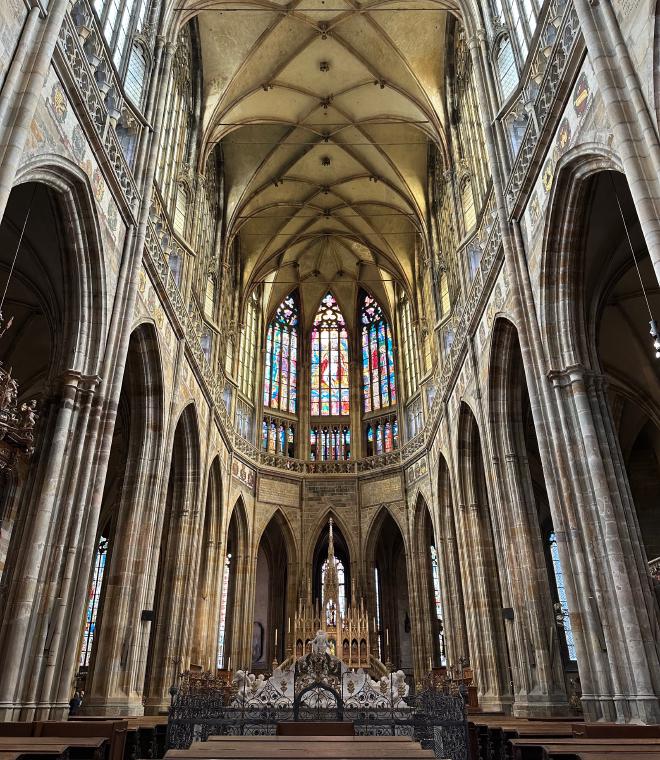
Another view of the Cathedral’s interior, showing the altar.
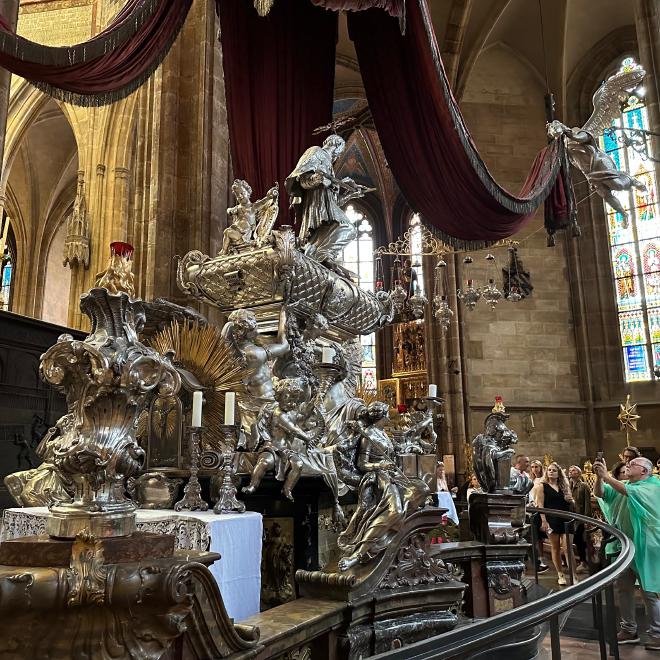
One of the most spectacular pieces in the Cathdral (certainly the gaudiest) is the tomb of Saint John of Nepomuk, constructed in 1736, 1746 and 1771 mainly at the direction of Marie Theresa, Queen of Bohemia.
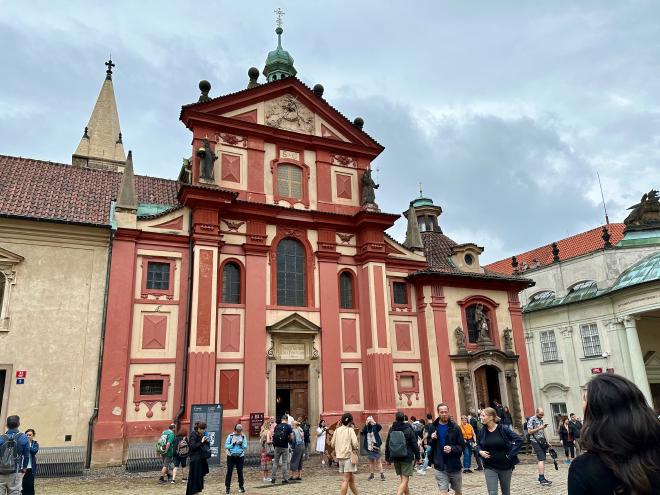
Just beyond the Cathedral is the Bazilika sv. Jiří, Saint George’s Basilica. This is the oldest surviving church building in the castle complex, dating from 920 CE.
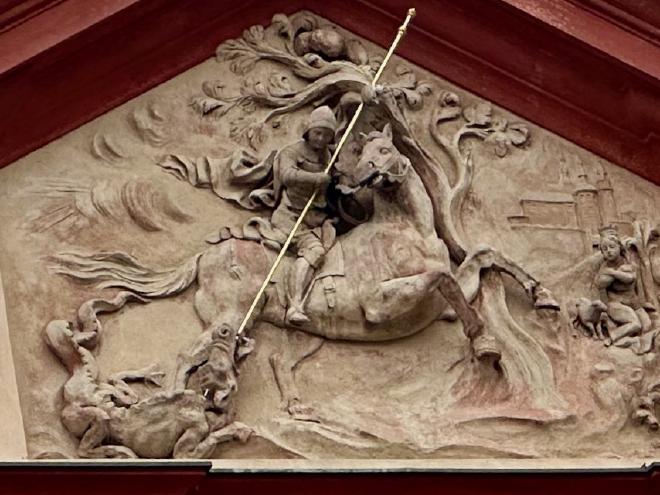
The exterior features two reliefs of Saint George slaying the dragon, this one on the western facade…
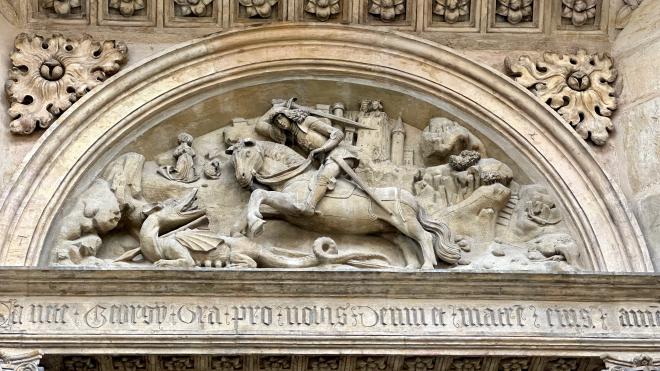
… and this one on the southern.
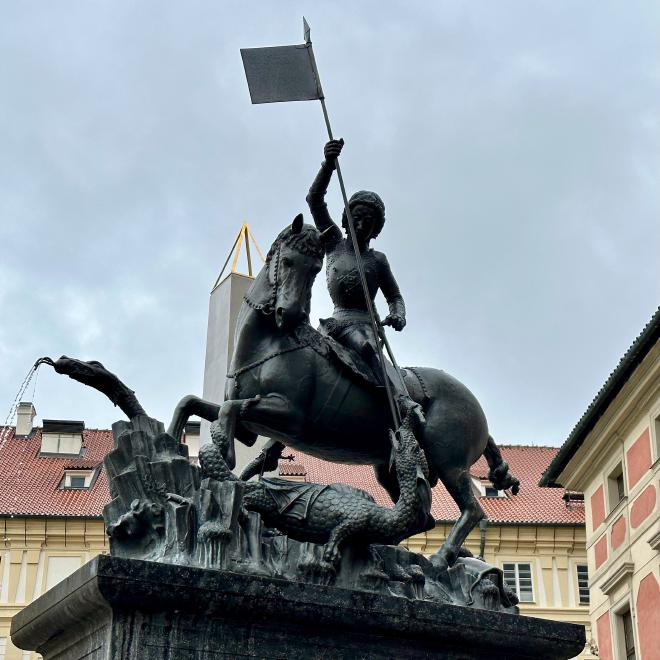
Additionally, this statue of Saint George is in a nearby courtyard. Because there’s no such thing as too much George.
The interior of the Basilica is decorated with frescoes, many of which are badly deteriorated. This was one of the better-preserved examples.
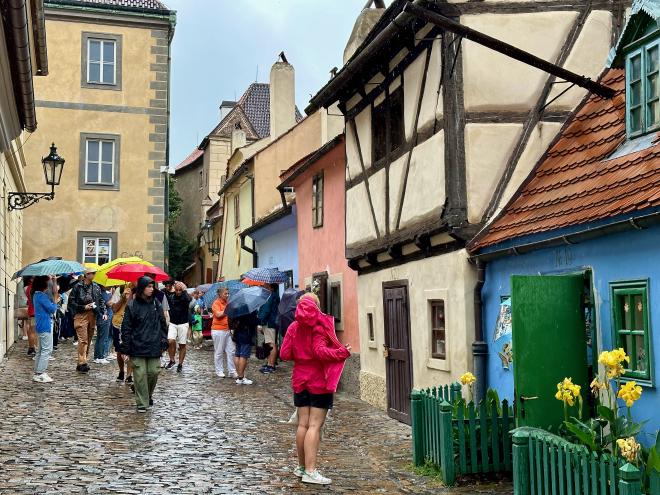
On the north-east wall of the castle compound is a narrow lane – Golden Lane – that has housed tradespeople at the castle, and their various businesses, over the years. In later years, Golden Lane became something of an artist’s colony. Franz Kafka’s sister had a place here, which he used on weekends to get away from the noise of the city.
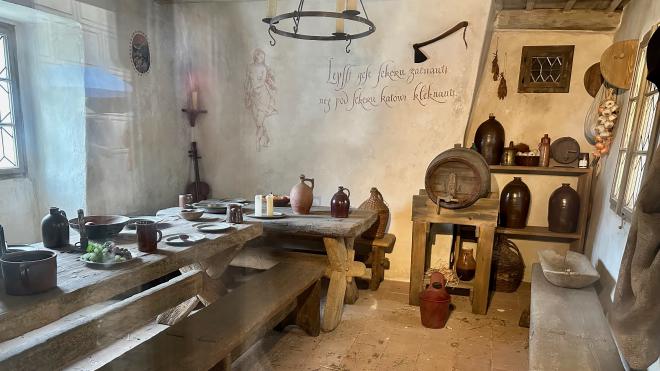
This is a tavern on Golden Lane. It’s actually one of the larger spaces we saw; most were tiny.
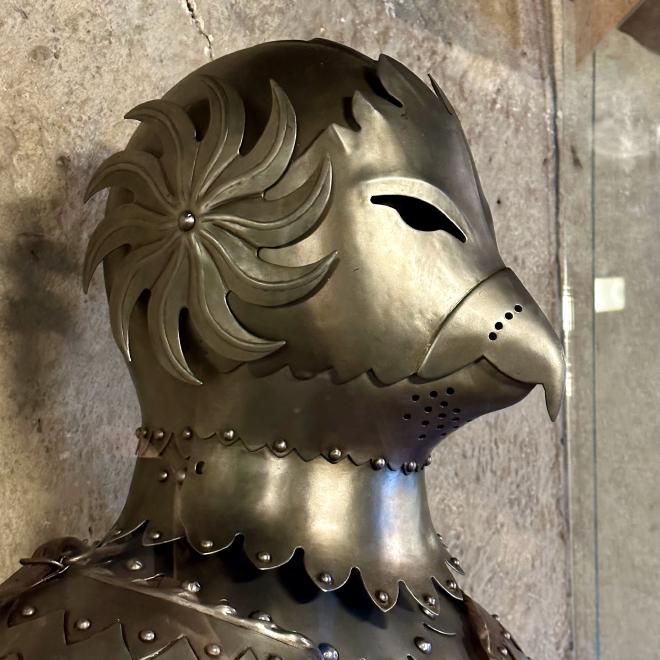
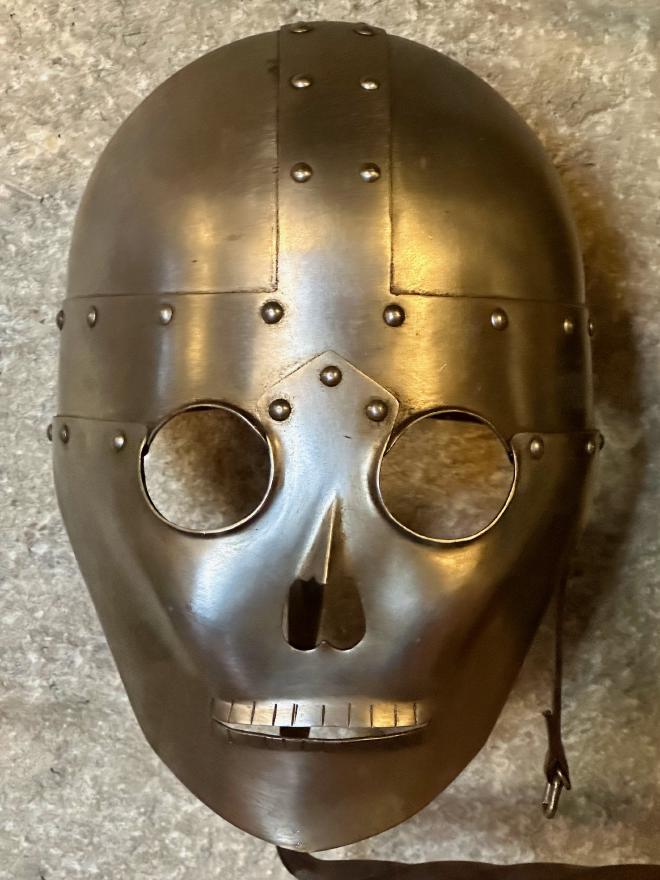
In the wall above Golden Lane there’s an exhibition of armour, spanning the better part of a millenium. This helmet belonged to the famed Chicken Man of Prague. (Actually, Greg made that up. But seriously, what is up with that helmet?)
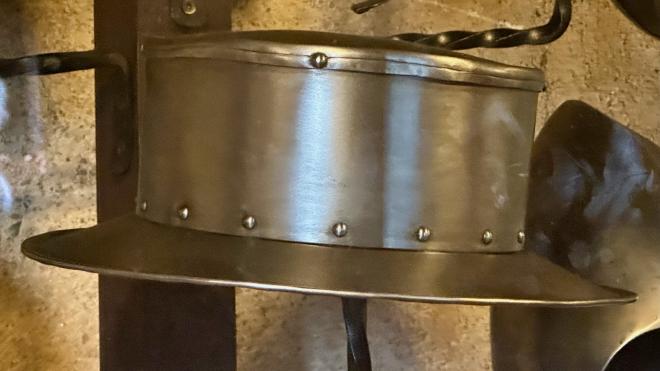
This clearly belonged to an ancestor of Tony Stark. Or possibly C3PO.
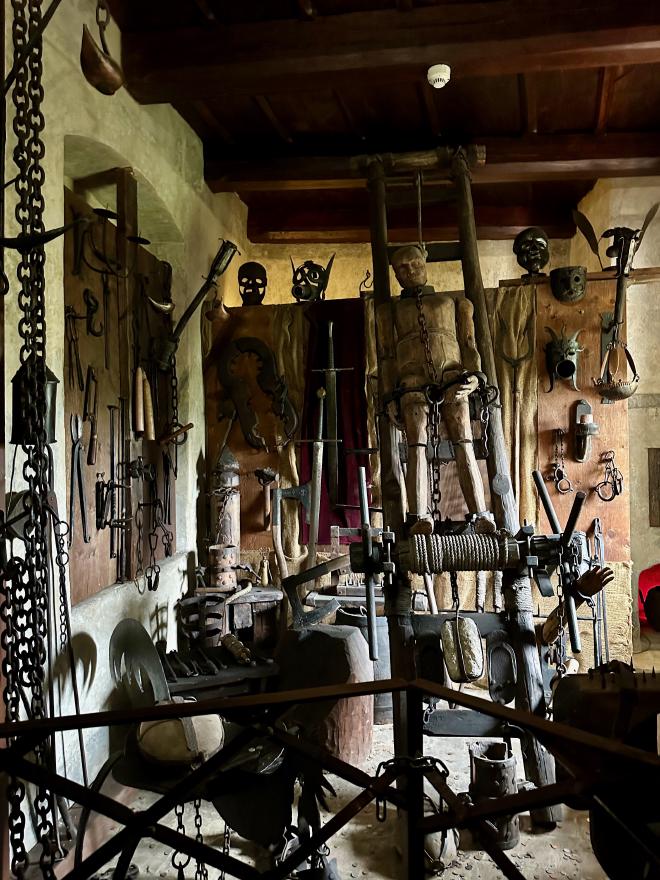
At the end of the armour exhibit is a torture chamber, which looks like No Fun At All.
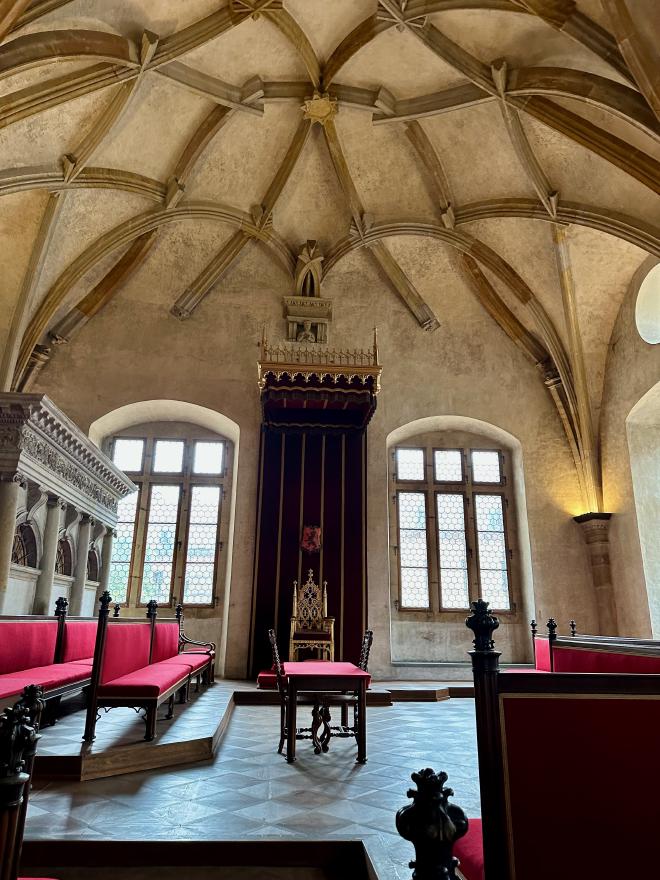
We also visited Starý královský palác, the Old Royal Palace, which dates from the 12th century. This is the throne room.
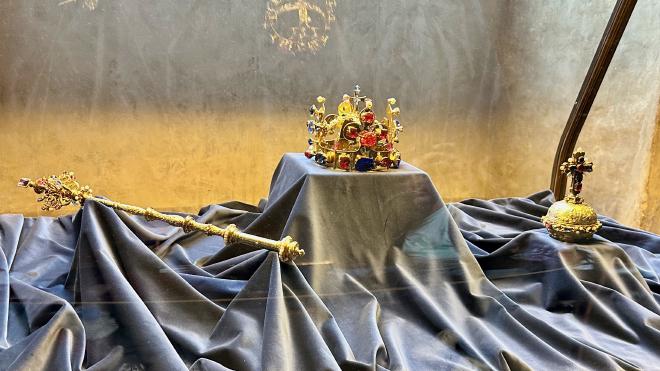
The throne room houses replicas of the Bohemian Crown Jewels. The real ones are stored in a secure facility in St Vitus Cathedral. The crown was made for the coronation of Charles IV in 1347.
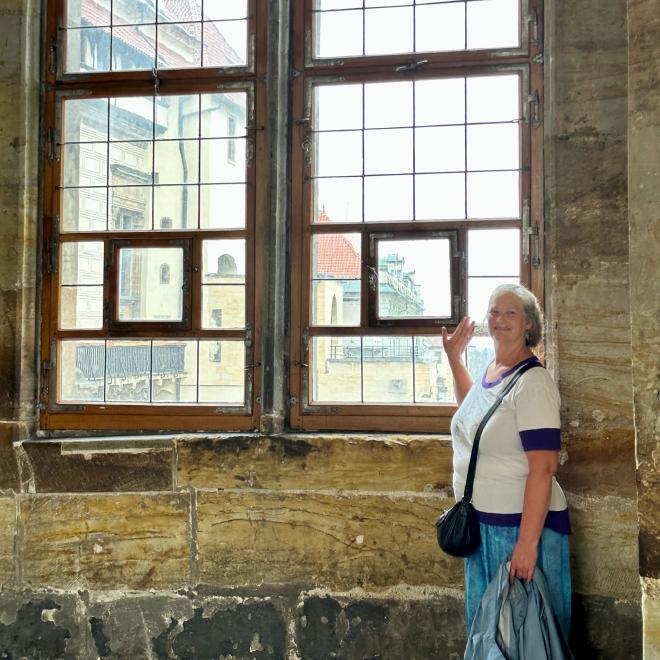
Also in the Palace is this window, notorious for being the site of the 1618 Defenestration of Prague, part of a sequence of events that led to the Thirty Years’ War. No one was defenestrated during our visit.
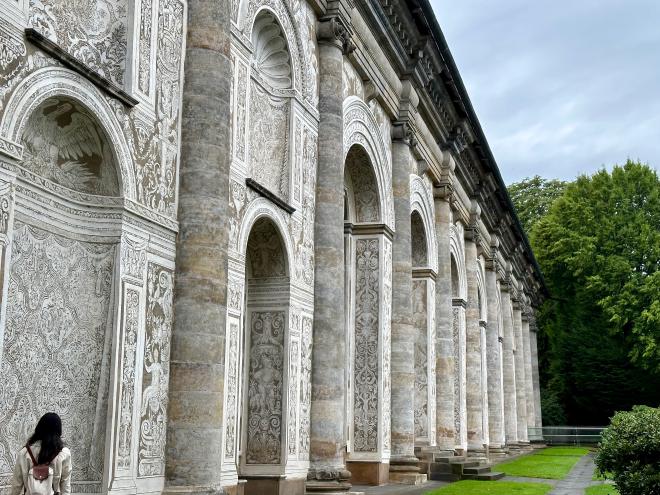
This is the Prague Castle Ball Game Hall, used for tennis-like ball games in the sixteenth century, then as a riding stables, and then as a military storehouse. The building was burned by the Nazis in 1945 and reconstructed in 1952. It’s currently used as an exhibition hall and for concerts. The decorations on the exterior are called sgraffito, and are made by scraping off a lighter exterior layer of plaster to reveal a darker layer below.
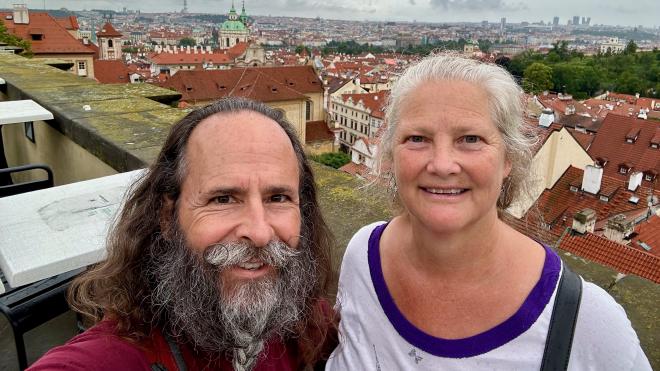
This is a view from a Starbucks (yes, really) at the edge of the south Castle wall.
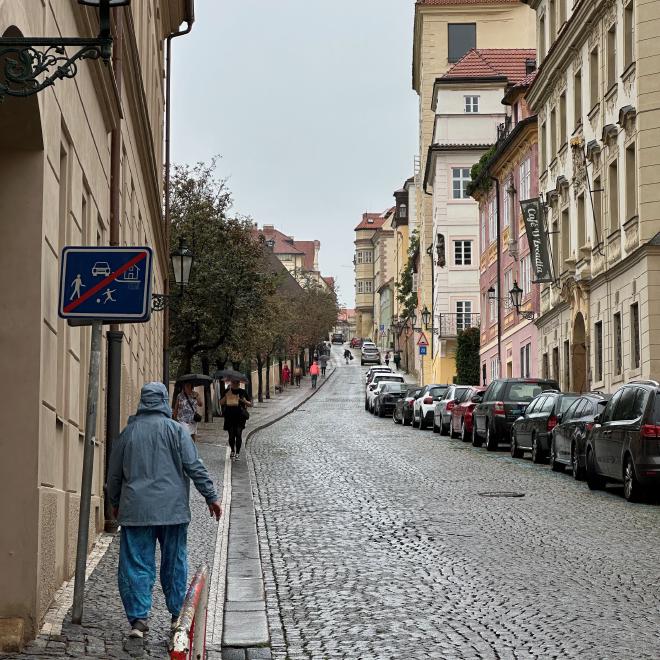
After touring the Castle we headed to Strahovský klášter, the Strahov Monastery, for dinner, based on the recommendation of our guide Jakub. As you can see, it was a bit of an uphill trudge through the rain.
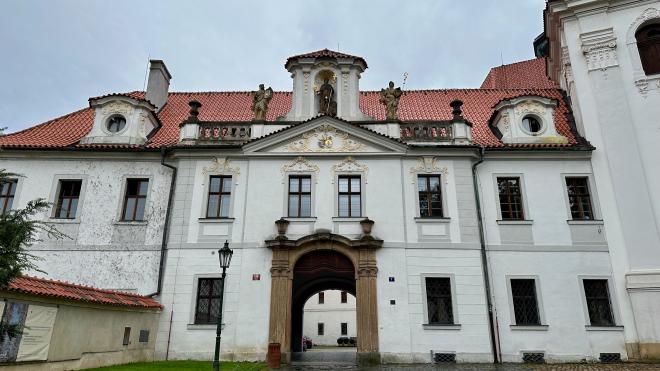
This is the main monastery building. We weren’t able to go in, but apparently parts of it are quite spectacular, particularly the Basilica and the Theological Hall.
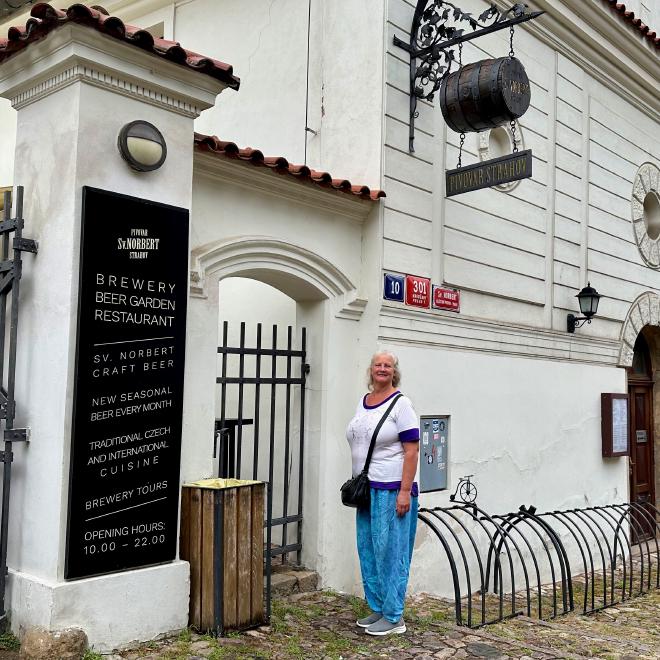
More importantly, this is the entrance to the monastery’s brewery, beer garden, and restaurant, our destination.
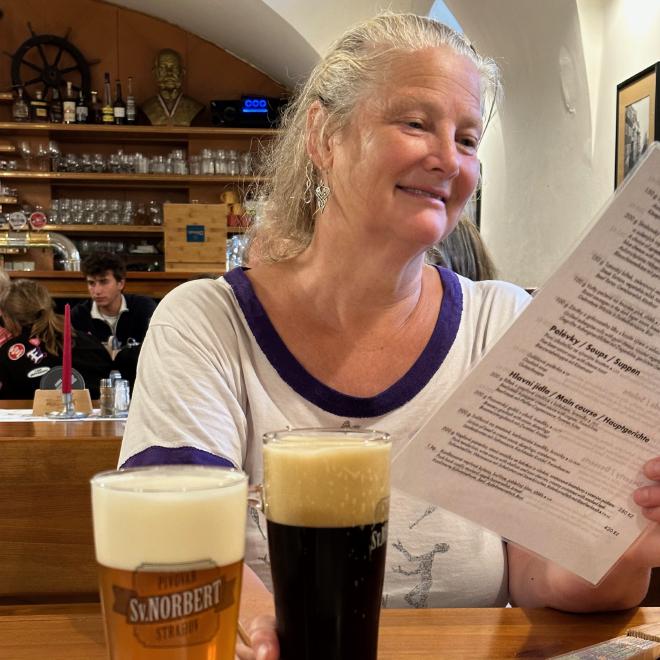
As you can see, we were a bit damp and bedraggled. However, the excellent monastery beer (Karen had the Dark, Greg had the IPA) and a delicious meal had us feeling better in no time.
On the way back down to the river the rain had lifted and we were treated to this spectacular view of the city.
Lesser Town also has its charming streetscapes.
We walked back across the Charles Bridge, giving us one more view of the Old Town Bridge Tower.
On the Monday it was raining buckets all day, and we were both exhausted from the previous days’ touring, so we elected to stay in the apartment and catch up on some maintenance and other things.