Our next stop was Hannover, chosen because (a) it’s a major German city we hadn’t yet visited, (b) it was in the right direction and reasonably easy to reach in a day from Copenhagen, and (c) our friend Bettina had invited us to stay with her.
Coincidentally, Greg was in the middle of re-reading Neal Stephenson’s trilogy, The Baroque Cycle during our visit. This is a 2700-page work of historical fiction with a small dose of fantasy, set between about 1650 and 1720, and one of Greg’s favourite reads. Some of the critical action takes place in Hannover and he was excited to see the locations mentioned in the books.
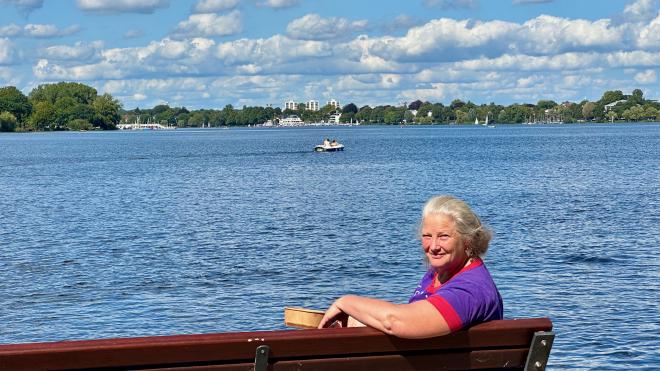
Due to some issues with train reservations we ended up with a totally unnecessary but pleasant two-hour stopover in Hamburg. Fortunately we were able to store our baggage at the station, which let us take advantage of the lovely day, buy some food, and have a picnic lunch at the nearby Außenalster lake.
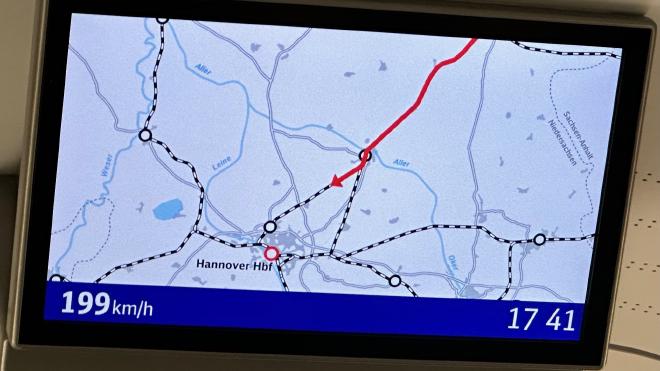
Then it was back on the train to Hannover. High-speed rail in Northern Europe is generally Trains Done Right™.
For anyone wondering, this is how Karen normally occupies herself on longer train journeys, when she’s not looking out the window.
From the main station it was a short tram ride to Bettina’s apartment where we were warmly welcomed and fed, partly with produce from Bettina’s shared garden allotment, about which more later.
The next morning we walked to the town centre (Hannover Mitte) to see some of the major sights.
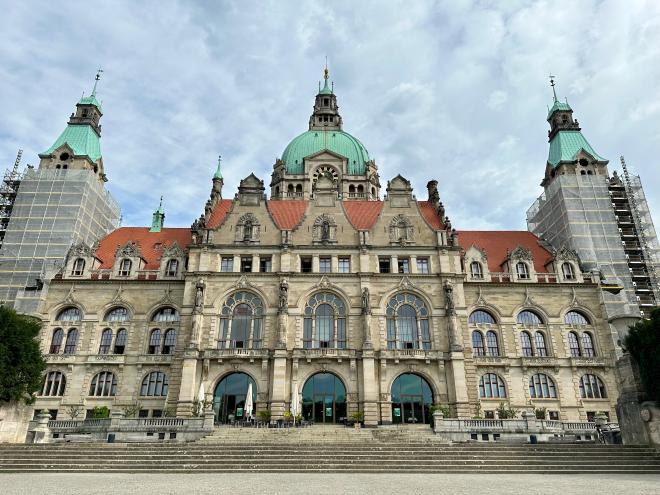
This is back side of the Neues Rathaus (New Town Hall) opened in 1913. (A handy rule: never name anything “New” – it begins to sound vaguely ridiculous far too quickly. Looking at you, RMC New Gym and Toulouse Pont Neuf!) The Rathaus is home to the City Council and many of the municipal offices, but is partly open to the public.
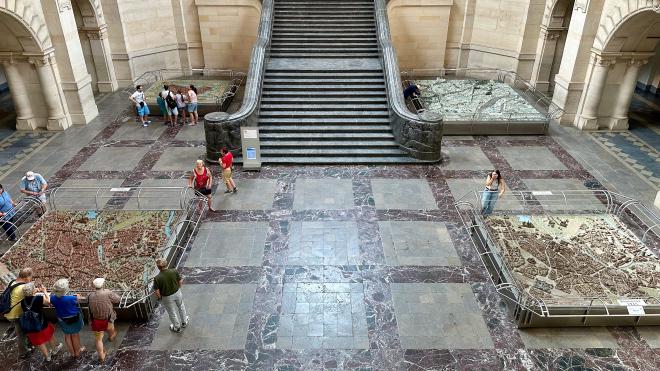
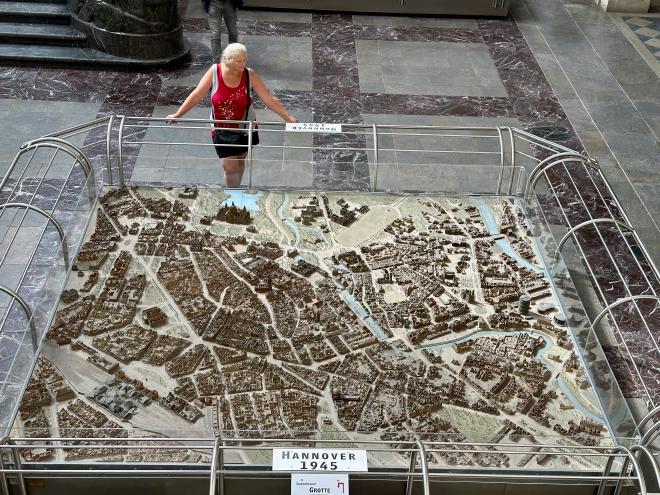
In the impressive main lobby of the Rathuas are four 3D city maps of Hannover, showing the city as it was in 1689, 1939, 1945, and today. Trying to figure out the relationships between the four was quite a puzzle, as most of the major landmarks, including the watercourses, have changed radically over the years.
This is the fortified city of Hannover as it existed in 1689. Interestingly, the main residence of the Elector and Electress of Hannover, Herrenhausen, was located well outside the city walls.
This is Hannover in 1939, a thriving industrial city. You can see the Neues Rathaus at the top, just left of centre.
And this is Hannover in 1945, after being largely destroyed by allied bombing during World War II. The Neues Rathaus escaped almost undamaged, but much of the rest of the city was in ruins.
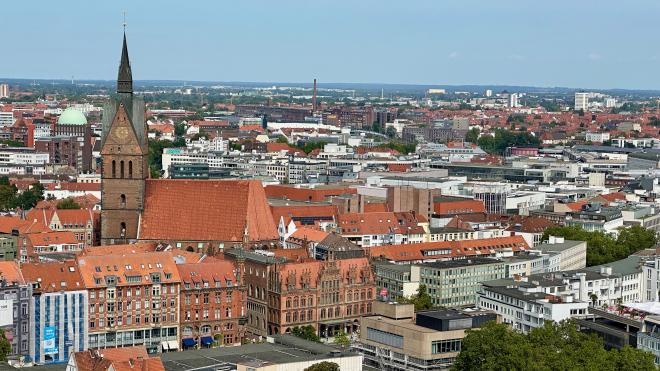
The Rathaus tower is open to the public for a small fee and is reached by a slightly-inclined elevator that actually goes around a bend on the way up. The views from the top are excellent. Notice the roofless church with its tower in this view, which we’ll see again in a moment.
This view features the Old Town Hall, the ornate red brick building just to the bottom right of the large church (Marktkirche). The Hall was originally built in 1410 and extensively restored in the 1950s and 1960s following its damage in the war. The oldest secular building in Hannover, the Old Town Hall is now used as commercial space.
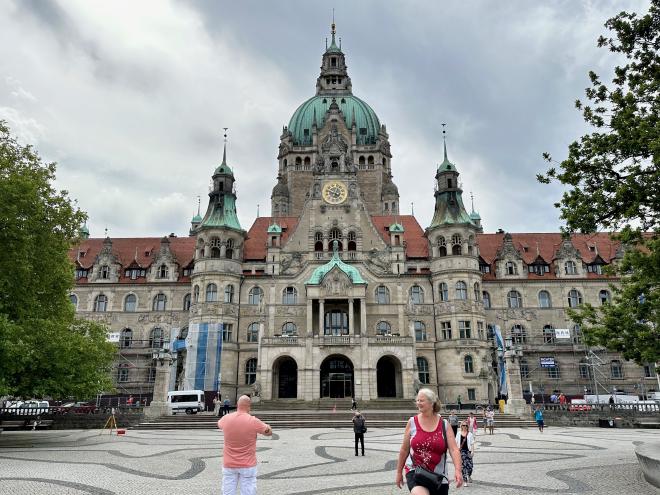
The front of the Neues Rathaus.
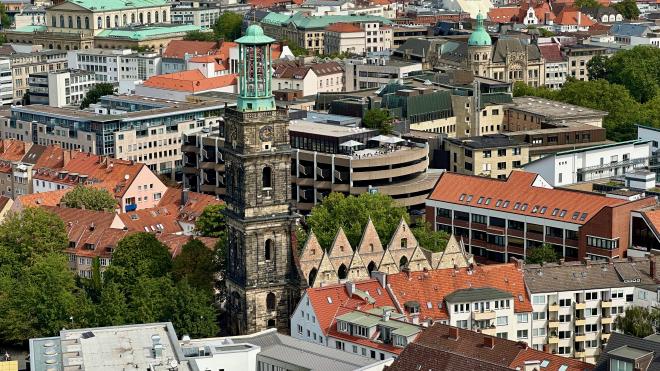
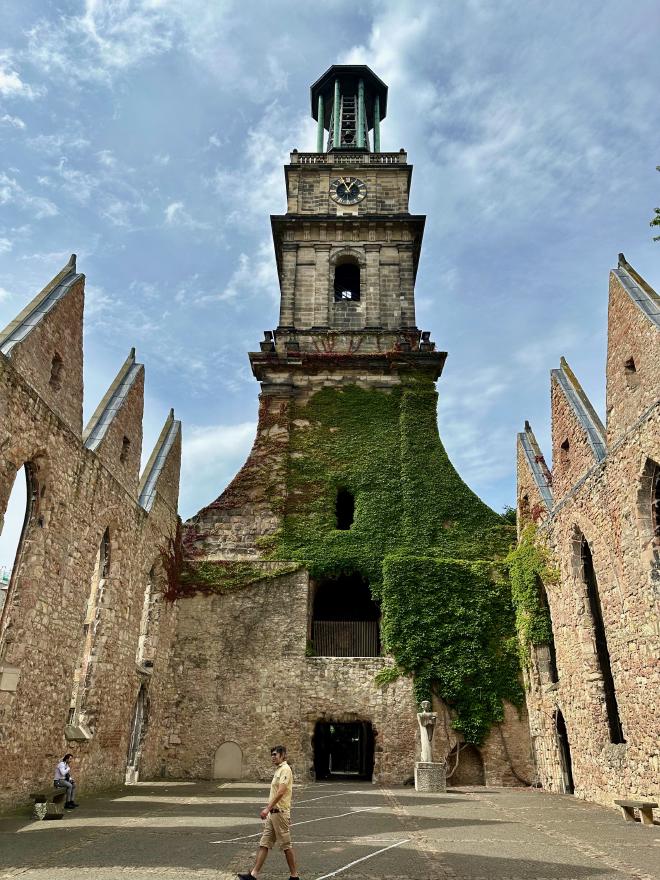
This is the ruined Aegidienkirche. It was built in 1347, replacing a twelfth century church on the same site. Destroyed by bombs in 1943, it was partially reconstructed in 1952 and kept unfinished as a memorial to victims of war and violence.
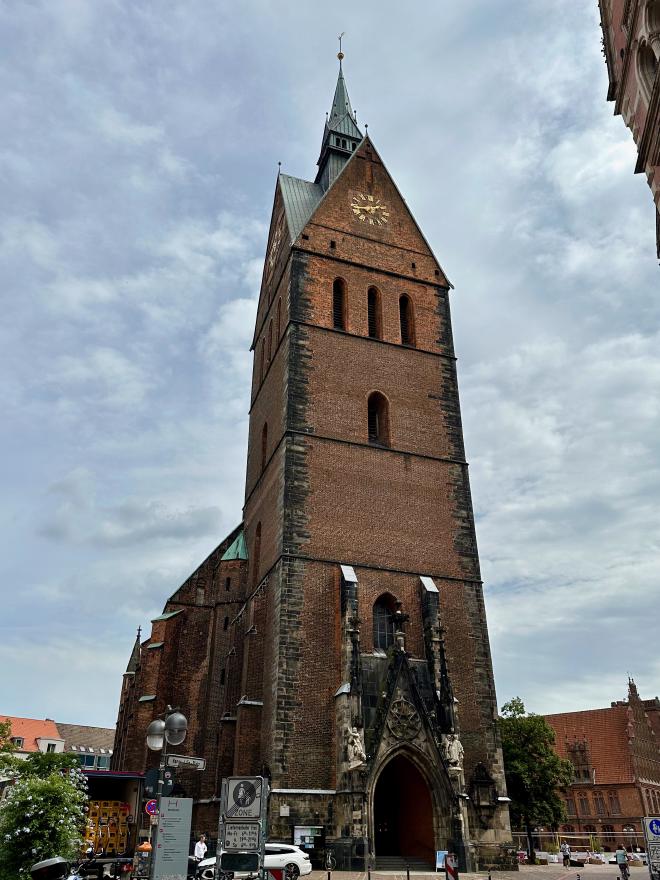
With its large tower, Marktkirche is a major landmark in downtown Hannover.
Built in the 14th century, Marktkirche was originally Catholic and is now Lutheran, with typically-spare interior decoration. Its roof and the vaults of the nave were restored in 1952 after having been destroyed by bombing in 1943.
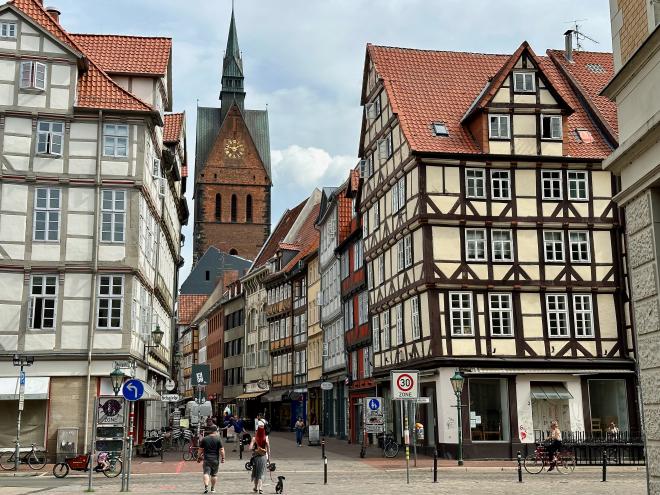
Very little of Hannover’s Old Town survived the bombing, and much of it was replaced with modern construction. However, there are a few streets with beautifully-restored medieval buildings.
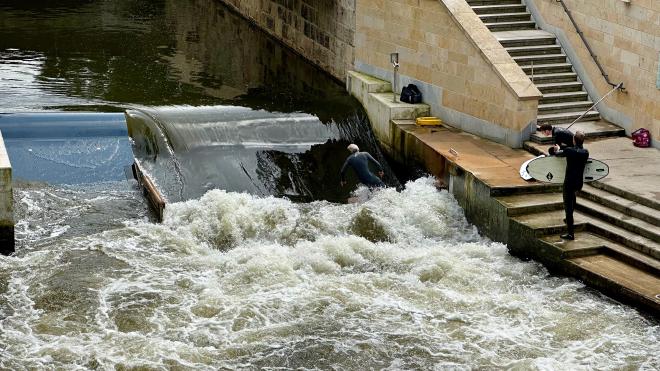
Just on the edge the Old Town is the Leine river, which features this artificial wave. Even in the early afternoon it was crowded with enthusiastic waveboarders of various skill levels.
Just upstream from the wave is the Leine Schloss. Once a city residence of the Elector and Electress, it now houses offices and a conference centre.
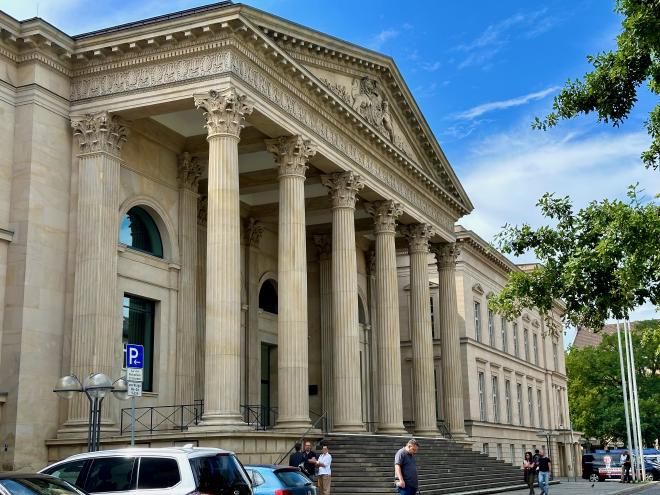
While the back of the Leine Schloss is quite austere, the front features this neo-classical entrance.
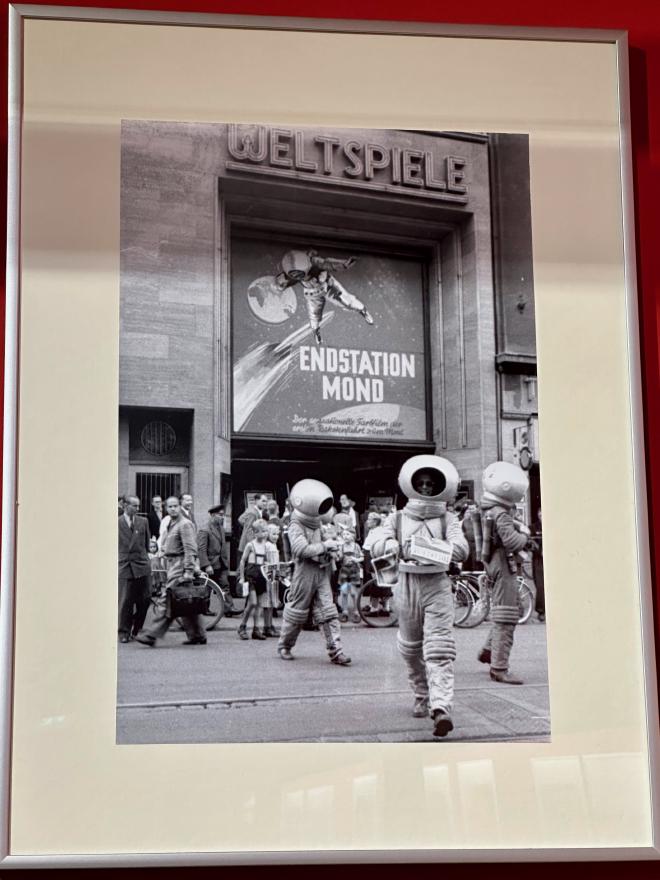
After walking most of the city core, we visited the Hannover History Museum. The permanent exhibitions were closed due to renovations, but they did have an interesting exhibit about Hannover’s vibrant movie production scene in the 1950s and early 1960s. Advertising for some of the features was literally out of this world (sorry, couldn’t resist). There was also an exhibit about Hannover’s role in colonialism and the slave trade, including its close connections with England. King George I of England was also Elector of Hannover, as were his successors George II, George III, George IV, and William IV. Queen Victoria was of the same line, but a woman could not be Elector of Hannover, so the connection formally ended there.
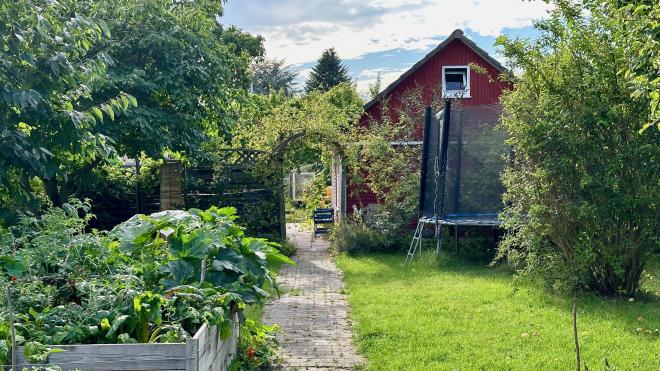
From Mitte we walked out to Bettina’s garden site. We weren’t sure what to expect; this is what we found. It’s very large and includes a small building with a kitchen, lawns, a hot tub, apple trees, and extensive garden spaces. Bettina co-owns it with several friends, many of them also jugglers.
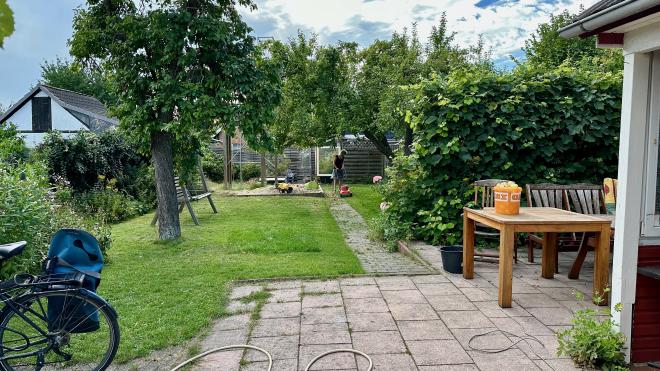
When we arrived, Bettina was taking care of some chores including mowing the lawns and collecting fallen apples. We helped with the latter, and moved furniture out of the mower’s way. This was partly general maintenance, but also partly preparations for Bettina’s birthday party to take place two days following.
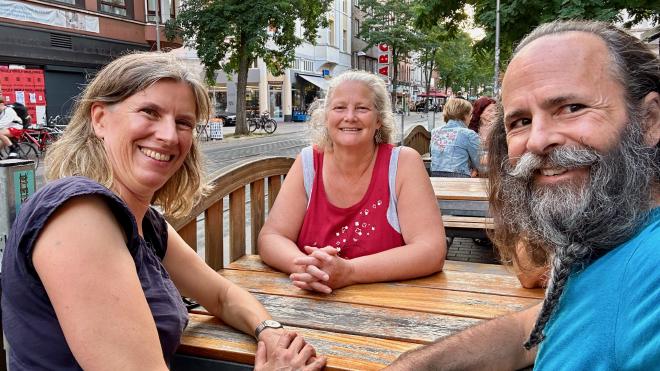
Once the chores were done we walked into the centre of Linden, which is the area where Bettina lives. We had an excellent dinner at a Vietnamese restaurant on the main entertainment street. We were sharing this table with a family of three; a mother and father about our age and their daughter, who looked to be in her twenties. They were excited to meet us as they were shortly to be leaving for Boston, to visit their older daughter, her husband, and their children.
Then it was back to Bettina’s for some well-deserved rest.
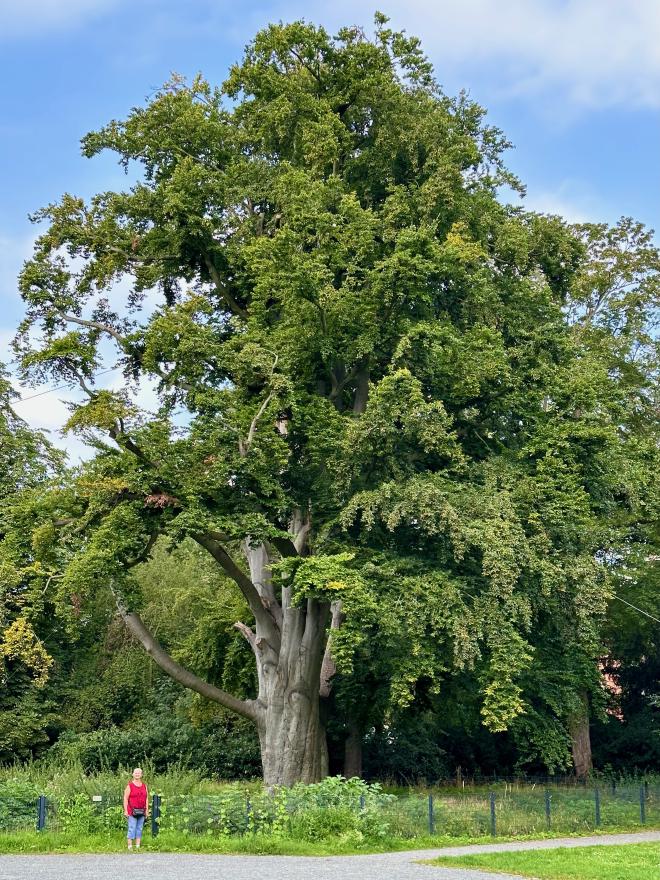
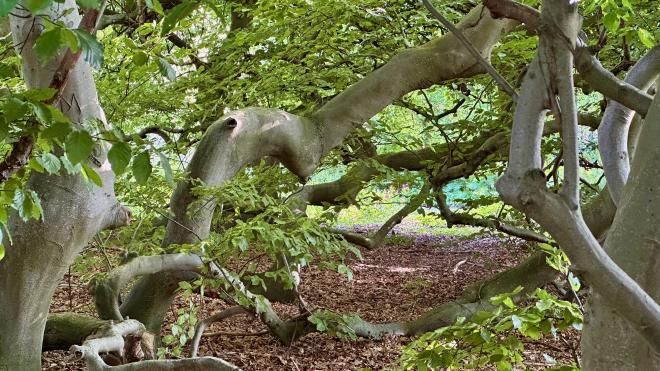
The next day we started by visiting the park immediately behind Bettina’s apartment building. This beech tree is over 200 years old and consists of three trunks that were twisted together as saplings. It is over six metres in circumference and thirty-five metres in height.
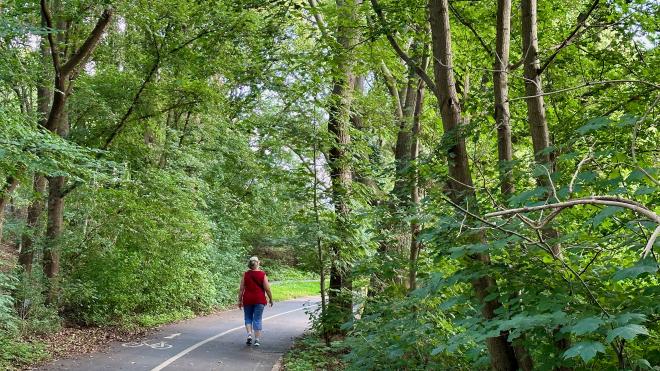
Our destination that day was Herrenhausen, once residence of the Electors of Hannover, now a museum, conference centre, and formal garden. We walked; Hannover is blessed with abundant walking and cycling paths, many of them treed.
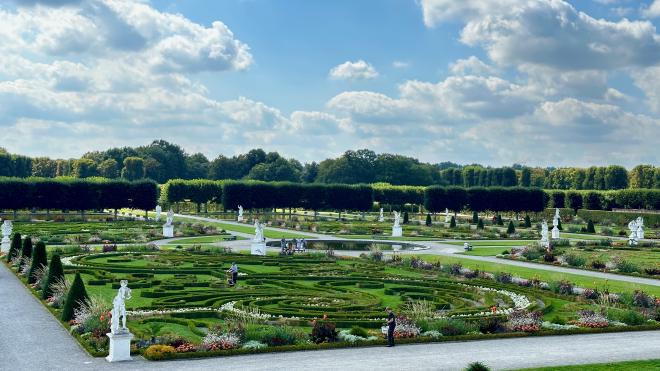
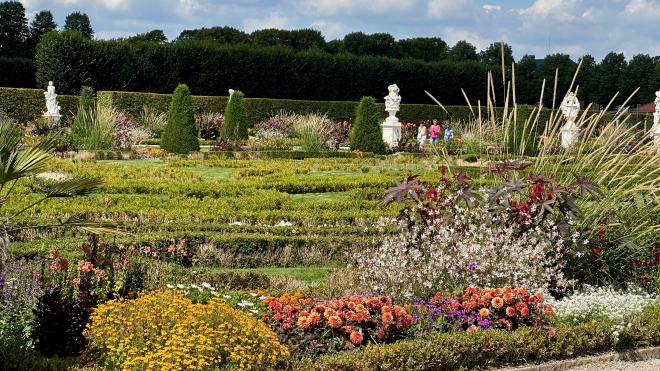
We toured the museum first, which features a history of the line of Electors and of Herrenhausen itself. The main building is not particularly exciting from the outside, but the gardens, largely installed at the direction of Electress Sophie in the late 17th century, are enormous, varied and spectacular. (Sophie and her gardens both play key roles in The Baroque Cycle.)
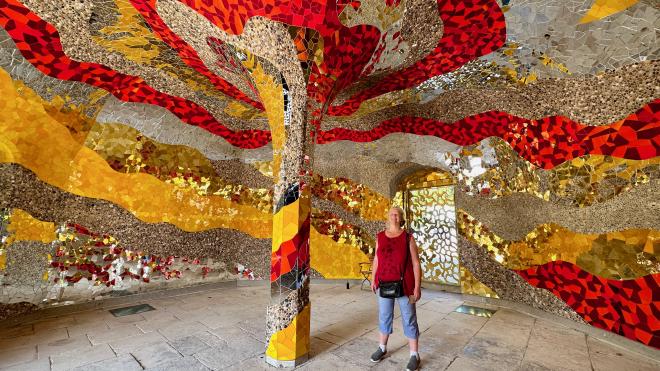
The gardens also house a Grotto, which has been entirely decorated in mosaic, in a variety of styles. Bettina, who has done some mosaic art herself, particularly encouraged us to visit.
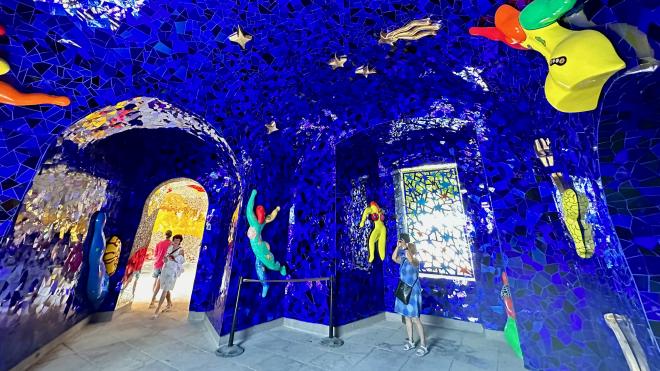
This is the other main room in the Grotto, featuring statuary by well-known Hannover artist Niki de Saint Phalle.
We spent a couple of hours walking the gardens, and took far too many pictures to post.
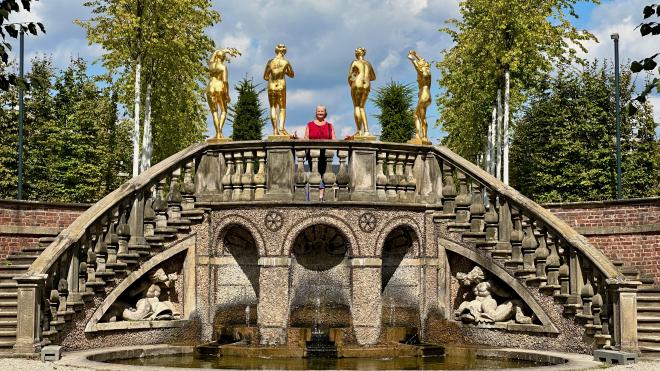
This fountain is near the entrance to the ground’s outdoor theatre. Greg suggested that Karen disrobe and pose on the rail with the statues, but for some reason she declined.
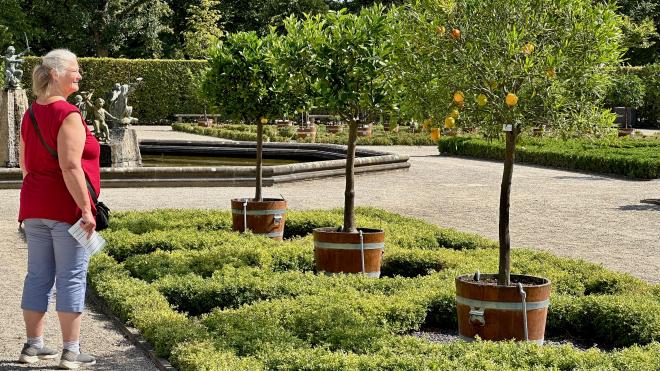
One corner of the garden contains the orangerie, partially a greenhouse for oranges and other citrus plants. In the summer the trees are placed outside to make the best of the sun.
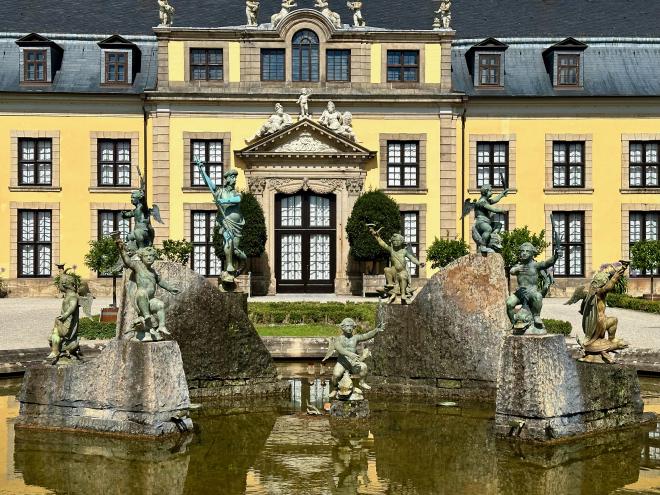
The orangerie itself is one of the more interesting buildings in the Herrenhausen complex, and also features this delightful fountain.
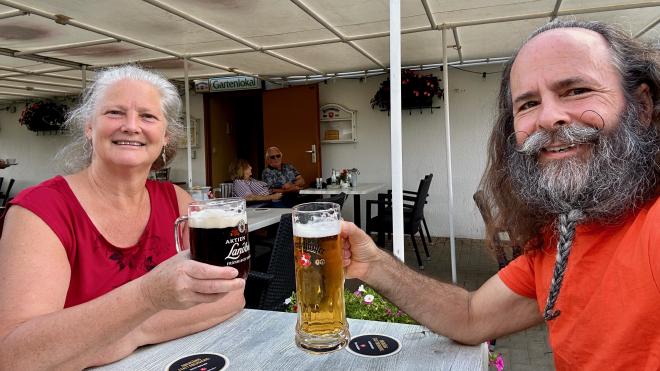
Our next stop was the Berggarten botanical gardens, just across from Herrenhausen. However, it was definitely time for a late lunch after all our walking. Google Maps helped us discover the Gartenlokal, a delightful little restaurant just beside the Berggarten and set in the middle of a community garden area much like Bettina’s.
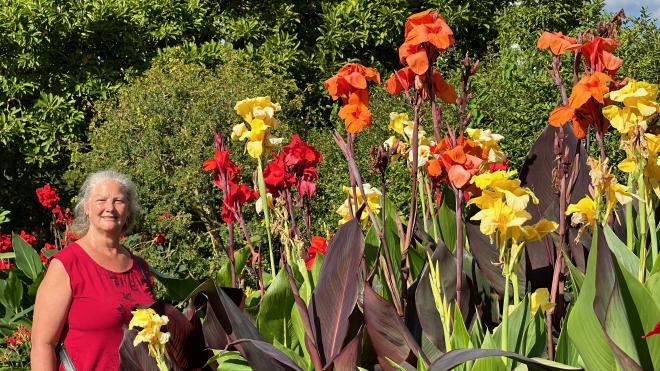
The Berggarten is quite large and includes plants from around the world, some outdoors and some in greenhouses. Again, we took way to many pictures to post, but Karen loves hibiscus, so this one is a must.
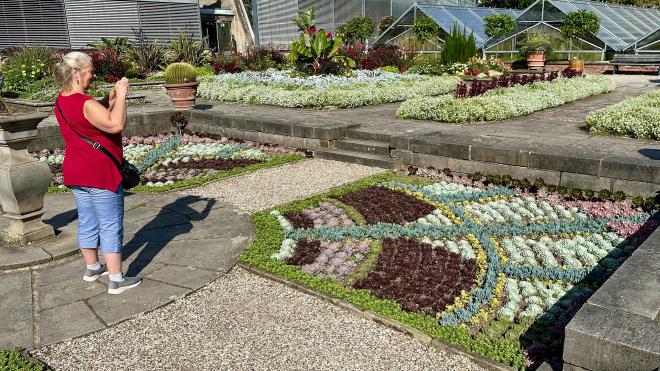
Another in our series of pictures of Karen taking pictures of things.
The gladiolas were enormous with incredibly vivid colours.
This tree is called the Süntelbuche. Translating from the sign in the garden: “Mountains of the Süntel, which lie approximately 50 km southwest of Hanover. The last large Süntelbuchen forest was cut down there in the [19th] century and burned as worthless “devil’s wood”. [This tree] was planted around 1880. The circumference of the main trunk is around 2.80 m. The treetop covers an area of approximately 750 square meters.” In The Baroque Cycle, the Electress Sophie’s death takes place on a tree like this. Whether that’s accurate or not, she did die in Herrenhausen gardens during a sudden rain storm, likely from a stroke. The books also include an attempted assassination scene that takes place on the same Süntelbuche a chapter or two later.
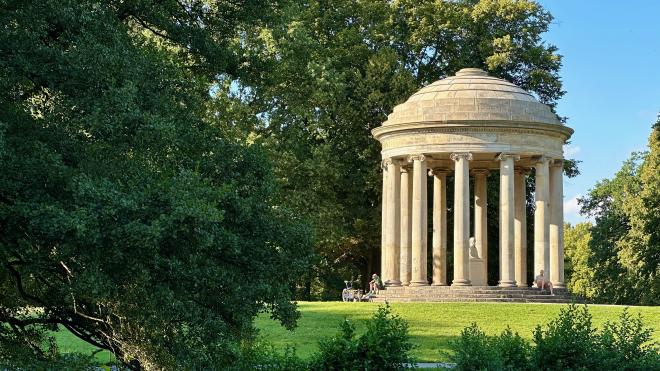
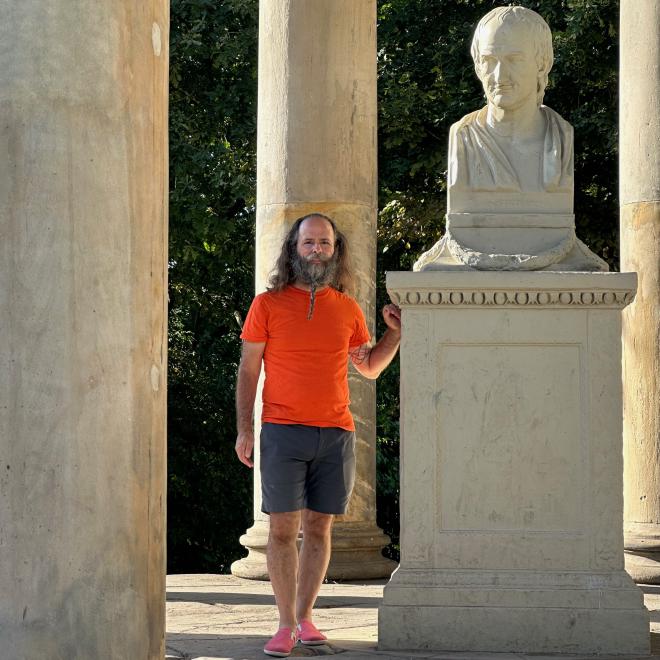
On the way back from Herrenhausen and the Berggarten we walked past the Leibniz Temple, a memorial to Gottfried Wilhelm Leibniz, sometimes referred to as “the last universal genius” due to his work in mathematics, philosophy, science, and diplomacy.
Leibniz is primarily known for his co-invention of the integral and differential calculus, also attributed to Sir Isaac Newton and subject of decades-worth of wrangling as to who should receive the credit. Greg took five years of calculus in high school and university, and has often said that his inability to develop any intuition for it was one of the things that drove him from physics to software engineering. (Yes, there’s mathematics in software engineering, but it’s entirely different mathematics!) Regardless, Leibniz is one of Greg’s intellectual heroes.
When we got back to Bettina’s, her boyfriend Martin was visiting and she was in the middle of baking cakes for her birthday party. We had already walked about fifteen kilometres by that point, but Martin and Bettina talked us into a stroll “up the Linden mountain” with a promise of refreshments at the Biergarten Lindener Turm on top. Fortunately the “mountain” was more of a gentle hill, the walk wasn’t far, and, as promised, the food, beer, view and company were all excellent. Oh, and remember that family we’d sat beside at the Vietnamese restaurant the day before? They were at the next table, leaving just as we arrived. Apparently Linden is a small place!
The next day was Bettina’s birthday, with her party scheduled to start about 4 pm, so we decided to keep our agenda fairly limited.
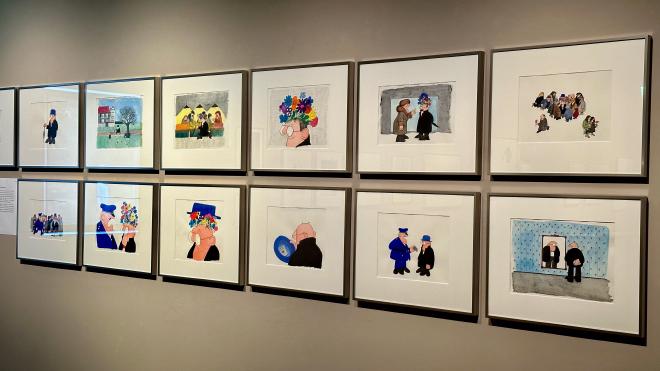
On the way from Bettina’s apartment to her garden is the Wilhelm Busch, a quirky museum dedicated to the art of caricature and drawing. The main exhibit during our visit was the work of Volker Kriegel, primarily known as a jazz guitarist and composer, but also a prolific cartoonist and author.
Greg was delighted to find one of Kriegel’s works (a caricature of one of his band mates) with a circus theme.
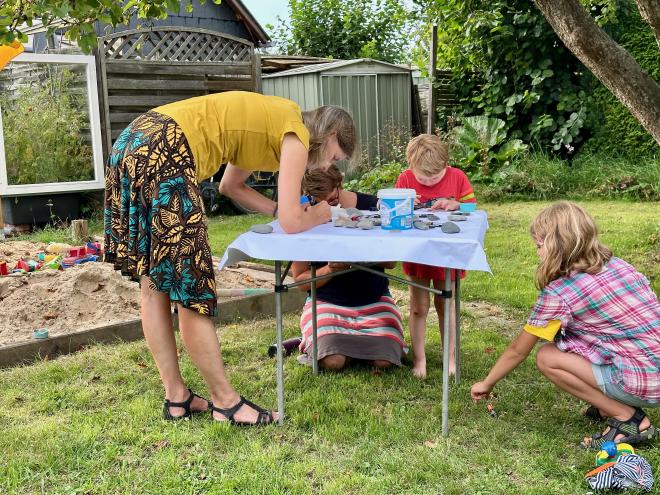
Then it was off to Bettina’s birthday party at the garden. The guests included other garden folk, jugglers, co-workers, and their children. Bettina had a rock-painting station set up for the kids, but adults got into the game as well (including Bettina, here). Greg made Bettina a rock with a diagram of the juggling siteswap [52] in honour of her fifty-second birthday. We also got her a deck of playing cards, for obvious reasons.
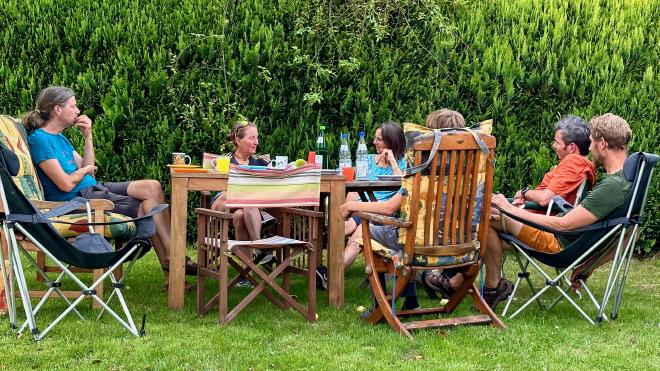
We spent a lovely afternoon and evening eating grilled sausages and several kinds of cake, relaxing, and chatting. Bettina’s friends all made us feel very welcome.
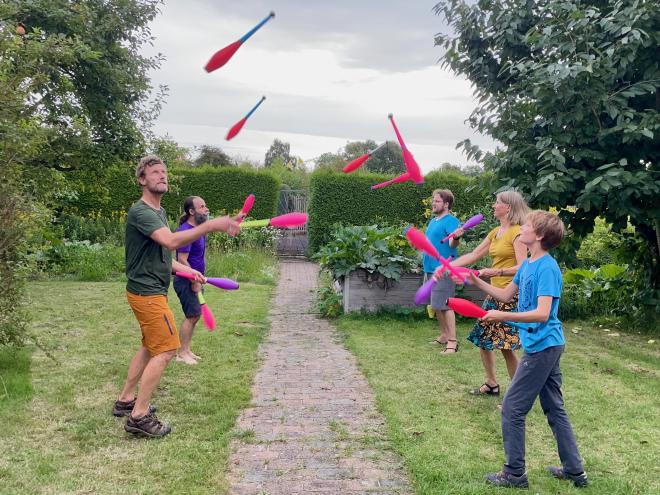
There was also a bit of club passing, of course. From the far end, our friend Lars, Greg, Bettina, a friend of Bettina’s whose name we don’t recall, and his son who we believe was named Jakob. For the jugglers: a three-count W, with Lars on the end juggling Chocolate Bar, so Greg was doing ultimates.
While at Bettina’s party Greg received a text that his former decanal colleagues Gregg Wade (left, Science) and Jim Denford (Social Sciences and Humanities) were meeting for a beer after work and would like him to join virtually. Meetings of the three Deans for beer, problem solving, kvetching, and mutual support were a monthly highlight of the several years they served together, and the three of them have continued the tradition since the ends of their tenures. So, once we were back at Bettina’s house, Greg got a beer from Bettina’s fridge and joined them briefly on FaceTime. Thanks to Gregg Wade for the remote selfie.
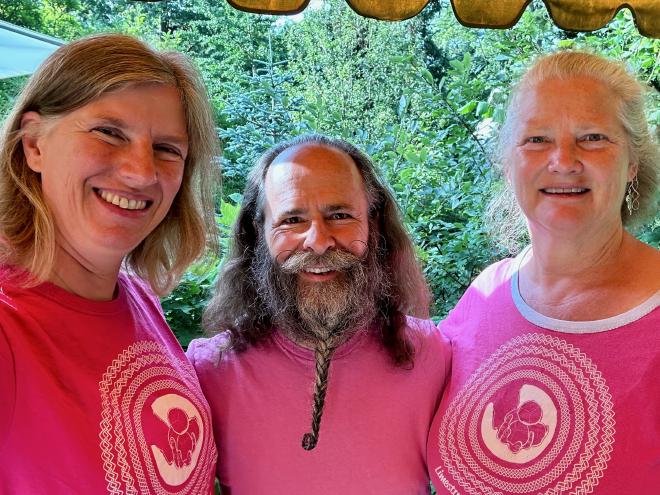
The next morning Bettina made us a lovely farewell breakfast which we ate on her balcony, where this picture was taken. By complete coincidence all three of us wore pink shirts, and Karen and Bettina were both in the shirt Greg designed for our fourth Kingston Juggling Festival. (Bettina wasn’t at the festival but she’d seen the shirt on a Facebook post and had Greg bring her one at the 2018–19 PassOut club passing convention near Hannover.)
After breakfast, a walk together to the tram stop, and fond farewells, it was off to our next stop, Prague.