We had been in Lublin once previously, for the 2017 European Juggling Convention, but that time we didn’t see much of the city. Since the EJC was returning to Lublin this year, we decided to arrive a couple of nights early (Thursday, 27 July) to remedy that. This was a last minute decision, so we’d only pre-booked accommodations for the EJC itself and had to find a second spot for our arrival. Fortunately, there was a nice AirBnB available about 800 metres from our main booking — ’though unfortunately it was quite a bit more expensive than our main booking for the week! Last minute decisions, peak travel time, etc.
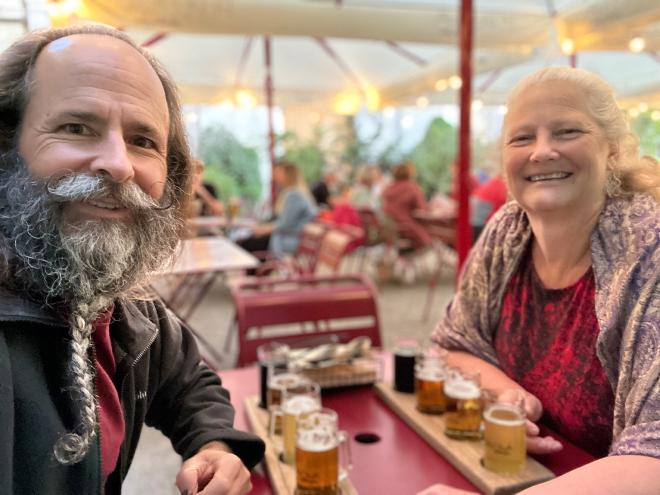
After we’d arrived and settled in, we headed out for a proper Polish meal. Lublin is headquarters to the Perła Brewery (pronounced ‘pear-wah’) and their flagship restaurant, Perłowa Pijalnia Piwa (“pijalnia piwa” means “beer bar”) was a five minute walk from our apartment. Perła makes a wide range of beer, so we each tried a tasting flight with different selections. Karen particularly enjoyed their dark lager and their honey ale. The food was also delicious.
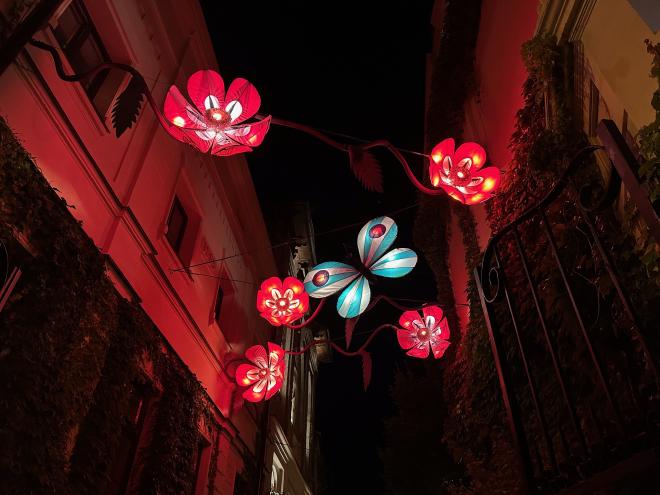
On our way back after dinner we passed this beautiful illuminated display.
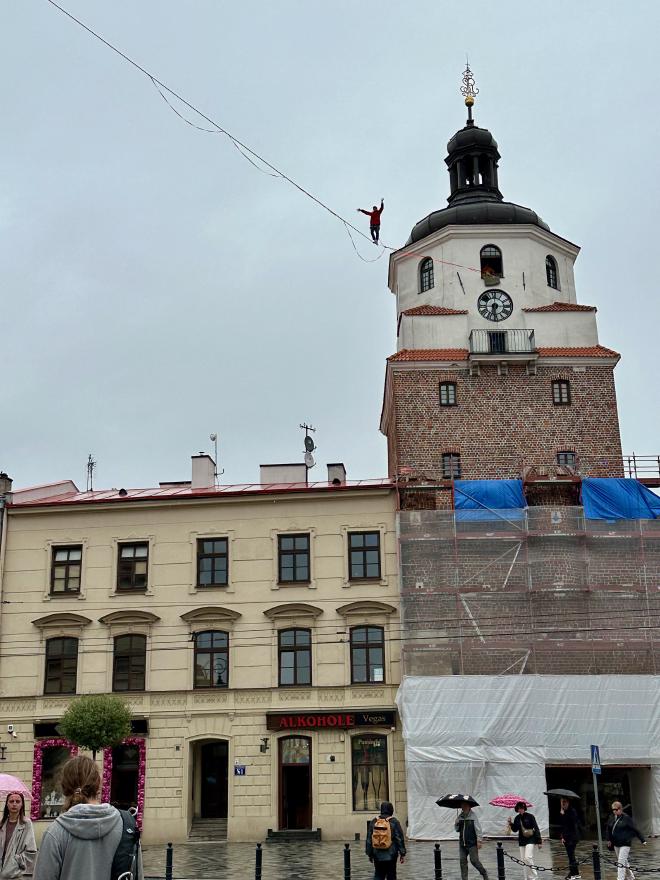
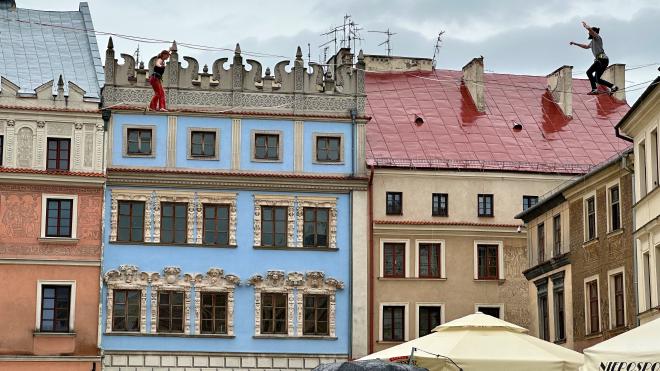
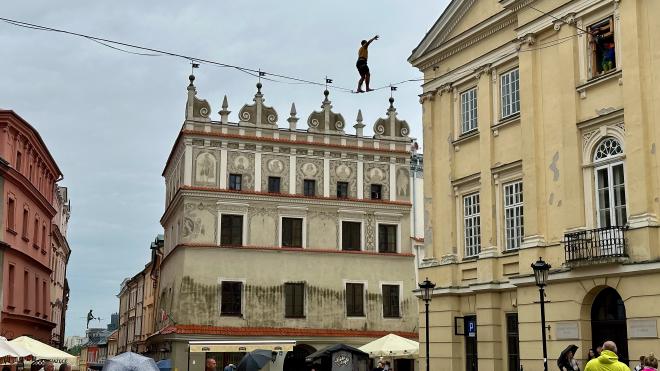
The next morning we headed out to explore the city, particularly the main pedestrian district, Old Town, and the Castle. The 11th annual Urban Highline Festival was running from 27 through 30 July, so we got an extra dose of circus. There were high lines strung at several places around the city centre, which festival participants could sign up to try. This was the highest, strung between the tower on the old city gate (shown) and the Town Hall. Despite the rainy conditions the lines were always in use, mostly for practice but occasionally for public demonstrations.
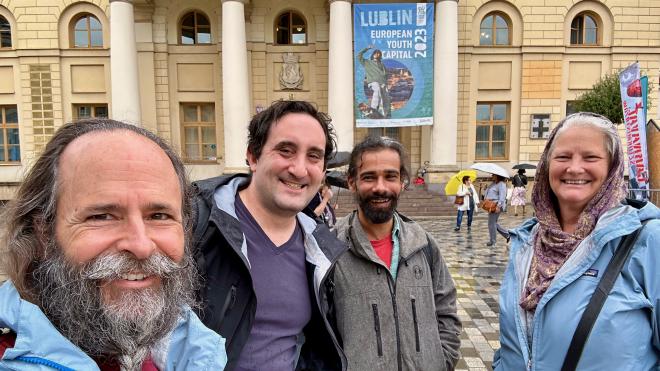
While watching the highline we bumped into our friend Elliot from New York City (second from left) and his friend Flo. Elliot is a juggler, club passer, and regular EJC attendee, so we weren’t surprised to see him. What we didn’t know was that he had taken up highline during the pandemic and was also here for the urban highline festival, as was Flo. That’s the Lublin Town Hall behind us.
There were also highlines in the Old Town square.
Seriously, those highliners were everywhere!
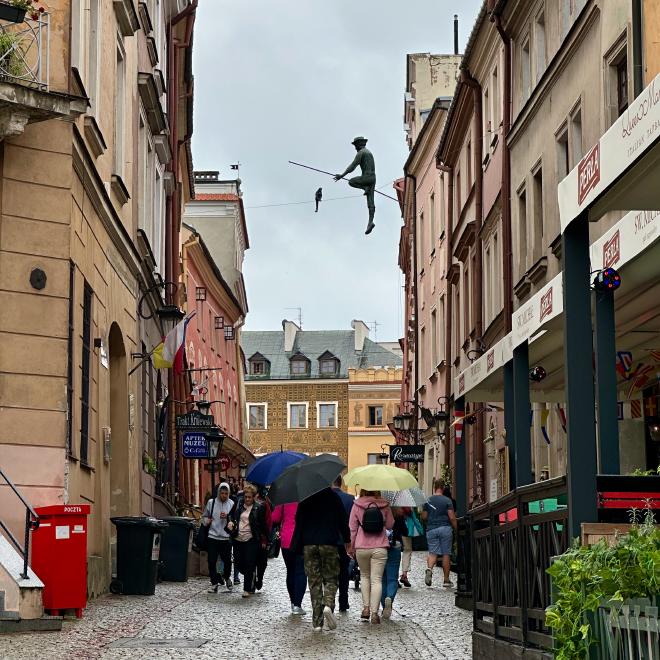
You can tell that Lublin loves the highliners. This is a permanent statue of a line walker and a monkey, above the main street in the Old Town.
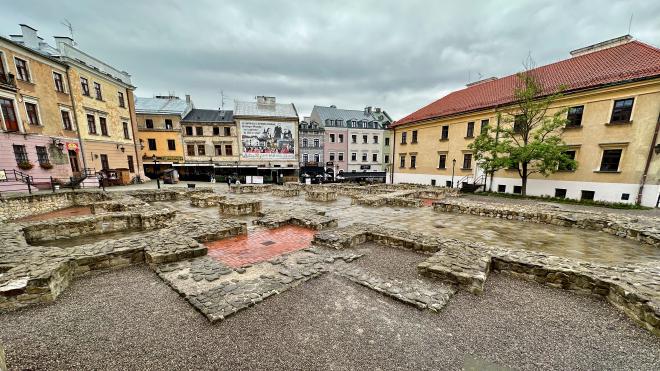
In the Plac Po Farze of the Old Town (“plac” means “square” or “place”) are the exposed foundations of St. Michael’s Parish Church, erected in the late sixteenth century and demolished in the middle of the nineteenth. It’s included as part of an app-based tour of “Lublin landmarks you can’t see”, which we heard about but didn’t do.
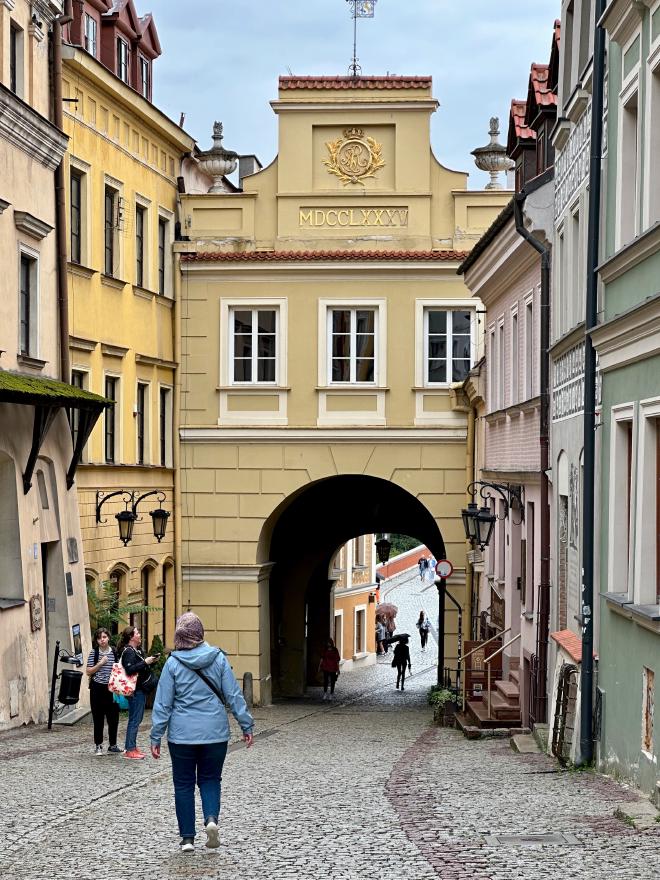
The Grodzka Gate, also known as the Jewish Gate, marks the exit from the Old Town towards the Castle complex. It was built in 1342 and remodelled in Neoclassical style at the end of the eighteenth century. Originally it marked the division between the Jewish part of the town and the Christian. In the second World War the Nazis murdered almost the entire Jewish population of Poland and there are virtually no Polish Jews remaining.
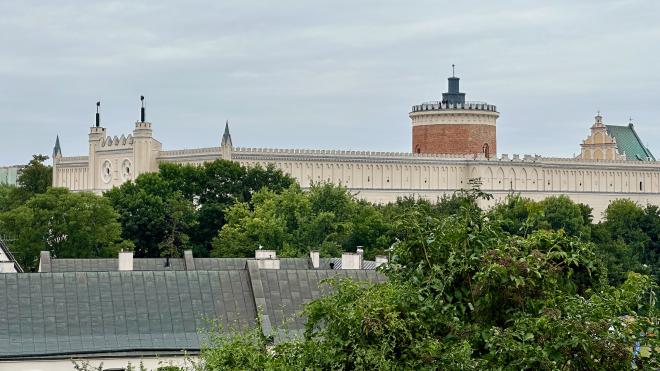
Across from the Old Town is Lublin Castle, which isn’t actually a castle. There have been various fortifications and royal residences on the site for over 700 years, but the current structure is the result of a major reconstruction in the late 19th century when the site was converted to a prison. It was used in that role by the Russian Tsar, the Poles after independence, the Nazis during their occupation of Poland in World War II, and the Poles again post-war. The prison was closed in 1954, renovated, and re-opened as a museum in 1957. The red tower or “donjon” dates from the mid-thirteenth century and is the oldest structure in the complex. The building at the far right is the Chapel of the Holy Trinity, erected in the early fourteenth century and significantly remodelled in the early fifteenth.
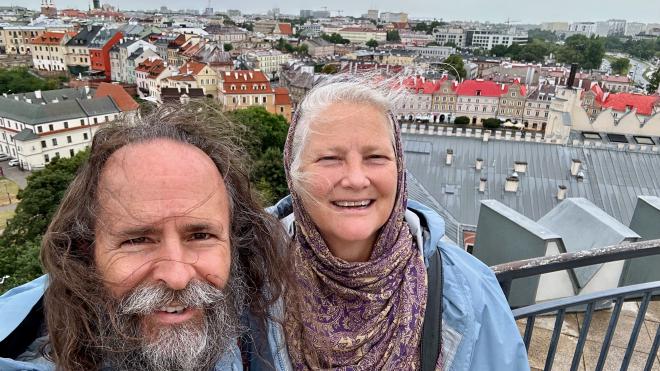
Of course we climbed to the top of the Castle tower, which has spectacular views in all directions. Behind us at left is the Old Town.
Another view from the Castle tower. The white building is one end of St John the Baptist Cathedral.
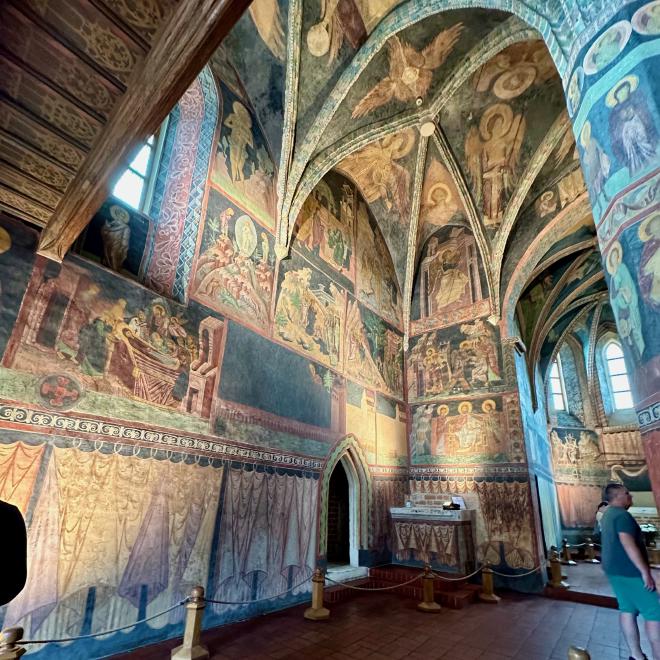
The Chapel of the Holy Trinity is entirely covered with frescoes completed between 1410 and 1418 in a Rutheno-Byzantine style. This is considered highly unusual, as at the time the Church in Lublin was Catholic, not Orthodox.
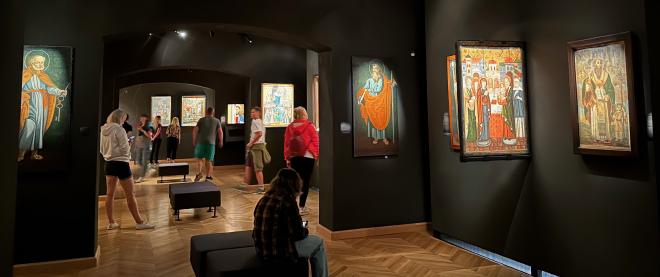
The museum in the Castle is divided into several sections. One tells the pre-history and history of Lublin, from the neolithic age onwards. Another has a large collection of religious art spanning several centuries in both Catholic and Orthodox styles. There is also a permanent collection of Polish paintings, and a special exhibit room. Confusingly, each section of the museum requires a separate ticket, but there aren’t physical barriers between them. At one point we found ourselves in an area we didn’t have tickets for, and were politely asked to leave.
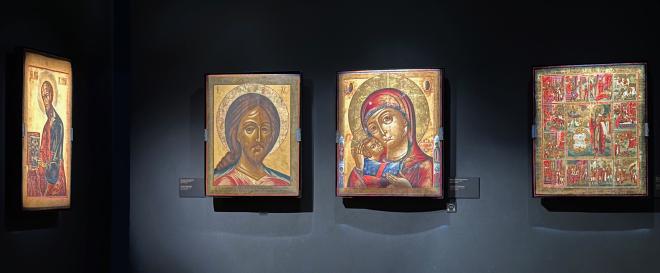
More icons in the collection.
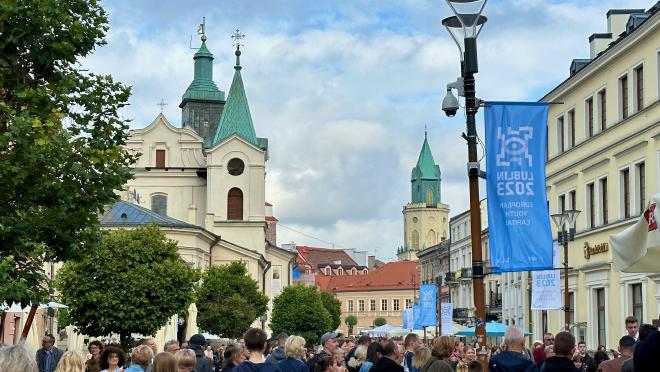
Outside the Old Town is a busy pedestrian district full of restaurants and shops. This is the view towards the Old Town. If you look closely you can see one of the high lines. Karen got a souvenir magnet with essentially this view.
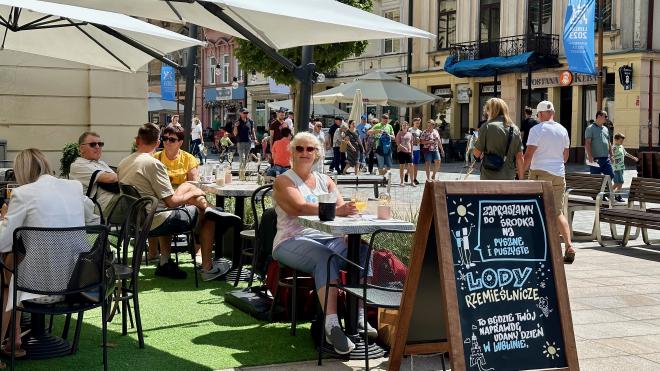
On the Saturday we had a four-hour gap between checking out of our first AirBnB and checking in to the other. We decided to spend part of it enjoying a leisurely brunch at a restaurant in the pedestrian district. If you look just behind Karen you can see our bags piled up. We wouldn’t recommend this particular place, but if you’re ever in Lublin, do check out the Pelier Bistro, which is just across the way.
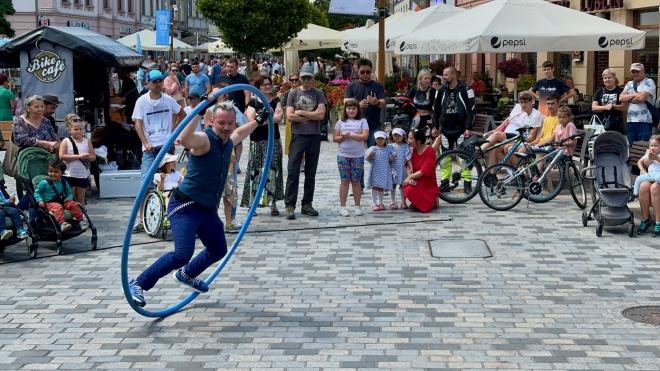
After brunch we still had some time and there were a couple of street performers setting up right near our restaurant. So, we got an extra-extra dose of circus as a transition to the EJC. Our AirBnB for the week was about 70 metres north of this spot.