CoastlessCon in Göttingen (15–23 July 2023)

From July 15th through 23rd we attended the CoastlessCon juggling convention in Göttingen, Germany. This entry is an overview of our week. Greg has also written a companion entry about the juggling he did, which is intended only for seriously nerdy club passing folks — but feel free to take a look even if that’s not you.

A bit of history #

The first predecessors to CoastlessCon were in 2012 and 2013 in Göttingen, and in 2013 included a bus, arranged by Nicki, to take participants directly to the European Juggling Convention in Toulouse, France.

The CoastlessCon series started in 2016, when the first edition, then called CoastCon, was organized by Wiebke C. and Nicki in the tiny village of Stedesdorf near Germany’s North Sea coast. (There were two Wiebkes at CoastlessCon this year, Wiebke C. and Wiebke S., hence the initial. Also two Jennys, two Christians, plus a Kathi and a Katia.)

Wiebke grew up in Stedesdorf, and her mother had connections with the directors of the local sports hall, which is the short version of the long story of how 30 jugglers ended up invading for a week and increasing the village population by 5%. The two of us were lucky enough to be among them, at the beginning of Greg’s last sabbatical, and it was both our first real connection with the European club passing scene and a thoroughly delightful experience.
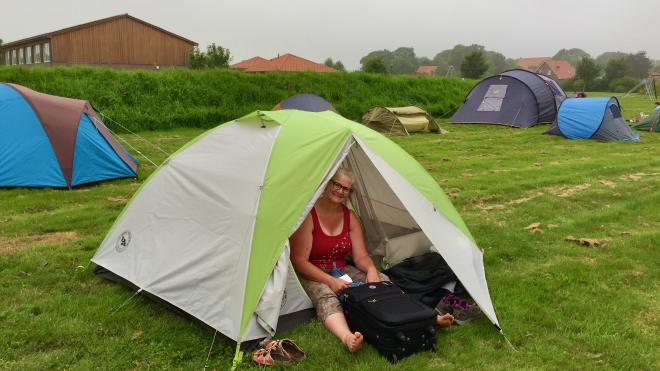
Karen in a tent in a field
Karen in our home for the week at the original CoastCon in 2016. The large building in the background is the sports hall where we juggled.

In 2017 Wiebke was on an epic kayaking journey so she couldn’t help organize or arrange for the sports hall. Fortunately, Nicki is a teacher at the Freie Waldorfschule Göttingen and managed to convince the management to let him use the school during their summer break. Since Göttingen is nowhere near the coast, a new name was needed. Greg suggested CoastlessCon, half as a joke, and the name stuck. Nicki and his partner Anett have hosted the convention every year since, scaling down a bit to meet health restrictions during the pandemic.
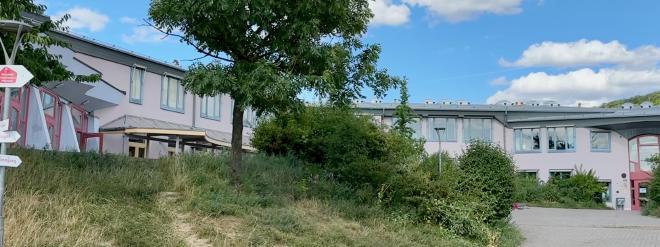
Wide shot of a school building
The main building of the Freie Waldorfschule Göttingen, home of every CoastlessCon since 2017. This houses the cooking and eating areas and the “indoor camping” classrooms. Juggling happens in a separate building, about where the picture was taken from.

In addition to 2016’s CoastCon, we attended the 2017 CoastlessCon and now this year’s event.

What it is #

CoastlessCon is a juggling convention mainly by and for nerdy club passers. So, what does that mean?

Club passing is a genre of juggling where two or more jugglers throw juggling clubs, which look sort of like bowling pins but aren’t, back and forth to each other. Within the club passing community there are those who prefer standard, simple, old-school patterns, and those who are constantly in search of novelty and complexity, as well as ways to share that novelty and complexity with one another.
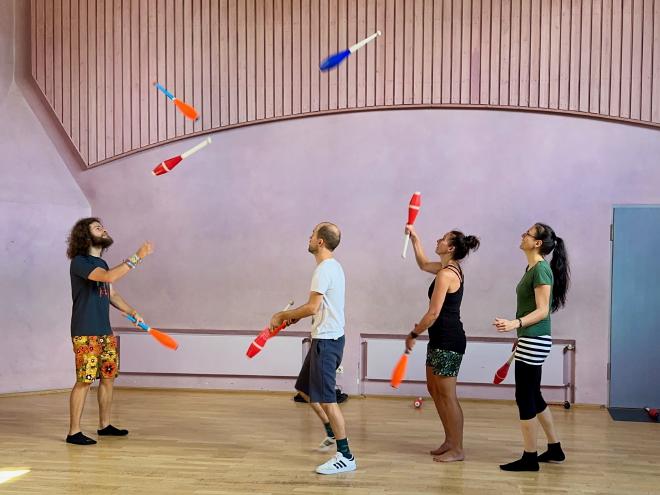
Four jugglers passing clubs in a gym
A complex (and fun) four person club passing pattern at this year’s CoastlessCon. Left to right: Lukas, Piet, Juli, and Kathi. Juli is about to catch a pass from Lukas; Piet is about to carry a club to Lukas. The pattern is called the “Lazy Lukas”. Lukas stands still, all the other jugglers race around in a loop, taking turns passing to Lukas and then handing him clubs.

This latter group has coalesced around the annual PassOut juggling convention, which has been running over New Years at various locations in Europe since 2003. More recently there’s also been a North American PassOut, often in May or June. Greg has been to two European PassOuts and six North American; Karen to one European and two North American. (No, Karen doesn’t pass or even juggle clubs, but she likes hanging out with nerdy club passers. Like Greg. Go figure.)

CoastlessCon is an offshoot of the European PassOut, in about the same format and attracting many of the same people. It’s held in the summer, generally within a week or two of the European Juggling Convention. Due to juggling space restrictions, attendance is capped at a maximum of 50 jugglers, and it usually sells out. Most of the participants are from Germany, but there are also people from nearby countries, this year including the Netherlands, France, Austria, Norway (John is Greek, but he lives there), and possibly a few others. There were also two participants from Singapore who were in Europe mainly for the EJC and some holidays (hi, Di Hong and Xin Fang (Chia)!) plus us two Canadians.

Dinner and workshops #

The best way to describe the CoastlessCon day probably starts at dinner, which is served around 7 pm and is the one time when you can expect almost everyone to be in the same place. The Waldorfschule has a full industrial kitchen which we take advantage of to cook for ourselves. Each day a volunteer team of four or five people prepares a meal for everyone (Karen helped one day, Greg another). The CoastlessCon community includes a lot of vegetarians and vegans, so the meal is generally planned for them, but occasionally there’s a meat dish as well. The call of “éssen!” is the signal for everyone to descend on the kitchen.
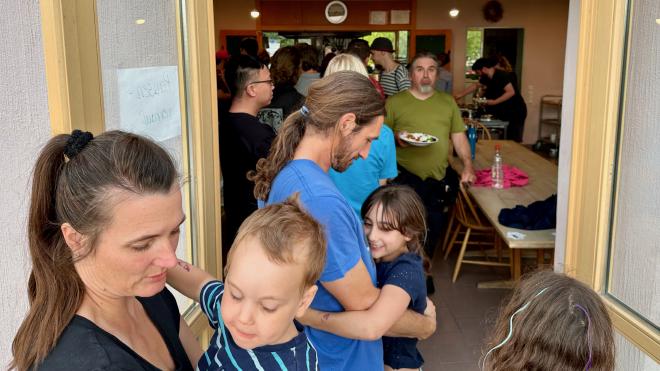
People queued for dinner
The dinner queue. This year there were several families with young children at the convention. We had met least one of them (seen here hugging her Dad, Axel) at CoastCon 2016, when she was just a babe in arms.

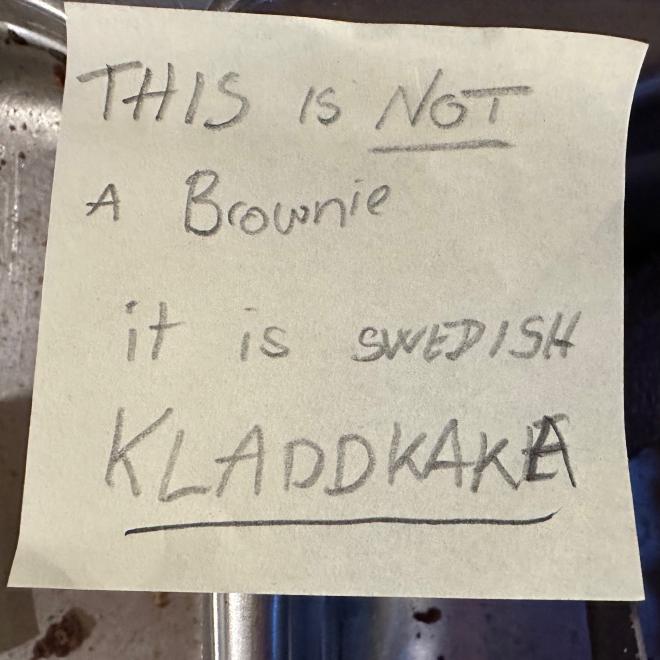
A post-it note reading “this is not a brownie, it is Swedish Kladdkaka”
There was always dessert after dinner. One evening it was about four different kinds of brownies, plus something wonderful labelled with this Post-It note. Do yourself a favour and make some Kladdkaka for the people you love!

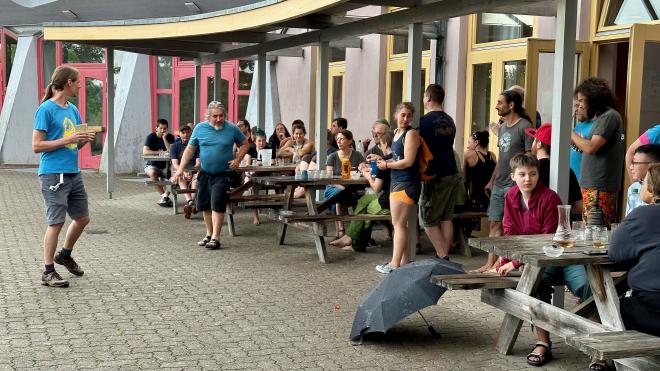
People sit at picnic tables outside a school building
There is some inside seating, but most people ate at the outdoor picnic tables, which are sheltered from any rain. After dinner was announcement time. Nicki, at left, made general announcements including ensuring we had volunteers to cook dinner for the next few days, to clean up after dinner, to set up breakfast in the morning, and to take care of other chores.

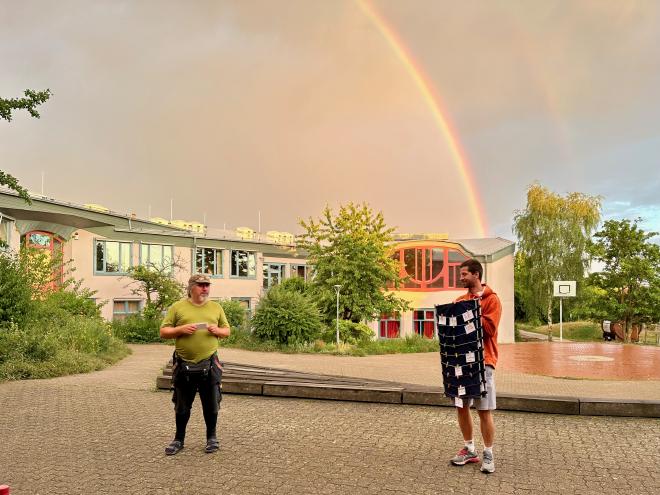
Two men standing in front of a school with a rainbow in the background
Once general announcements were done, Nicki turned things over to Toto, the workshop coordinator. Workshops were generally planned two or three days in advance, but re-planned each day as things changed. Toto (left) asked for requests for workshops (e.g., “I’d like someone to run a workshop on X”) and volunteers to teach those or anything else. The actual schedule was established more or less by consensus. John is holding the workshop board. As you can see, we did have some rain, and two days of beautiful dinnertime double rainbows.

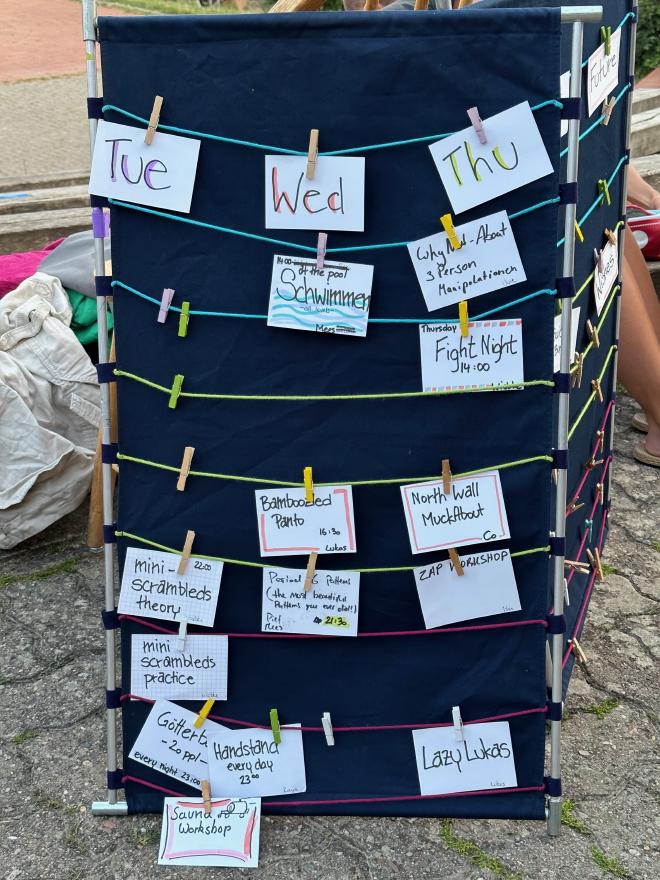
A board with cards hanging from strings, showing workshop titles
This is the workshop board as of Tuesday after dinner. Juli brought the board and also wrote out most of the cards. Workshops were generally in the afternoon and evening and also included trips to the nearby pool, a swim in a lake, a run through the nearby forest, the daily handstand (several of the jugglers are also acrobats), and Fight Night, about which more later. Toto also arranged for a portable sauna to be on-site (the “sauna workshop”), paid for separately by those who wanted to use it. Like everything else at CoastlessCon, participation in workshops is optional. But most of them are very well-attended.

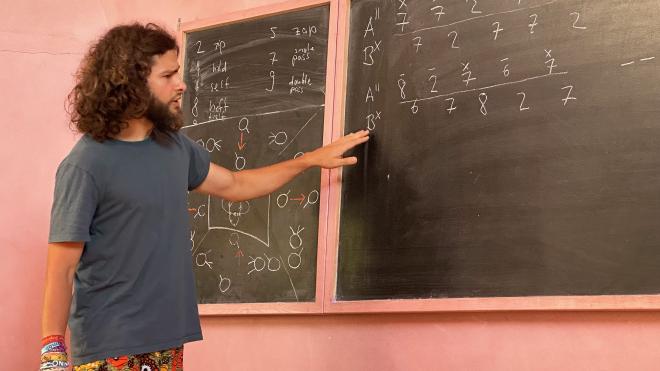
A youngish man with a beard stands in front of a blackboard with juggling notation on it
Workshops generally consisted of a bit of theory, some demonstration, and a lot of practice time. Here Lukas explains how to take a particular class of two-person patterns (four-handed siteswaps) and extend them to make “feeding” patterns for three or more people. Participants were encouraged to design patterns of their own choosing in groups of three, then practice juggling them.

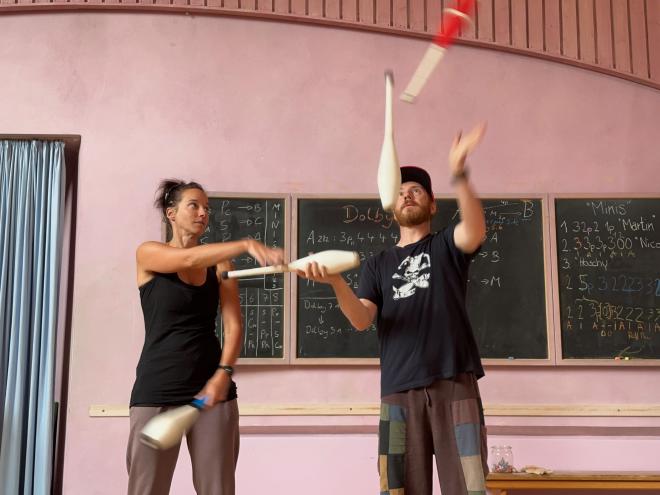
Two people juggle side by side
Juli (left) and Hoschy demonstrate a “mini” pattern for two people and four clubs called “Martin”. You can see a video if you’d like. A description of the pattern in Prechac notation is on the blackboard at right.

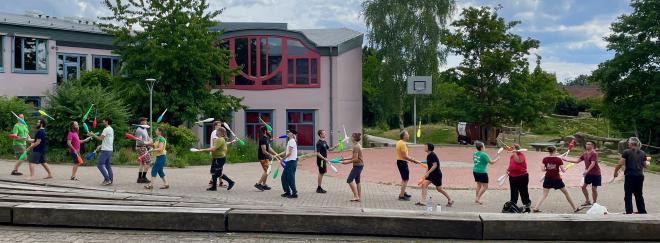
A long line of people juggling
The Paternoster workshop. Paternoster is a conceptually-simple passing pattern that can be run with any large-ish number of jugglers. Greg is in the pink shirt, third from the left.

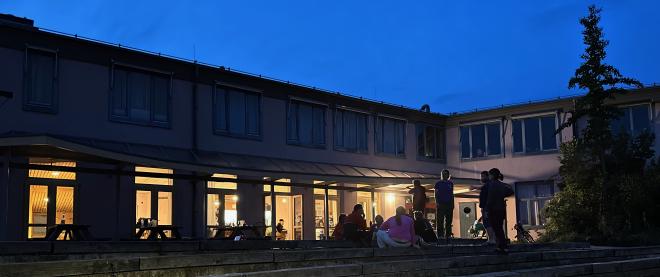
A school building at night
At the end of the day there’s progressively less juggling and more hanging out, chatting, and drinking beer, sometimes outside if the weather is good.

Eventually people start heading off to bed. We had an AirBnB about 700 metres away, so we were sleeping in relative comfort. Most of the remaining jugglers either slept in one of the school’s classrooms, “indoor camping” style, or camped in tents on the grounds.

Breakfast and daytime #

A typical day at CoastlessCon started with breakfast/brunch/lunch, which is a continuous self-serve meal from about 9 am to 5 pm. Whoever was likely to be up early (parents with small children, habitual early risers, people not yet on Central European Time) volunteered to make a run to the local bakery, where Nicki had placed an order for a rather large quantity of buns and breads. This was set out, along with a range of meats, cheeses, yogurt, milk (and vegan equivalents), spreads, fruits, vegetables, and cereals, plus whatever was left over from last night’s dinner. As supplies were used up, we would restock from the cupboards and refrigerators. Each day these would be replenished during the shopping trip for the evening meal.

The early part of the day was a mix of eating, coffee drinking, chatting, board game playing, and juggling.
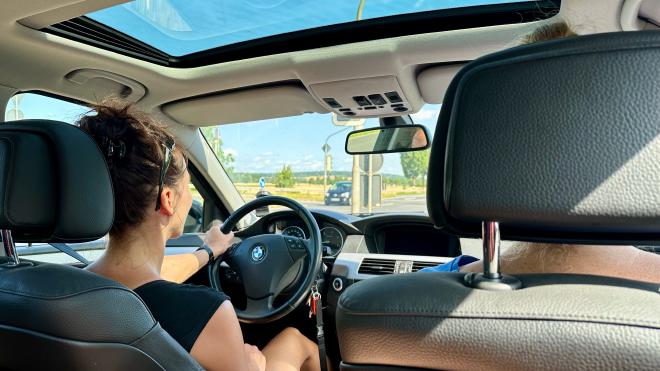
A woman driving a car, seen from the back seat
On one day, Juli (seen here, with Karen beside her) and Paula drove two carloads of us to a nearby small lake, where we went for a delightful swim. Thanks to Barbara for the recommendation! Juli is training for triathlon and trying to get at least a swim in every day, either in the lake or in a pool. On another day, six of us (plus a dog) went for a 10 km run through the forest, which included a lot of hill climbing and a stop at the Burg Plesse castle.

Four people around a volleyball net, holding juggling clubs
When the weather was nice, you’d often see pickup volleyclub games being played. The rules are similar to beach volleyball, but with juggling. One club is the “game club”, here the one in red. Each juggler holds two other clubs. You have to catch the game club into a juggle, then send it to either your teammate or over the net the first time you throw it. The guy in the grey shirt is Wolfgang, an excellent and very competitive player. Shortly after this picture as taken, Greg made the mistake of trying to snag one of Wolfgang’s harder throws and managed to slightly injure his thumb.

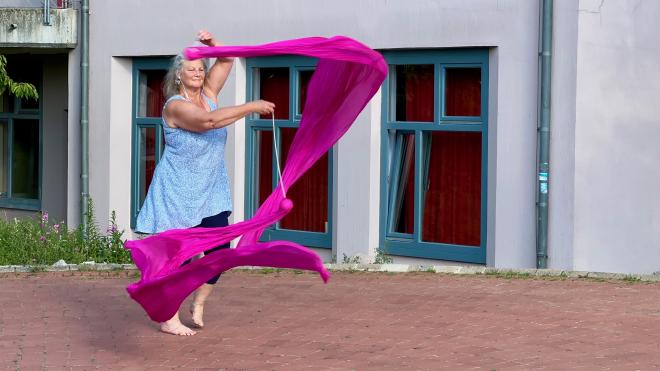
A woman swinging poi with long silk scarves attached
Karen spent much of her time working on sewing projects and chatting. But she did also get her poi out on a few occasions to swing them and dance.

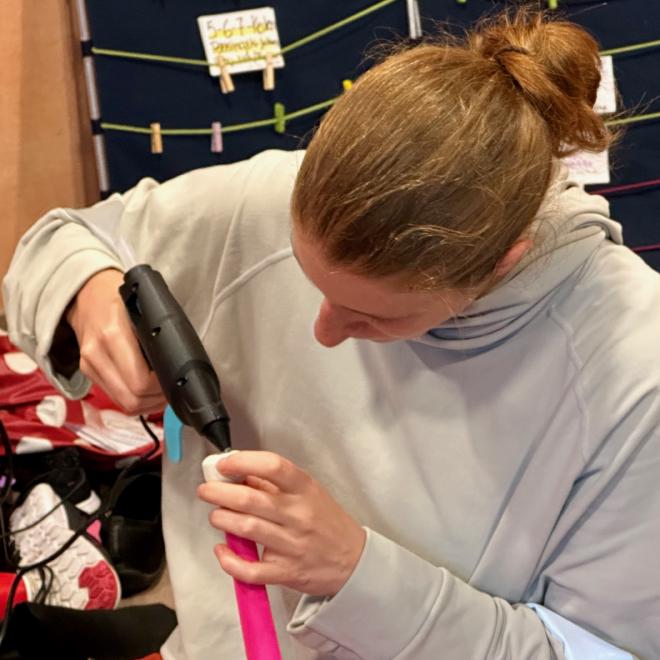
A woman uses a hot glue gun to cover the screw on the handle of a juggling club
One of the conditions for letting us use the school gyms was that we ensure we wouldn’t damage the wooden floors with the screws on our juggling clubs. Nicki supplied self-adhesive furniture pads we could use as screw covers. Matty and Helene decided on an alternate approach, using hot glue.

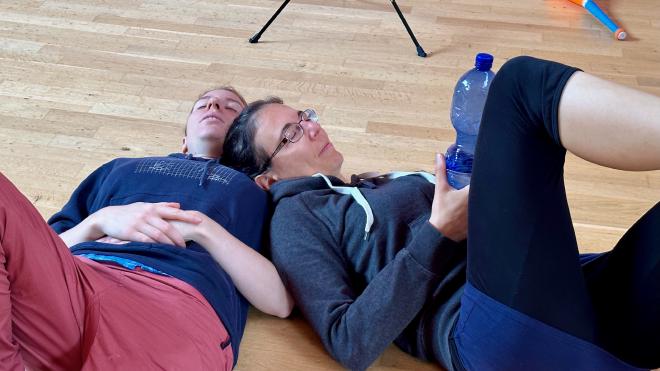
Two women lie on a gym floor, eyes closed
Sometimes tired jugglers just rest wherever they are.

A man holds a precarious arrangement of juggling clubs
Sometimes tired jugglers get goofy. Jenny and Paula challenged Kilian to balance the club sculpture they’d made on his face. This is just a few moments before things stopped going well.

Fight Night #

Most juggling is cooperative, but some (like volleyclub) is competitive. One of the biggest ongoing competitions is Fight Night Combat, run by professional juggler and friend of ours, Luke Burrage. The idea is simple: two jugglers, the last one juggling wins the round, no intentional body contact but you’re allowed to strike or steal your opponents clubs, first juggler to three or five rounds wins the match. Of course, like most sports, the full rules are quite a bit more complicated.

Tournaments are held all over the world and wins contribute to a player’s rankings, with the number of points for a tournament determined by a bunch of different criteria. At one point Greg was ranked 158th in the world, and was the top (and only) Canadian in the standings. But he’s a terrible combat player and getting more injury-averse by the year, so he hasn’t played since 2017.
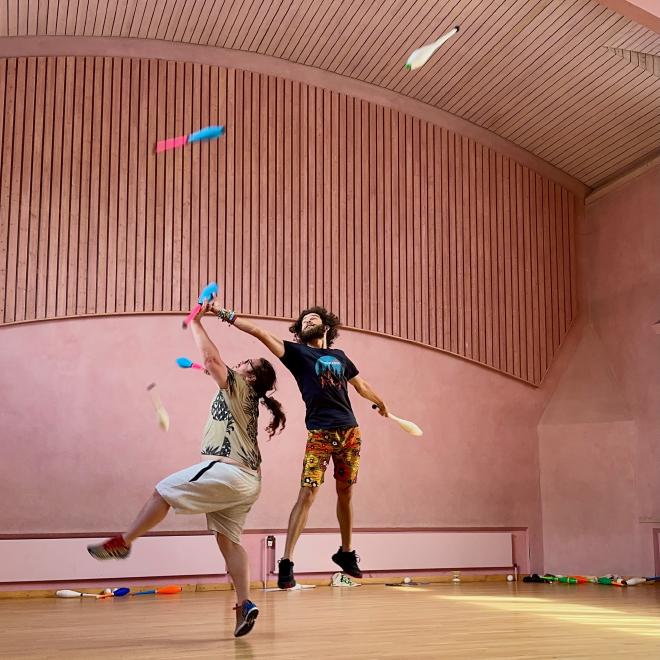
Two jugglers leap in the air, fighting for clubs
This year’s CoastlessCon tournament was worth 250 ranking points to the winner. Thirteen players participated, with Kilian easily defeating the competition, dropping just one round over all his matches. This shot from the semi-final shows Lukas about to steal one of Matty’s clubs. Lukas went on to win the round and the match, losing to Kilian in the final. Third place went to Paula, who beat Matty in the consolation round.

Closing thoughts #

CoastlessCon is a wonderful event, made so by the truly lovely people who organize and participate. We’ve missed it the last six years and really enjoyed being back — in some ways it felt like coming home. Huge thanks to Nicki and Anett for everything they do to bring it together, and to all the participants for cooking, cleaning, shopping, teaching, and most of all, playing together.
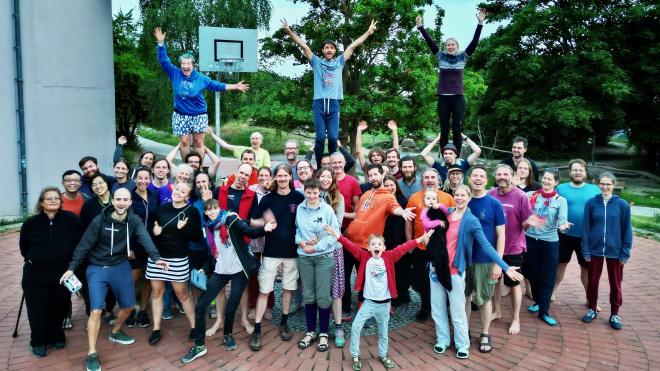
A big group of people lined up for a photo shoot, three of them standing on others’ shoulders
All the participants who were still around on the last Saturday after dinner. This isn’t everyone — some had already left, or were only there for a few days — but it’s most of us. Thanks to Piet and his drone for the photo!

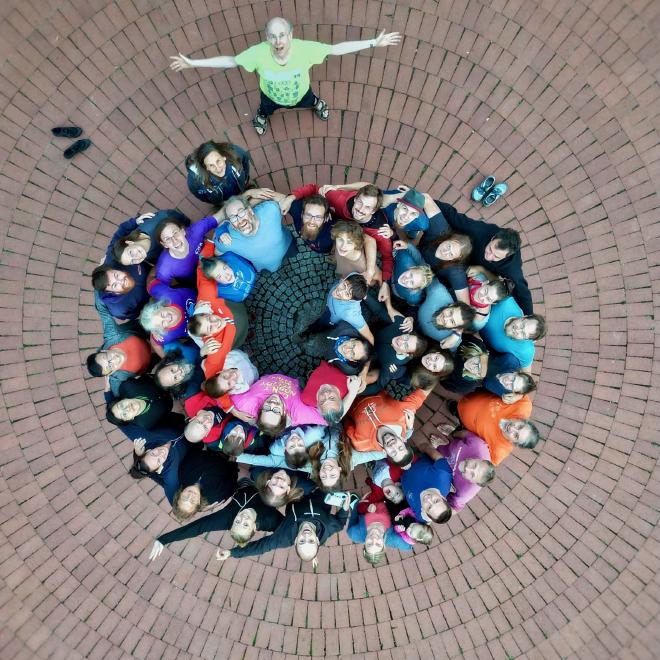
A circle of people from above
And a second photo, of the closing group hug. Thanks again to Piet!