Atlantic Crossing on the Queen Mary 2 (7–14 July 2023)
Table of Contents
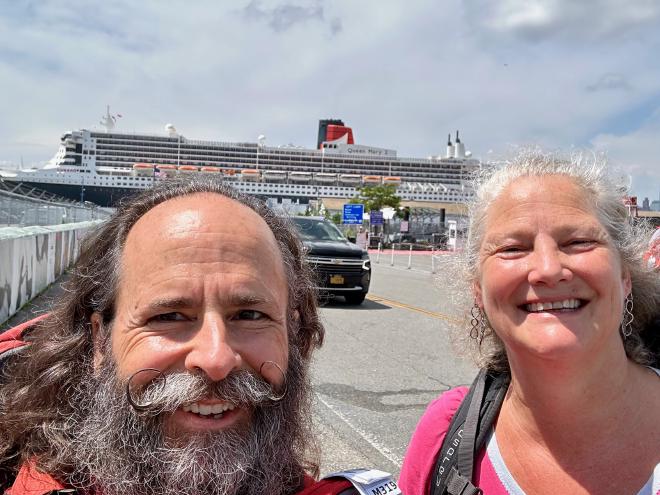
On 7 July we said our farewells to Cynthia and headed for New York to board Cunard’s RMS Queen Mary 2 and cross the Atlantic. After a train ride, lunch at Grand Central Terminal (Cornish pasties bought at the Bethel train station, thanks for the tip, Cynthia!), a subway ride, a bus ride, and a short walk, we arrived at Brooklyn Cruise Terminal Pier 12 and the ship at about 2:30 pm.
Departure #
We’ve crossed the Atlantic on the Queen Mary 2 once before, at the start of Greg’s 2016–2017 sabbatical. Our memory of boarding that time was long queues and tedium, so we were delighted to find the process very quick and painless. We were able to go straight to our stateroom where our key cards were waiting for us. Then we dropped our small bags (large bags are delivered) and headed out to reacquaint ourselves with the ship, treating ourselves to Bellinis at the farewell party on the stern deck.
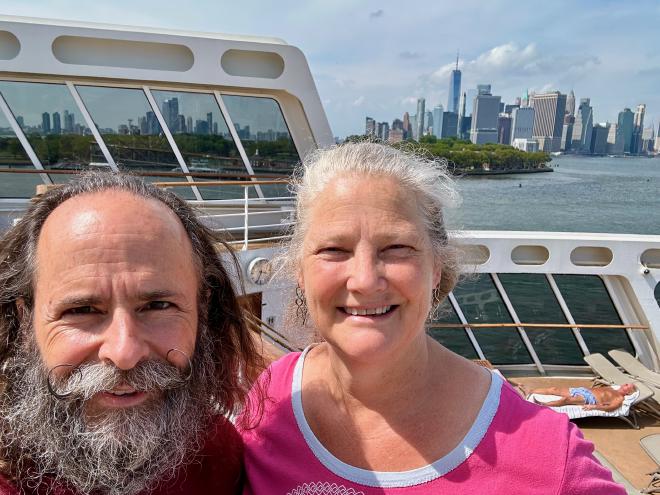
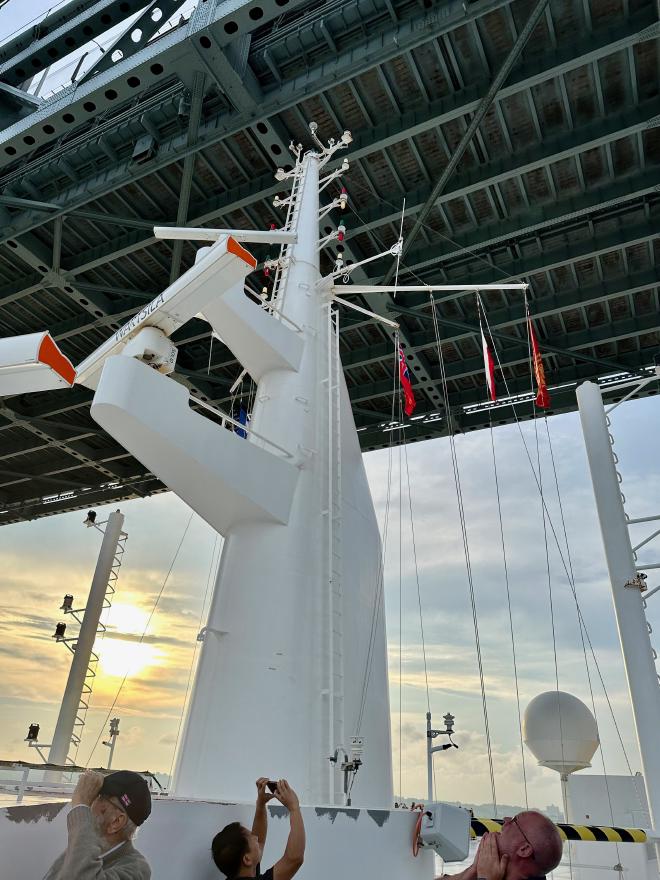
The ship sailed bit after 6:30 pm and made its way slowly out of New York harbour amidst heavy traffic. We were on the top deck with a few hundred others. Fully booked, the total passenger complement of the Queen Mary is almost 2700, with just under 1200 crew.
Life aboard #
Rather than give a day-by-day account of the crossing (“it’s a crossing, not a cruise”) we’re going to answer the kinds of questions people have been asking us, both before and after the trip.
Who’s aboard? #
Unsurprisingly, the passenger demographics skews towards affluent retired folks. However, there were also a few families with younger children, some newlyweds (we ate lunch one day with a lovely young couple from Spain finishing out their honeymoon on the Queen Mary), an Amish family, and a few middle aged folks like us. Without having done the arithmetic, I’d guess that the median age of passengers is about 75.
Almost all the passengers are white, and almost all the serving and cleaning staff are various shades of brown. The passengers are mostly American and British, with a scattering of Europeans, Canadians, and Australians. The staff is mostly from the Philippines, other east Asian countries, and South America, with a few Eastern Europeans. If you want a stark reminder of global economic and class differences, this is it.
What are the dining options like? #
The QM2 has a range of restaurants, varying in formality and service. Food is included in the fare, except if you choose to dine at the specialty restaurants, which have an extra charge. Alcohol and soft drinks are extra, and there’s also an extra-fee fancy coffee shop.
More formal #
At the more formal end of the spectrum, the main dining room for most passengers is the Britannia, which offers full table service for breakfast, lunch, and dinner. The menu for each meal is multi-course, and you’re welcome to order as many or as few courses as you’d like. A typical dinner menu will have four appetizer options, two salads, two soups, five mains, and five desserts. And if you order all four appetizers, the waiters won’t bat an eye. The food quality and variety easily rivals an excellent upscale restaurant, with options from seriously carnivorous to vegetarian and vegan.
The lunch and dinner menu is accompanied by a wine list the size of a telephone book (remember those?), ranging from wines by the glass to rare bottles at eye-watering four-digit prices. The house Chardonnay is very nice, and we particularly liked the Malbec.
For breakfast and lunch all tables are first-come, first seated and we never had a wait. For dinner there are two options: fixed dining and open.
If you’re on fixed dining you’ll be at the same table each night, at either the 6:00 pm or the 8:30 pm sitting. Tables are for two, four, six, or eight and you can request your table size when booking — so if you’re a couple and you’d like company, you can request to share. However, most tables for two have others in close proximity, so you’re generally not going to be alone and can easily have a cross-table conversation. The fixed option can be great if you like the timing and your neighbours.
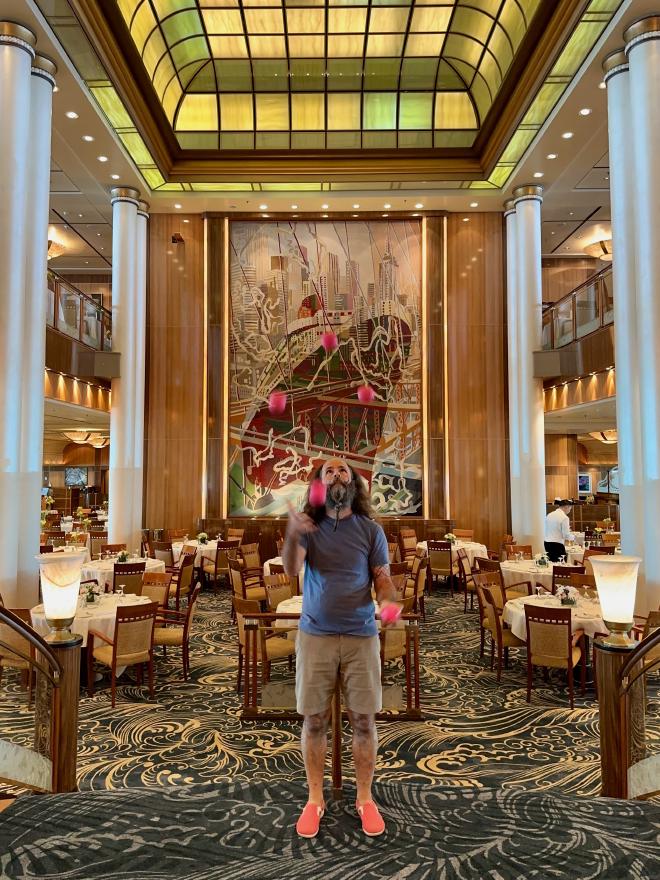
Karen and I ate in Britannia every evening and decided to do open dining. Here again you have two options. You can book a time in advance, in fifteen-minute intervals, for either a single meal or every night of the voyage. Or, you can simply show up and hope to be seated. If they don’t have a space for you immediately, you’ll be given a pager that will alert you when a table is available and can head elsewhere on the ship to wait. Either way, you’ll be seated at a different table with different neighbours each night.
There are also three formal restaurants for those who booked the more expensive staterooms or suites and don’t want to mix with the common folk. Where the china and table settings are fancy in Britannia, they’re extra-fancy in the Queen’s Club, Princess Club and Britannia Club. I understand that the food and the wine list is the same.
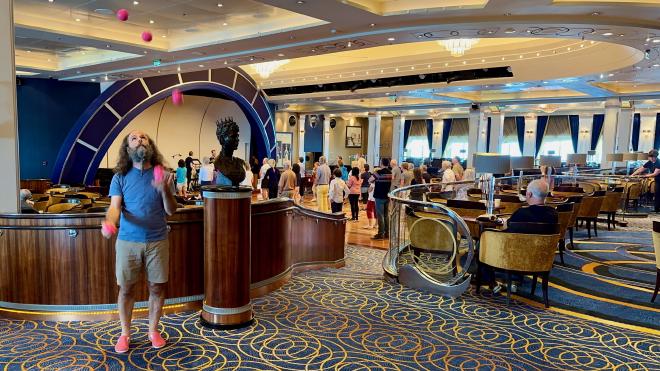
Cunard being British, one of their specialties is afternoon tea, which is served in the Queen’s Room ballroom every afternoon with great ceremony. This includes sandwiches, scones with jam and clotted cream, a variety of desserts, and, of course, tea.
Specialty #
There are two specialty restaurants on board which charge extra: The Verandah Steakhouse, and another (really a section of the King’s Court seating) that alternates between Indian and East Asian. On this trip we didn’t feel the need to try either, so we can’t report. On our 34-night trip from Barcelona to Melbourne on the Queen Elizabeth we likely will check out the specialty offerings.
Less formal #
The other extreme is the King’s Court buffet, which is very casual and offers food almost continuously from 6 am to 12:30 am. Breakfast is mostly the same each day, with classic British options like sausages, fried mushrooms and tomatoes, fried eggs, and black pudding. There are also omelettes, sliced meats, cheeses, smoked salmon, cereals, oatmeal, yogurt, fruit, pastries, and breads.
The lunch and dinner menus at the buffet are daily changing and seem to generally complement what’s in Britannia rather than mirror it. The selection is quite wide. There’s also an attached King’s Court Chef’s Galley, which serves burgers and hot dogs at lunch and pizza and pasta at dinner.
The Golden Lion Pub serves lunch, including an entirely credible fish and chips with mushy peas, which goes well with a British ale. You can also dine in the Carinthia Lounge, and in good weather there’s the Boardwalk Cafe on the upper deck. Finally, there’s 24-hour room service.
What do you wear? #
Cunard is traditional, British, upscale, and known for being more dressy and formal that other cruise lines. During the day, shorts and t-shirts are accepted in all areas of the ship, but after 6 pm the rules are stricter. On most days the standard is “Smart Attire”, which Cunard describes as
… collared shirt and trousers, top and skirt or stylish trousers, or a dress. Of course, if you prefer to spend tonight in more relaxed attire, a selection of casual dining and entertainment venues are available for your enjoyment. Feel free to dress casually as you visit any of the following venues: Kings Court, Golden Lion, Casino, Carinthia Lounge, and G32.
Please note non-ripped jeans are appropriate, but please refrain from wearing shorts, sports attire, swim wear or sleeveless t-shirts outside of the gym, spa and deck spaces.
However, two days of the crossing have “Gala Evenings” where guests are encouraged to
… join in the sense of occasion with eveningwear of dinner jacket, tuxedo, or dark suit with a regular tie or bow tie, or floor length dress, ball gown, cocktail dress, smart trouser suit, or formal separates. Guests are welcome to embellish their Gala Evening attire to fit the applicable theme of the evening. A range of gentlemen’s formal wear is available to hire on board in the fashion boutique on Deck 3.
Some guests treat this as an opportunity to dress up in their best and have fancy photos taken by the ship’s every-ready cohort of photographers. Others avoid dressing up by going to King’s Court for dinner.
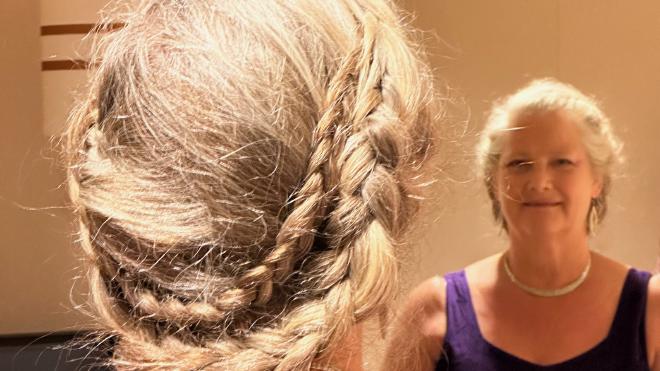
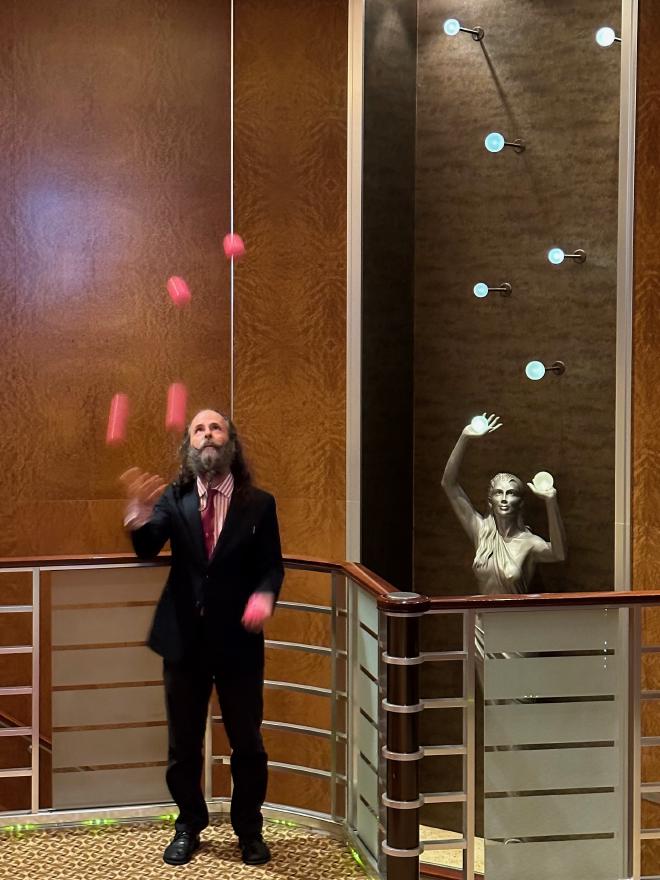
The current dress standards are quite a bit more relaxed than our last crossing in 2016, where the minimum dress in the main dining room was jacket and tie on regular nights and tuxedo or dinner jacket on the Gala Nights. We were very happy to learn of the change, since we have to carry all our clothes for the year and it would be a pain to pack ultra-dressy pieces that we’d hardly ever wear. This way Greg can get away with one blazer, a couple of long-sleeved dress shirts, a few ties, and one pair of nice leather shoes, all of which work fine with his regular trousers. Karen has a couple of fancier dresses, a bit of jewelry and makeup, and some elegant sandals.
What do you do all day? #
The short answer is “whatever you want”. The longer answer is that the ship offers activities and entertainment to suit most tastes, from early morning to late at night, plus a lot of quiet spaces where you can relax or amuse yourselves. And of course there’s always the option of reading a book or watching TV in your stateroom.
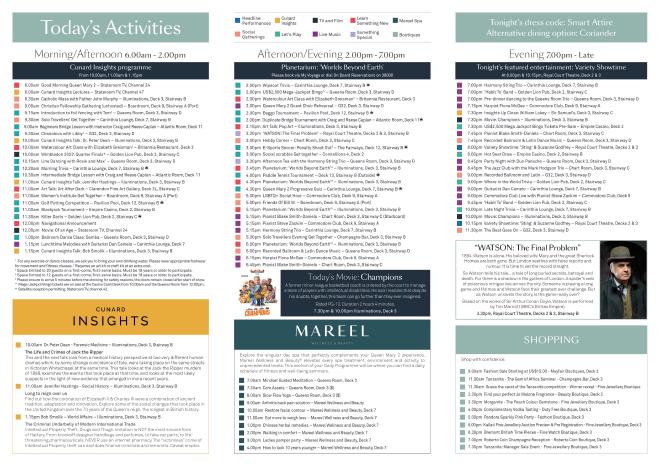
Entertainment #
The Queen Mary has a live theatre (Royal Court), a combined movie theatre and planetarium (Illuminations), and ten bars, ballrooms and lounges that have live music playing most evenings and occasional other times.
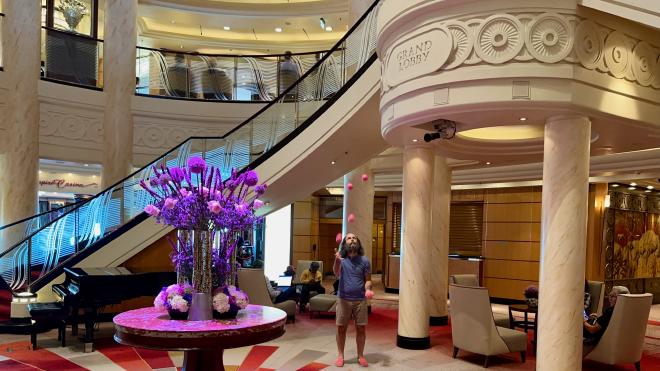
The two theatres have two show times each evening, and Illuminations has planetarium shows most days and movie matinees on the others. Illuminations also hosts most of the “Cunard Insights” talks, which are lectures for the general audience by academics, explorers, or other folks of note. The feature lecturer on our crossing was a former Royal Marine (Ben McBean) who had stepped on a landmine, was severely injured, and is now a motivational speaker.
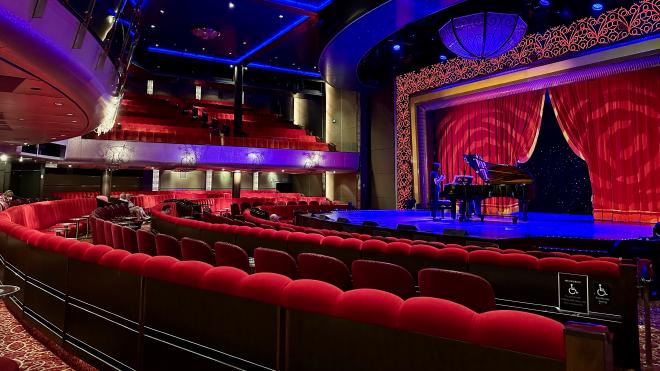
We went to several shows in the Royal Court Theatre. On some nights they have featured performers (on our cruise, a flautist, a singer and storyteller, and a comedian — we protest the lack of juggling and circus!) and on others their in-house troupe performs. We were particularly impressed with the ship’s troupe, which consists of four vocalists and ten dancers. The quality of the choreography, dancing and singing was far better than we’ve seen elsewhere. Also, a big shout-out to the hard working and very talented house band, which performed two shows most evenings and rehearsed most afternoons.

Our favourite show by far was Watson: The Final Problem, a one man, one act play written by Bert Coules and Tim Marriott, and performed by Tim Marriott. It was presented as an afternoon matinee in the Royal Court and is a lovely addition to the Sherlock Holmes oeuvre. If you’re going to be in Edinburgh for the Fringe this year, it’s playing from 3 to 28 August 2023.
The ship also has a casino, of course, but neither of us find that an appealing option.
Exercise #
If you want to keep fit while on board, the main options are walking on the promenade deck, swimming in one of the three small pools, or working out in the fitness centre.
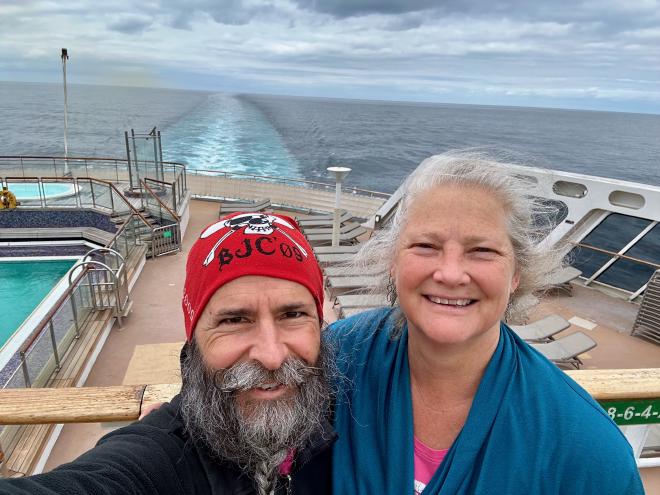
The promenade on Deck 7 is a loop of about 550m. You can run on it, and some people do, but it’s quite narrow in places and you’ll be dodging walkers all the time. We went on short walks most days, and one day Greg put on some podcasts and walked about 10 km.
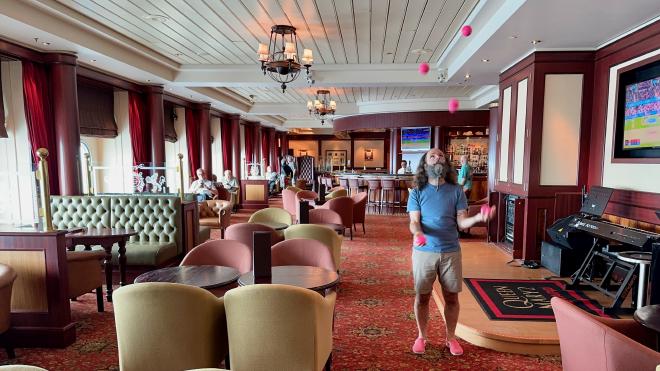
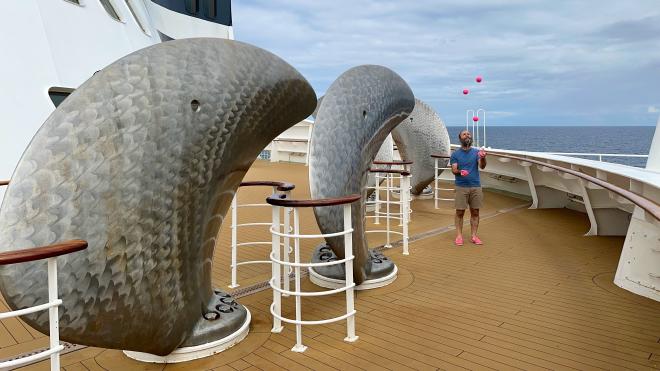
The fitness centre is fully equipped with treadmills and rowing, cycling, elliptical, and stair machines as well as free weights, benches, and strength machines. Greg ran on a treadmill every second day (which he’s not fond of, but it was better than the alternative), used the aerobic machines on the alternate days, and juggled for at least half an hour every day.
Quiet activities #
The ship also provides lots of more-or-less quiet spaces where you can read or do other activities. Of course, you can always seek quiet in your stateroom, but we booked an inside cabin for this trip, which made that option less appealing. On our longer voyages we’ve booked balcony rooms for exactly that reason.
There was an informal “Hobby Group” that met once a day in the Carinthia Lounge to chat and work on projects from the comfy chairs. Karen brought her sewing (she was taking apart a dress to re-fit and re-style it) and most of the other women (yes, they were all women) brought knitting or crochet. Karen enjoyed the opportunity to meet fellow crafters and to make some progress on her dress.
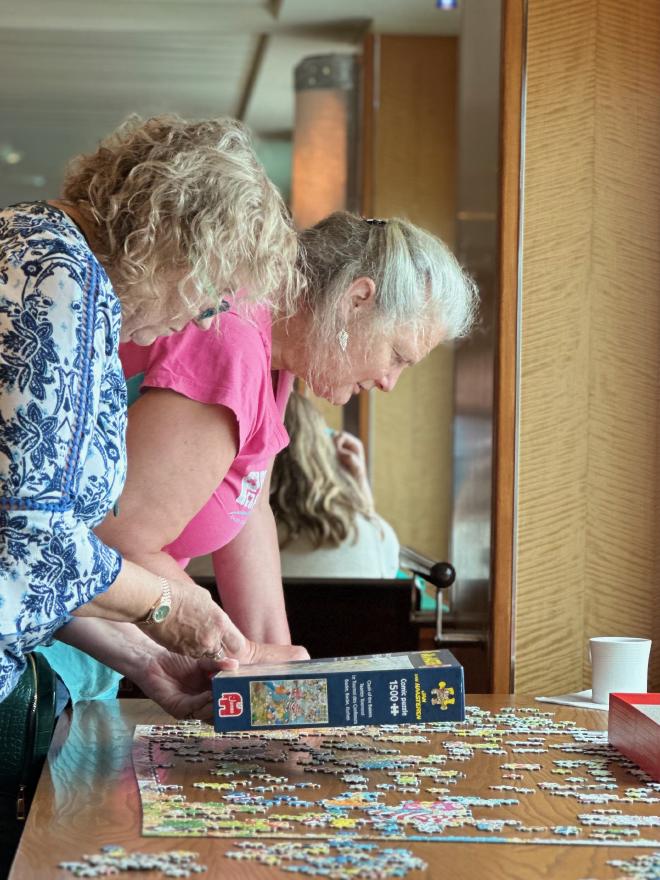
Towards the forward end of the ship, beside Illuminations, there are two corridors with large windows, tables, and desks. These are complemented by a rotating selection of jigsaw puzzles and board games. Anyone who knows Karen will be thoroughly unsurprised to learn she spent a lot of hours at the tables, contributing to the completion of about half a dozen puzzles.
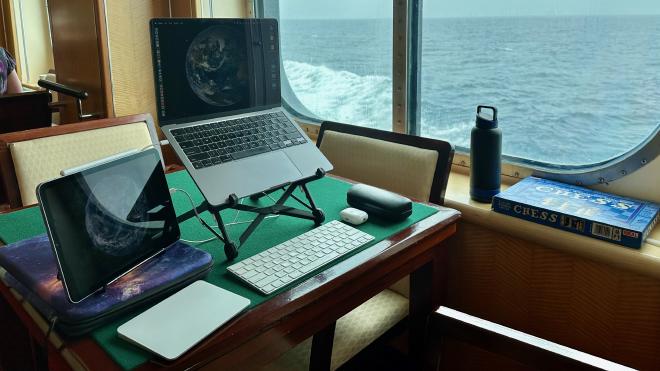
Greg often set up his computer in the same corridor to work on his research (yes, he is doing research on our travels, but we won’t write about that here) and on other things, including previous entries of this diary. There was generally a lot of soft chatter between puzzlers or game players, but noise-cancelling earbuds took care of that distraction nicely.
What about the time change? #
From New York to Southampton is a change of five time zones, and we were six days at sea. On every sea day but one, the Captain’s noon announcement began something like “It’s noon, and now it’s one o’clock.” So, rather than having a one-shot jet lag, you have a gradually-incurred ship-lag, which seemed much more reasonable to us. Jumping forward in the day time is arguably the most humane option, since you lose one of your daytime hours but can still get a normal night’s sleep if you’re keeping to a regular schedule. I’m told that in the other direction they add the hour during the night.
The time change does make meal hours a little weird, in that lunch at noon is actually lunch at one, so dinner at 6:30 pm can seem a bit early. The obvious solution is to eat dinner later, which is what we did.
Cruise ships, freighters, and carbon intensity #
As some readers will know, our original hope had been to make our sea voyages as passengers on freighters. This was partly because “it would be cool”, partly to let us travel in short hops, and partly to reduce our trip’s carbon footprint. Yes, freighters are high carbon intensity, but the argument goes that the ships are sailing anyway to deliver their cargoes and a passenger adds negligible fuel requirements. There’s also a family “romantic” angle: Greg’s father Henry was a ship’s radio officer in the British merchant marine for about a decade, who came ashore when he met and ultimately married a Canadian woman who took a two-week Caribbean holiday on his ship.
Unfortunately, all the major freighter lines suspended passenger travel during the pandemic due to the potential risks to crew, passengers, and (more importantly from their perspective), their schedules and profitability in the event of a medical emergency or a passenger being denied disembarkation. Three of the four big lines are talking about resuming passenger travel in early 2024, but that’s too late for this trip. The one exception may be our travel between Australia and New Zealand, which is not yet booked. We’re in touch with a freighter passage travel agent and holding out hope for those legs, but he tells us there’s still no firm news.
So, after a lot of discussion, we decided to book travel on ocean liners and cruise ships. This still lets us get most of the places we want to go, and arguably in greater comfort, but with a far less flexibility and choice of routes.
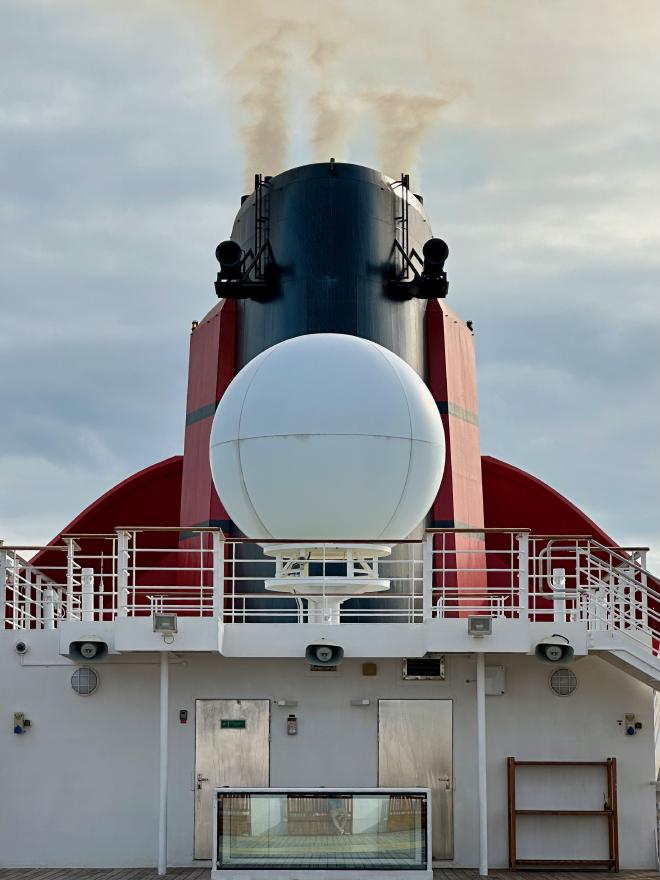
The bad news is carbon intensity. According to the best information Greg has been able to find, passenger ships are floating environmental disasters, with far greater carbon intensity than flying, even factoring in equivalent time spent in a luxury hotel. Yes, we’re conflicted about this.
Arrival in Southampton #
As we learned on our last crossing, “normal” assisted disembarkation involves a lot of waiting about, especially if you booked a cheap cabin like we did. The other option is “fast track” disembarkation, which is available to passengers who can manage all their luggage without assistance.
We wanted to be on a train towards London as early as possible to catch the Eurostar to Brussels, so we opted for fast-track. We got up, grabbed a quick breakfast in King’s Court, and were off the ship about 7:30 am. Then it was literally a straight walk out to the taxi rank, since we’d already cleared immigration. By 8 am we were on a train for London Waterloo — but that’s a story for the next entry.